Archive

November 2026

Browsing

Rohit Mehta, a London-based graphic designer, was looking at Christmas and New Year tickets when a British Airways price stopped him.

On 24 November, an Economy Standard return from London Heathrow to Mumbai was listed at £3,136.09 for one passenger.

The outbound flight leaves Heathrow at 09:35 on Thursday 10 December and lands in Mumbai at 00:15 the next day, a direct journey of 9 hours and 10 minutes.

The return leaves Mumbai at 02:15 on Sunday 10 January 2027 and arrives at Heathrow at 07:05, after 10 hours and 20 minutes in the air.

“I was shocked to see the economy ticket prices from London to Mumbai on British Airways,” Mehta said.

“Is this all because of the rising jet fuel prices or just a seasonal jump? Whatever it is, it’s insane.”

At the mid-market rate of 121.5346 rupees to the pound on Google Finance at 17:10 UK on 24 November, that fare was about ₹381,143, an Invezz calculation.

Jet fuel has had a violent year, and Christmas on the UK-India corridor is one of the busiest fortnights on the calendar. The evidence suggests it is not just one or the other.

    What this ticket actually is

    This is a specific fare, not a market average: a British Airways direct Economy Standard return, seen 16 days before departure, for a month-long trip that covers Christmas and New Year.

    Kayak, which compiles user searches, puts the average UK-to-India return in December at £503, and the cheapest month, September, at £330.

    Those figures mix airlines, connections and Indian cities, so they are not a like-for-like match for a late-booked British Airways direct seat.

    Even so, £3,136.09 is more than six times Kayak’s December average, an Invezz calculation, and it was seen only 16 days before departure.

    Jet fuel had a shock year, but it is falling now

    After the Middle East conflict intensified from late February, jet fuel prices more than doubled.

    IATA data compiled by Aviation Week, citing S&P Global Platts, put the global average at $94.97 a barrel in the week ending 30 January.

    By 30 March, Platts had assessed Northwest European cargoes at $1,765 a tonne, above the 2022 peak of $1,475.

    In its 7 June outlook, IATA said it expected average jet fuel prices to be 70% higher than in 2025, adding $100 billion to the industry’s fuel bill this year.

    Willie Walsh, then IATA’s director general, said: “Airlines are bearing the brunt of the fuel price shock. While air fares are rising, airlines are still absorbing part of the hike in their bottom lines.”

    The spike later reversed and then returned. Il Sole 24 Ore, citing IATA’s monitor, reported a global average of $116.63 a barrel for the week ending 26 June, still 29.5% higher than a year earlier.

    On 6 November, when International Airlines Group, the parent of British Airways, reported third-quarter results, Invezz cited IATA data putting the average at $191.54 a barrel the previous week, up 112% on a year earlier.

    IAG said its total fuel cost rose 30.4% in the quarter, even after hedging that has cushioned part of the shock, and it expects a full-year fuel bill of €8.9 billion. It was 45% hedged for 2027.

    The latest official reading is lower. IATA’s Jet Fuel Price Monitor, fetched on 24 November, said the global average “last week fell 8.9% compared to the week before to $154.76/bbl.”

    IATA does not print the week-ending date on that page.

    An Invezz calculation puts that figure about 63% above the late-January average, but about 19% below the $191.54 level reported in early November.

    Brent crude was $87.39 a barrel at 17:07 UK time on 24 November, according to Yahoo Finance. Fuel can lag crude, but the direction is no longer “rising”.

    Official average fares are not in a straight surge

    The Office for National Statistics consumer prices index for passenger transport by air, where 2015 equals 100, stood at 176.2 in October, 4.1% higher than a year earlier.

    Prices rose 1.8% between September and October, the ONS said in its 18 November bulletin, with an upward effect from long-haul flights and a downward effect from European routes.

    Headline UK CPI inflation in the year to October was 3.6%.
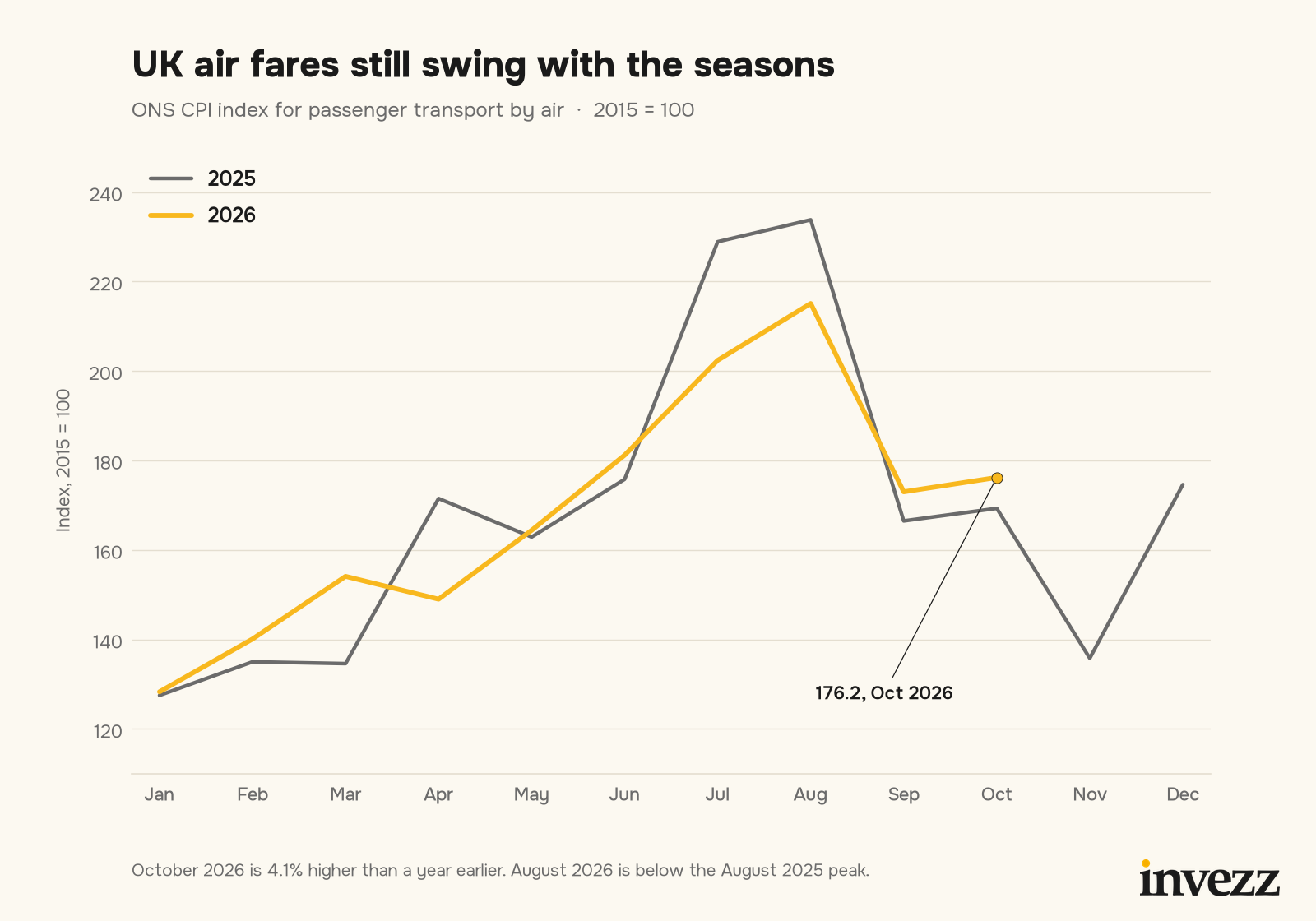
    Line chart of the ONS CPI index for passenger transport by air (2015=100), monthly from January 2025 to October 2026, showing a sharp seasonal swing and a more modest 4.1% rise in the year to October 2026. August 2026 is below the August 2025 peak.
    UK air fares still swing with the seasons

    That 4.1% annual rise is not trivial, but it is nothing like a doubling.

    In August, at the summer peak, the index was 215.1. In January it was 128.3.

    That is a 67.7% gap, an Invezz calculation, between the cheapest and dearest months so far in 2026.

    The August peak was also lower than in 2025, when the index reached 233.8.

    Average UK air fares have been seasonal, not in a one-way climb, and the official series stops in October, so it does not yet capture Christmas bookings.

    Christmas demand on the UK-India route

    Seasonality is especially sharp on flights between Britain and India. English school holidays typically run from around 18 December 2026 to about 4 or 5 January 2027, a window that also covers Christmas and New Year. Mehta’s dates, 10 December out and 10 January back, sit just outside the main school-break window, but the trip still occupies seats over the entire festive period, booked relatively late, on a direct British Airways service.

    Demand on the corridor has also had a one-off lift from the war. IAG said the conflict, particularly from 28 February, led it to suspend flights to several Gulf cities, including Dubai, Doha and Abu Dhabi. British Airways redirected aircraft to South Asia, Africa and Asia-Pacific, including additional flying to Bengaluru and Delhi.

    In the Africa, Middle East and South Asia region, IAG’s third-quarter capacity was 19.0% lower than a year earlier, while unit revenue rose 13.2%, helped by business customers flying from North America via London.

    Sean Doyle, British Airways’ chair and chief executive, told the group’s November 6 earnings call: “I think we have done very well as well to pick up a lot of traffic between the U.S. and markets like India, our hub is a really strong alternative to corporates who have been bypassing the Gulf gateways. We see that being very strong in Q4 and actually continuing into Q1 as well when we look at forward bookings.”

    He said the airline’s hub was “a really strong alternative for corporates who have been bypassing the Gulf gateways,” and that “We see that being very strong in Q4 and continuing into Q1 forward bookings.”

    Luis Gallego, IAG’s chief executive, said in the results statement: “Our strong yield performance in all our markets reflects robust ongoing customer demand for travel for our airline brands.”

    The group still posted a 17.7% operating margin before exceptional items in the quarter, he said, despite “the very high price of jet fuel” and one-off disruption.

    IAG shares closed at 447.60p in London on 24 November, down 1.67%.

    Tight aircraft supply, closed airspace and a modest tax rise

    Airlines have also been short of new aircraft. In June, Walsh said the order backlog was over 18,000 and that the average fleet age had reached a record 15.2 years.

    Airlines were “short over 5,000 more fuel efficient replacement aircraft that we had counted on.”

    IAG cut its 2026 delivery guidance from 16 aircraft to 12 because of delayed Boeing 737s at Vueling and one Airbus A321neo for British Airways, and it cited aircraft availability linked to engine issues. In May, carriers worldwide cut about 13,000 flights as fuel costs spiked.

    Ryanair, a European short-haul airline rather than a London-Mumbai carrier, struck a similar note in its 2 November results.

    Michael O’Leary, its chief executive, said: “Unless there is a swift resolution of the Middle East conflict, we expect jet-fuel prices to remain elevated well into 2027.”

    Airspace closures have mattered too. Longer routings burn more fuel, and connecting traffic that once went through Dubai or Doha has been looking for other hubs, including London, which tightens inventory on India routes.

    That pressure has also been visible in IAG’s share price on days when oil has jumped.

    UK Air Passenger Duty is a smaller piece of the puzzle. India is in Band B, and the reduced rate for the lowest class of travel rose to £102 from 1 April 2026, from £90 the year before.

    Duty is charged on the UK-originating outbound flight, not the return from Mumbai. Even the full £102 cannot explain a £3,136.09 ticket; that duty is 3.3% of the fare, an Invezz calculation.

    Fuel or a seasonal jump?

    Mehta’s question sets up a false choice. It is not all because of rising jet fuel, and it is not just a seasonal jump.

    Fuel is still expensive compared with January, and airlines have spent the year trying to recover that cost through higher fares and tighter capacity.

    Walsh warned in June that the “big unknown is how long travelers and shippers can tolerate the higher costs of connectivity.”

    That pressure has not disappeared, even as the latest IATA average and the Brent price show the immediate spike is easing.

    A £3,136 British Airways direct return, bought in late November for a trip that spans Christmas and New Year, also has the marks of peak-season yield management: scarce non-stop seats, late booking, and a route where holiday visiting and rerouted corporate traffic are competing for the same cabin.

    The ticket sits far above both the official 4.1% annual rise in average UK air fares and Kayak’s £503 December average.

    The honest answer is a stack of causes. Elevated fuel, even as it falls, seasonal demand, a late booking, tight aircraft supply, and the diversion of India traffic through London have all played a part. Rising jet fuel alone does not get you from a typical December fare to £3,136.

    The post Why a £3,136 London to Mumbai fare is not just about jet fuel appeared first on Invezz
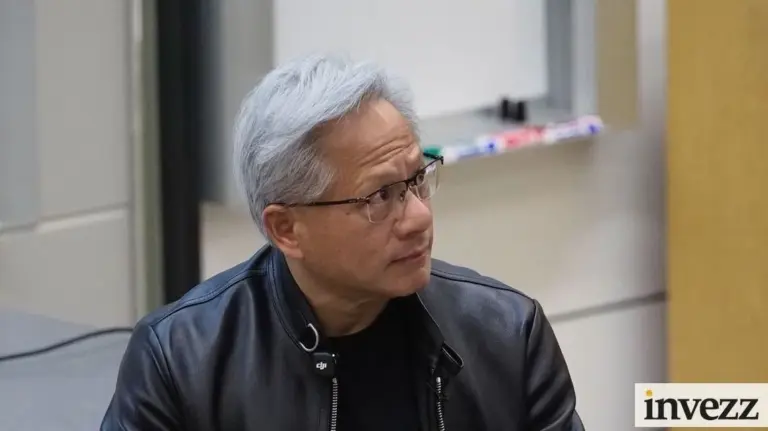
    Jensen Huang used his first staff meeting after being reinstated as Nvidia’s chief executive to address a question that has hung over the company for weeks: who comes after him. His answer was that Nvidia does not need a succession plan of the kind a normal organisation would write.

    Nvidia shares were $152.44, down 7.6% on the day, at 20:38 UK time on 24 November.

    What Huang told staff

    The meeting on Tuesday was Huang’s first all-hands since the board brought him back on Monday, 23 November, 11 days after it announced his resignation.

    “I also didn’t believe in succession planning. Let that sink in. I don’t believe in succession planning. I think it’s flawed,” Huang said.

    “The idea of succession planning is not flawed. What people think succession planning means is flawed.”

    He added: “There’s a reason why we don’t have succession planning, it’s not because we are unaware of the word. I’m the longest-running tech CEO in history.”

    Huang argued that Nvidia can already run without him.

    “All day long, this company can run autonomously, and you saw it. I promise you, whether I’m here or not, this company is wired up to execute, execute, and execute, and deliver on financial results and financial results.”

    Huang said Nvidia does not require succession planning the way a normal organisation does, and that a formal plan would create unnecessary hierarchy.

    “I made some terrible mistakes,” he said. “I was unfaithful to Lori, and I hurt my kids and, of course, I hurt all of you.”

    A three-week reminder of key-person risk

    On 8 November, Huang told staff he had been unfaithful to his wife.

    On 12 November, the board announced that, “after disclosure of personal behaviour inconsistent with the company’s code of conduct, standards, and cultural norms, Jensen Huang voluntarily resigned his positions as President, CEO, and board member.”

    Harvey C. Jones, the new board chair, repeated that wording on the 17 November earnings call, as reported by The Verge, and said the board “unanimously accepted his resignation and does not intend to reinstate Jensen as CEO.”

    Colette Kress, the long-serving chief financial officer, became interim chief executive, and the board retained Heidrick & Struggles to search for a permanent successor.

    Six days later, the same board voted unanimously to bring him back.

    “The Board believes Jensen is the right person to lead NVIDIA, and that his reinstatement is in the best interests of our stockholders, employees, partners and customers,” Jones said in the 23 November statement. Our day-by-day timeline sets out that stretch in detail.

    On 17 November, with Kress as interim chief executive, Nvidia reported third-quarter revenue of $115.8 billion, up 103% from a year earlier, and guided fourth-quarter revenue to $130.0 billion, plus or minus 3%. “From a business perspective, it’s business as usual,” Kress said on the call.

    It was one of the peaks in a turbulent year for Huang and the company.

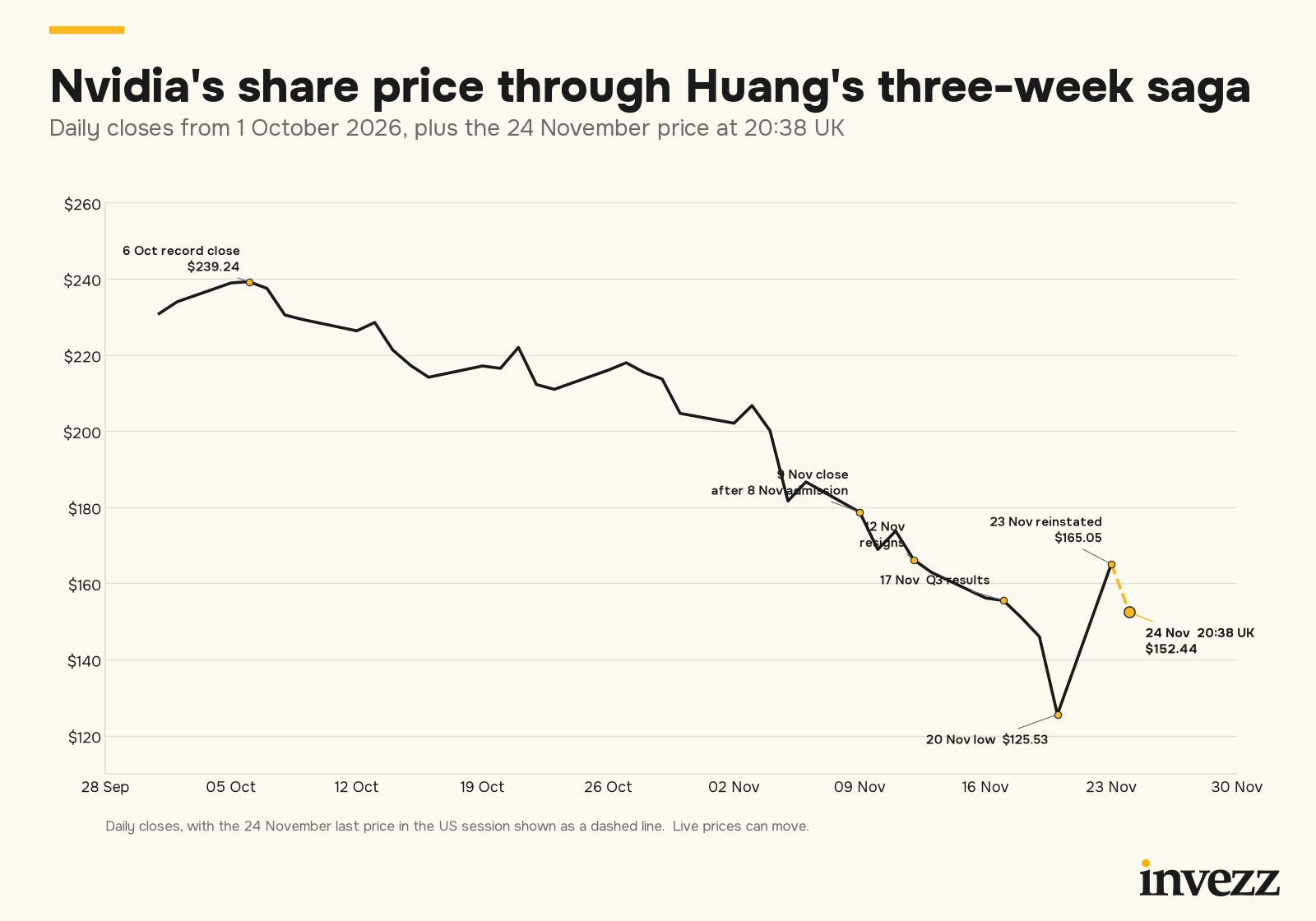
    Shares closed at $125.53 on 20 November and jumped 31.5% to $165.05 on 23 November, opening more than 30% higher.

    What Nvidia’s own filings say

    The comments sit awkwardly beside Nvidia’s own filings. In its annual report for the year ended 25 January 2026, filed on 25 February, the company warned: “Additionally, we are highly dependent on the services of our longstanding executive team. Failure to ensure effective succession planning, transfer of knowledge, and smooth transitions involving executives and key employees could hinder our strategic planning, execution, and long-term success.”

    The board’s corporate governance policies, dated 2 March 2023, go further. They require that each year “the Board shall review senior management development and discuss candidates to fulfil senior management’s, including the CEO’s, responsibilities on an interim basis in the event that a member of senior management is disabled or otherwise incapacitated.” That is an emergency plan, not a named heir, but it is still succession planning.

    Line chart of Nvidia's daily closing share price from 1 October 2026, plus the 24 November last price of $152.44 at 20:38 UK in the US session, shown as a dashed line. Annotations mark the 6 October record close of $239.24, the 9 November close after Huang's 8 November affair admission, the 12 November resignation, the 17 November third-quarter results, the 20 November close of $125.53 and the 23 November rebound to $165.05.
    Nvidia’s share price through Huang’s three-week saga

    Analysts had already spelled out the risk. “Jensen is Nvidia. Nvidia is Jensen,” Bernstein’s Stacy Rasgon told CNBC’s “Squawk on the Street” on 9 November, adding that Huang “runs the thing pretty much top down” and “sort of pulls all the strings.” Melius Research wrote the same day: “The issue at Nvidia is that there is no clear successor to Jensen, and we had expected him to stay in this role for at least 10 more years.”

    The structure around him is unusually flat. Huang told CNBC’s Becky Quick in September 2025 that he had as many as 60 direct reports; records reviewed by CNBC in early November showed 33.

    The ‘too big to fire’ problem

    Huang’s return has not closed the governance debate. “What does it mean if you have a company too big to fail or a CEO too big to fire?” Angela Mancini of Dow Jones told CNBC’s “Squawk Box Asia” earlier on Tuesday. “What does it mean when someone has 60 direct reports, and you literally are in a situation where you feel like you can’t fire them?”

    Yang Wang of Counterpoint Research called the rebound a “founder premium”. CNBC put Nvidia’s value at about $3 trillion on Friday and almost $4 trillion after his return. “The reaction has been staggering,” Wang told CNBC’s “Squawk Box Europe”. “But is this level of dependence healthy?”

    Jeff Herbst, a former Nvidia executive now at GFT Ventures, told CNBC he had written to the board calling for Huang’s return, but said oversight had to catch up with the company’s size. “I think the corporate governance, the succession planning, the legal function, the regulatory function, the political function, all has to scale at the same time,” he said.

    Rasgon, speaking after the reinstatement and before the all-hands was reported, said the risk had been ignored. “We all knew that there was key man risk here. We all chose, and I’m including myself in that. We all kind of chose to just ignore it.” Succession, he said, is something “both Jensen and the board will have to figure out, and I think communicate to investors.” Charles Elson of the University of Delaware later told CBS News it would be “the first item on the board’s agenda,” a comment on the reinstatement rather than the all-hands remarks.

    How other founder-led firms have handled it

    Other founder-led firms have eventually named a successor in public. When Steve Jobs resigned as Apple’s chief executive on 24 August 2011, the board named Tim Cook, then chief operating officer, as CEO the same day. Apple said Jobs had “strongly recommended that the Board implement its succession plan and name Tim Cook as CEO.”

    Microsoft took longer. Steve Ballmer announced on 23 August 2013 that he would retire once a successor was named. On 4 February 2014, after a five-month search, the board appointed Satya Nadella. John Thompson, then lead independent director, said: “The Board took the thoughtful approach that our shareholders, customers, partners and employees expected and deserved.”

    Berkshire Hathaway gave the market more notice. On 5 May 2025 it said Warren Buffett had recommended, and the board had on 4 May unanimously approved, Greg Abel as president and chief executive from 1 January 2026, with Buffett remaining chairman. Abel took over on that date.

    Nvidia has now lived through an emergency transition, reversed it, and heard its founder say a formal plan is not required. His nuance matters: he argued that “what people think succession planning means is flawed.” The 10-K, the board’s policies and the search firm retained on 17 November all suggest the company has, on paper, accepted that some planning is necessary.

    What investors are watching

    Nvidia was $152.44 at 20:38 UK on 24 November, down 7.6% from Monday’s close of $165.05, according to Yahoo Finance. That is still 21.4% above Friday’s close of $125.53, but 36.3% below the 6 October closing high of $239.24, Invezz calculations. The shares were already giving back part of Monday’s gain in Tuesday trade.

    The pullback should not be read as a verdict on the succession comments alone. Using the same 24.186 billion diluted weighted-average shares, the live price implies a value of about $3.69 trillion, an Invezz calculation.

    The board has said it will continue an investigation into reports that Huang was “the target of a foreign intelligence effort,” and that it is searching for a chief compliance officer. Those steps do not name a deputy, or a successor.

    Rasgon’s point still stands. If Huang is right that Nvidia can execute whether he is there or not, the next test is whether the board will say so in a plan that investors can see. If he is wrong, the past three weeks were a preview, not an exception.

    AI disclosure: AI tools assisted with research and drafting of this piece. An Invezz editor reviewed the facts, sources and wording before publication. Any opinions or analysis are Invezz’s, not those of an automated system.

    The post Huang tells staff that Nvidia does not need a succession plan appeared first on Invezz

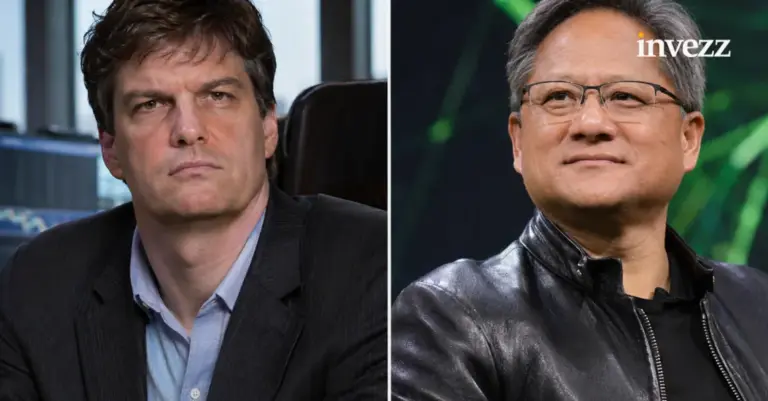
    Michael Burry, the investor known for predicting the 2008 housing market collapse, has maintained his bearish outlook on Nvidia (NVDA) despite the return of Jensen Huang as chief executive, arguing that the leadership reversal does not resolve the underlying concerns surrounding the chipmaker.

    In a Substack post on Tuesday, Burry said the market was not yet in the clear following Huang’s reinstatement, although he expected the company’s operations to return to normal.

    Burry argued that Huang understood Nvidia’s internal operations better than its board, leaving competitors and customers facing uncertainty following the leadership changes.

    However, he maintained that his short thesis on Nvidia remained intact, as it had never depended on Huang leaving the company.

    Burry says Nvidia’s short thesis remains intact

    Burry said his existing bearish thesis on Nvidia “is still valid, still has legs at full strength.”

    He argued that Huang’s return would restore business as usual but leave the company in a precarious position.

    Huang returned as Nvidia CEO on Monday after the board held discussions with US President Donald Trump, less than two weeks after his departure following allegations involving extramarital affairs and a woman alleged to be a Chinese spy.

    Nvidia shares rallied 31% on Monday following the announcement, reaching $165.05.

    However, the stock subsequently traded 7% lower.

    Burry had also adjusted his Nvidia options positions before the rally.

    According to his latest trading update, he sold 75% of his bearish put options on Nvidia, initially disposing of half on November 20 before selling another quarter following reports of a potential Securities and Exchange Commission investigation into the company’s accounting practices.

    He also purchased a small position in long-dated, far out-of-the-money call options to hedge his remaining bearish exposure.

    Burry described the combination as effectively creating a straddle rather than a straightforward directional bet.

    Despite reducing his bearish options exposure, he remained critical of Nvidia’s corporate governance and dependence on Huang.

    He also urged US authorities to continue investigating the company’s accounting and antitrust practices.

    Michael Burry adds to JD.com, BYD and Tencent holdings

    Separately, Burry disclosed that he had increased his exposure to three Chinese companies following the recent decline in Hong Kong stocks: JD.com, Tencent and BYD.

    On JD.com, Burry highlighted its valuation discount relative to his estimated intrinsic value of approximately $45 per share.

    He also noted that the company’s price-to-sales ratio had fallen to an all-time low of 0.17.

    Burry also expressed interest in BYD, saying its shares had declined into the low HKD 60s since his previous commentary in March.

    He lowered his preferred buying level to approximately HKD 58, describing the current price near HKD 60 as “close enough.”

    However, he acknowledged several challenges facing the electric vehicle manufacturer, including higher capitalisation of research and development expenses, a roughly $7 billion reduction in supplier credit and increasing inventory days.

    Overseas sales have also increased as a proportion of BYD’s vehicle sales, rising to 43% from 21% a year earlier.

    On Tencent, Burry said the company’s aggressive artificial intelligence spending had reduced his estimate of its intrinsic value.

    Nevertheless, he continued to view the stock as undervalued, describing Tencent as “the best business in China” and a “Fortress business.”

    Burry adjusts other investments amid market volatility

    Burry’s latest portfolio adjustments also included changes to several other positions.

    He exited his entire put position in the VanEck Semiconductor ETF (SMH) and sold half of his Nasdaq 100 put options expiring in April 2027.

    Elsewhere, he reduced his call options in Zoetis (NYSE: ZTS) by approximately one-third and increased his stake in MercadoLibre (NASDAQ: MELI) by 20%.

    The adjustments indicate a shift in his exposure across several technology and international equities, even as he maintains his broader concerns about Nvidia’s business and governance.

    AI disclosure: AI tools assisted with research and drafting of this piece. An Invezz editor reviewed the facts, sources and wording before publication. Any opinions or analysis are Invezz’s, not those of an automated system.

    The post Michael Burry maintains Nvidia short thesis despite Jensen Huang’s return appeared first on Invezz

    Dothan, Alabama is set to become the center of a major shift in industrial manufacturing as Niron Magnetics prepares to break ground on a massive 1.8 billion dollar production facility. Announced alongside Governor Kay Ivey, the project will establish a sprawling 1.6 million square foot campus at the Westgate Super Site dedicated to producing permanent magnets that completely bypass the need for rare earth elements. This move represents a significant leap in scale for the Minneapolis-based firm, moving far beyond their upcoming smaller operation in Sartell, Minnesota.

    While many modern technologies rely on neodymium-based magnets often sourced from volatile overseas markets, Niron utilizes iron nitride technology based on abundant domestic materials. The company claims that roughly 90 percent of global rare earth magnet production happens outside the United States, making this high volume facility a strategic win for American supply chain security. These innovative magnets are already finding their way into critical sectors including artificial intelligence infrastructure, defense systems, and consumer electronics.

    CEO Jonathan Rowntree noted that Alabama emerged as the top choice after an exhaustive search across 22 different states. To prepare for the arrival of such a heavy industry giant, local partners utilized state funding through various economic development programs to secure and develop the 446 acre plot of land. With integrated access to CSX rail lines, the site is perfectly positioned to handle the logistics of a plant capable of churning out 10,000 tons of product annually.

    The timing of the expansion coincides with growing interest from the automotive world, highlighted by a recent investment from Honda Motor via its Xcelerator Ventures program. Industry leaders emphasize that traditional electric propulsion motors are currently too dependent on resource-constrained metals prone to market swings. By scaling up in Alabama, Niron aims to provide a cost competitive and stable alternative that could reshape how everything from electric vehicles to industrial machinery is built globally.

    The Democratic Republic of Congo is once again leveraging its massive mineral wealth to steer global markets, announcing a total suspension of cobalt exports starting November 30. This decision comes from the Authority for the Regulation and Control of Strategic Mineral Substances’ Markets, which stated that the blanket ban is necessary to combat a persistent price slump and an oversupplied international market. Regulators pointed toward a combination of slowing global consumption, bloated inventories, and erratic speculative trading as the primary drivers behind the recent decline in value.

    As the source of roughly 75 percent of the worlds cobalt, the DRC holds significant leverage over the electronics and electric vehicle industries. However, this dominance is complicated by the fact that China handles nearly three quarters of the refining process and remains the dominant exporter from Congolese soil. This latest move follows a volatile period where previous attempts to stabilize prices through quotas and temporary bans saw mixed results, leaving the government determined to take more aggressive action to protect its national revenue.

    Industry giants like Glencore are feeling the pressure as these restrictive policies bite into production levels. The instability has already prompted some firms to reconsider their footprint in the region, with Glencore currently exploring a multi billion dollar deal to sell a minority stake in its local operations to a US backed consortium. These shifts highlight a growing tension between private mining interests and a state looking to maximize its sovereign control over critical resources.

    Beyond simple price stabilization, this ban reflects a broader trend sweeping across African nations seeking to break away from being mere exporters of raw materials. By restricting shipments of unprocessed ores, Kinshasa joins countries like Guinea and Zimbabwe in pushing for domestic processing and industrialization. While analysts note that previous quota systems were flexible, this return to a hard ban suggests that the DRC is willing to risk short term trade disruptions to force a long term structural rebalancing of how its minerals are valued globally.

    Newly unsealed court documents have pulled back the curtain on a legal clash between the Justice Department and a magistrate judge regarding the search of Representative Ilhan Omar’s private residence. The filings reveal that U.S. Magistrate Judge Matthew Sharbaugh pushed back against government lawyers over whether a sitting member of Congress maintains specific constitutional protections even inside their own home. At the heart of the debate was the Speech or Debate Clause, a provision intended to shield legislators from executive branch harassment and intimidation.

    While federal prosecutors argued that such privileges should be restricted to official congressional offices and specific electronic devices, Judge Sharbaugh flatly rejected that reasoning. He insisted that the government’s interest in its criminal probe had to be carefully weighed against Omar’s constitutional rights. This disagreement eventually led to a compromise where the government agreed to a protocol allowing the congresswoman to claim privilege over protected materials before agents began their sweep of the property.

    The search is part of an ongoing investigation into potential fraud surrounding immigration paperwork within Omar’s family. While these latest records provide insight into the judicial maneuvering behind the scenes, they offer little new information about the evidence gathered or the ultimate goal of the probe. Chief Judge James Boasberg ordered the release of these files following lawsuits from several media organizations asserting a public right to access them, though he kept more sensitive portions of the search warrant under seal to avoid jeopardizing the case.

    Representative Omar has consistently denied any wrongdoing, characterizing the investigation as politically motivated given her frequent clashes with former President Donald Trump and other Republican figures. Following the October raid, which took place just weeks before she won reelection, Omar noted that agents seized various personal items ranging from electronics to a children’s book written in Somali. As of now, no charges have been filed against her in connection with the matter.

    The return of Jensen Huang to the helm of Nvidia has ignited a fierce political debate in Washington, leaving lawmakers divided over the ethics and security implications of his reinstatement. After resigning amidst a whirlwind of scandals involving an alleged affair with a suspected Chinese spy, Huang was brought back as CEO following direct intervention from President Donald Trump. While Huang returned to the tech giant to a warm reception, promising to be a better leader during his second tenure, his comeback has not sat well with all members of Congress.

    Senator Kevin Cramer of North Dakota emerged as one of the most vocal critics, sharply condemning the circumstances surrounding Huang’s return. For Cramer and other concerned legislators, the situation transcends corporate governance and enters the realm of national security. The senator is now urging Congress to move swiftly on legislation that would tighten restrictions on AI chip sales to China, arguing that the vulnerabilities exposed by the recent scandal make such safeguards an urgent necessity for the country.

    As the controversy grows, the Justice Department has remained notably tightlipped about its role in the matter. During a recent press conference focused on combating cyber scams, Attorney General Todd Blanche largely dodged questions regarding any official government action related to Huang or Nvidia. This silence from the legal arm of the administration has only added to the tension as critics question whether proper vetting took place before the president pushed for Huang’s restoration to power.

    Despite the turmoil surrounding one of America’s most valuable companies, the atmosphere at the White House remains festive as President Trump prepares for traditional Thanksgiving activities. Even as Capitol Hill grapples with the fallout of the Nvidia crisis and debates new trade restrictions on critical technology, the administration continues its push toward holiday celebrations and high profile awards ceremonies.

    Democratic candidates who centered their campaigns on abortion rights saw significant success in recent midterm elections, securing key victories across Congress and various state governments. However, these wins are unlikely to translate into immediate or sweeping national policy shifts. While the party expanded its footprint, it failed to seize total control of the legislatures and governors’ offices in states with the harshest bans, meaning those restrictive laws remain firmly in place for now. Even with a Democratic majority in both houses of Congress, any attempt to pass federal legislation barring state-level bans would almost certainly face a veto from President Donald Trump.

    Despite the federal stalemate, several states are becoming battlegrounds for lasting constitutional change. In Pennsylvania and Wisconsin, newly empowered Democratic leadership is pushing to amend state constitutions to explicitly guarantee abortion rights. This mirrors a growing trend seen in a dozen other states where voters have already approved similar protections. Meanwhile, in Georgia, Governor-elect Keisha Lance Bottoms and Lieutenant Governor Josh McLaurin hope to peel away enough Republican support to repeal the state’s strict six-week ban, citing heartbreaking reports of maternal deaths caused by physician hesitation under current law.

    The shift in personnel is also creating openings in the legal arena, particularly in Texas. Newly elected Attorney General Nathan Johnson has signaled a departure from his predecessor’s aggressive tactics, stating he will not pursue out-of-state medical providers who ship abortion pills via telehealth. This move represents a significant win for advocates who argue that medication is the primary lifeline for people living in ban states. By potentially withdrawing from lawsuits against federal policies regarding mifepristone, Johnson could effectively lower the legal barriers for reproductive healthcare access within the Lone Star State.

    On the opposing side, anti-abortion activists are pivoting their strategy toward restricting pharmaceutical access at the federal level. Groups like SBA Pro-Life America are urging the Trump administration and the FDA to crack down on mail order prescriptions for abortion pills to close loopholes created by telehealth services. Some Republican strongholds continue to double down; Ohio recently moved to bar telehealth prescriptions despite previous voter support for abortion access. As both sides dig in, it appears that while Democrats have captured more territory on paper, the actual landscape of reproductive legality remains fragmented and heavily dependent on local geography.

    The atmosphere at Nvidia headquarters in California was electric this week as employees gathered in massive crowds to cheer the return of Jensen Huang as chief executive officer. Social media footage captured a celebratory scene of workers welcoming back the leader whose vision propelled the chipmaker to global dominance, suggesting a deep internal level of confidence in his leadership during a pivotal era for artificial intelligence.

    However, the celebration inside the corporate walls stands in stark contrast to the growing tension on Capitol Hill. Lawmakers from across the political spectrum have begun voicing significant concerns regarding Huang’s reinstatement, focusing primarily on potential implications for national security. The discourse has quickly evolved beyond simple corporate governance, with some politicians openly questioning whether outside influence played a role in his comeback.

    Specifically, questions are being raised about any possible involvement from President Donald Trump in facilitating Huang’s return to power. This intersection of high tech and high politics has caught the attention of Senator Elizabeth Warren, who recently told CNN that there is now a stronger sense of urgency to launch an investigation into the circumstances surrounding the move.

    As Nvidia continues to sit at the center of the global race for AI supremacy, these political inquiries suggest that Huang will face far more scrutiny than he did during his previous tenure. While shareholders and staff may be thrilled to see him back at the helm, Washington seems determined to ensure that such a powerful position isn’t subject to opaque political maneuvering.

    President Trump’s aggressive campaign to reinstall Jensen Huang as the head of Nvidia has triggered a rare moment of unity in Washington, pitting the White House against a coalition of Republicans and Democrats. The controversy centers on allegations that Huang maintained a relationship with a suspected Chinese spy while overseeing the mass shipment of advanced AI chips to China in violation of U.S. export laws. Despite the president’s insistence that Huang poses no national security risk, lawmakers from both sides of the aisle are calling for immediate accountability and have scheduled hearings for Huang to testify next week.

    The rebellion is particularly striking within the Republican party, where longtime loyalists appear to be breaking ranks over concerns that American technology is fueling its primary global adversary. High ranking members of the House foreign affairs and intelligence committees expressed skepticism toward Nvidia’s internal probe, suggesting that a corporate apology cannot erase potential security breaches. Even figures like former senator Mitt Romney have voiced alarm, questioning how the administration can claim to compete with China while simultaneously allowing the sale of critical hardware that helps Beijing close the gap in artificial intelligence.

    While Vice President JD Vance and Attorney General Todd Blanche have defended the move as a victory for business stability, critics argue it reveals a dangerous blind spot regarding national security and government corruption. Democratic leaders view the fallout as an opportunity to push through stricter bipartisan export controls, though some wonder if Republican courage will hold once political pressures mount. For now, however, the standoff marks a significant rupture in GOP discipline, signaling that even Trump’s most steadfast allies may have reached their limit regarding his interventions in high tech diplomacy.