Archive

November 2, 2026

Browsing

Amazon stock (AMZN) fell 2% on Friday after the company’s third-quarter results disappointed investors.

However, most analysts remain bullish on the shares, pointing to the longer-term growth potential of Amazon Web Services (AWS) and the company’s expanding artificial intelligence business.

Amazon reported earnings of $1.89 per share, below the $1.96 expected by analysts polled by LSEG. Revenue came in at $201.94 billion, missing the consensus estimate of $202.31 billion.

AWS revenue was approximately $45.98 billion, broadly in line with expectations.

The company also reported a trailing 12-month free cash flow outflow of $42.4 billion, highlighting the capital requirements of its AI infrastructure expansion.

Amazon’s capital expenditure reached $75.9 billion in the third quarter, as it continued investing in data centres and AI-related capacity.

The results triggered a sharp reaction in the stock, with shares falling nearly 7% in premarket trading before opening lower on Friday.

However, analysts generally viewed the sell-off as an opportunity, even as several firms adjusted their price targets.

The stock recovered some of the losses and was trading down 2% at the time of writing.

Analysts see potential despite earnings disappointment

Morgan Stanley analyst Brian Nowak maintained an Overweight rating on Amazon but lowered his price target to $335 from $350.

The revised target still implies approximately 37% upside from Thursday’s closing price.

Nowak said the growth figures were disappointing relative to expectations, but noted that the $3.8 billion quarter-over-quarter increase in AWS revenue was the second-largest in the segment’s history.

He added that the result did not change the cloud business’s long-term opportunity or potential for further acceleration.

Deutsche Bank maintained a Buy rating and a $325 price target.

The bank attributed the negative market reaction largely to AWS growth falling short of higher investor expectations.

However, it highlighted management’s outlook for growth above 40% and said the latest capital expenditure could support a further increase in revenue growth in the coming quarters.

Bernstein also maintained an Outperform rating, with a $320 price target.

The firm acknowledged that advertising growth was weak and AWS did not reach the 40% growth threshold some investors had expected.

However, it noted that cloud growth accelerated and management indicated that growth above 40% was possible through 2028.

Price targets revised as analysts assess AI spending

Several other firms adjusted their valuations following the results, although most retained positive ratings.

Barclays maintained an Overweight rating and a $365 price target.

The bank highlighted Amazon’s capacity expansion and growing backlog, noting that the company was adding more cloud capacity than any other provider.

Bank of America lowered its price target to $317 from $320 while maintaining a Buy rating.

The firm said AWS growth accelerated by two percentage points quarter over quarter to 39%, although investor expectations had reached as high as 42%.

Goldman Sachs also maintained a Buy rating but reduced its target to $370 from $375.

The bank said uncertainty around the long-term economics of AI, including the need for sustained capital expenditure and how companies will finance infrastructure expansion, remained a concern for investors.

Nevertheless, it expects Amazon to deliver revenue growth and operating margin expansion over a multi-year period.

Other firms made more substantial changes.

TD Cowen lowered its target to $340 from $350 but maintained a Buy rating, describing the post-earnings sell-off as overdone.

AWS outlook remains central to bullish forecasts

Analysts continued to identify AWS as a key driver of Amazon’s longer-term investment case.

UBS raised its price target to $352 from $348 and maintained a Buy rating.

The firm highlighted management’s expectation of AWS growth above 40% in both fiscal 2027 and 2028. It also pointed to Amazon’s $578 billion backlog as evidence of demand visibility.

BMO raised its target to $390 from $380, maintaining an Outperform rating.

The firm noted that AWS revenue growth accelerated by 200 basis points from the second quarter, marking six consecutive quarters of improving growth.

It also highlighted triple-digit year-over-year growth in AI revenue, with Amazon Bedrock emerging as an important contributor.

Citi maintained a Buy rating and a $350 target, pointing to the potential for AWS margins to remain in the mid-to-high 30% range.

JPMorgan also retained an Overweight rating and a $365 target, citing management’s confidence in demand as support for its investment plans.

The post Amazon stock falls: why analysts are saying its a buying opportunity  appeared first on Invezz

Reddit shares RDDT plunged more than 25% at market open on Friday after the social media company warned that user growth could weaken further in the fourth quarter as declining traffic from Google search weighs on its audience.

Chief Executive Steve Huffman said daily active unique visitors could fall by a low double-digit percentage in the current quarter from approximately 130 million if referral traffic continues to decline.

The warning overshadowed stronger-than-expected third-quarter results and a 53% increase in revenue.

The company also forecast fourth-quarter revenue of $1 billion to $1.03 billion, below the Bloomberg consensus estimate of $1.05 billion, raising concerns about whether its advertising business can maintain its growth momentum amid changes in online search.

The outlook prompted several analysts to reassess the stock, which has fallen 46% this year.

BofA Securities and Citizens downgraded their ratings, while Guggenheim and Needham retained Buy recommendations but substantially reduced their price targets.

Google’s AI search raises traffic concerns

Reddit has increasingly blamed changes to Google’s search experience for reducing the number of users directed to its platform.

AI-powered search features can answer queries directly, potentially limiting the need for users to click through to websites and online communities.

Huffman said search engine referrals to Reddit had declined by more than one million on average each week during October.

He also argued that Google’s AI search experience was failing to direct users to the platform despite continued crawling of its content.

“Google is crawling us as hard as ever, so the demand hasn’t changed from their point of view either. The reality is, the AI mode does not drive traffic, not for us and not to anybody,” Huffman said on the post-earnings call.

The company is responding by shifting its focus towards registered users and its mobile application.

On Thursday, Huffman outlined plans to require sign-ins for access to most content, partly to deter data scraping by artificial intelligence companies.

The strategy could help Reddit protect its data and improve advertising targeting, but it also carries the risk of reducing the number of casual visitors who access its communities through search engines.

Reddit’s global daily active uniques were flat quarter over quarter at 130.3 million in the third quarter, although they were up 12% from a year earlier.

In the US, daily active uniques fell to 50.7 million from 53.2 million in the second quarter, marking a 2% year-over-year decline.

The US decline is particularly significant because it represents the first annual contraction in the metric since Reddit went public in 2024.

Huffman sought to emphasise that the company’s most valuable audience remained intact.

“The vast majority of our revenue comes from our app users and logged-in users are direct traffic, and both of those are up Q. over Q., and so that’s where our focus is,” he said.

Reddit generates most of its revenue from online advertising and can monetise registered users more effectively because they tend to be more active and provide advertisers with better opportunities for targeted campaigns.

Strong third-quarter results fail to reassure investors

Reddit reported third-quarter revenue of $895 million, up 53% year over year and above the Bloomberg consensus estimate of $869.6 million.

Net income climbed to $283 million, or $1.40 per diluted share, compared with analyst expectations of $272.6 million.

Adjusted EBITDA increased 70% to $402 million, exceeding the $398.5 million estimate.

However, the latest revenue growth marked a slowdown from the company’s previous performance.

Reddit had reported eight consecutive quarters of revenue growth exceeding 60% as recently as its second-quarter results in July.

The weaker growth trajectory, combined with the user figures and fourth-quarter forecast, raised questions about whether the company can sustain its rapid expansion.

Huffman described the revenue outlook as resilient despite the pressure on search traffic.

“It’s still a strong guide,” he said. “We are still growing at an industry-leading rate, and that’s despite the headwinds from search referrals.”

Analysts cut price targets as outlook deteriorates

BofA Securities lowered its price target on Reddit to $135 from $190 while maintaining a Neutral rating.

Reddit stock closed at $129 per share on Thursday.

The firm expects investor sentiment to remain subdued for several quarters until the company establishes a positive trajectory for US logged-in user growth, which has been challenging since 2024.

BofA also warned that traffic headwinds could intensify before improving and highlighted uncertainty surrounding Reddit’s planned transition towards a logged-in-only experience.

The firm cited the renewal of the company’s Google data licensing agreement in the first quarter of 2027 as another source of uncertainty.

At an after-hours share price of $106, BofA valued Reddit at nine times its estimated 2027 EBITDA and seven times its 2028 EBITDA, broadly in line with peers despite higher revenue growth expectations.

Citizens downgraded Reddit to Market Perform from Market Outperform, citing declining user growth and reduced referrals from Google.

Analyst Andrew Boone noted that US daily active users had fallen 5% quarter over quarter and warned that Google’s push towards AI-powered search could worsen the platform’s logged-out traffic problems.

Citizens acknowledged that Reddit continued to execute well on monetisation but said uncertainty surrounding user growth was putting greater pressure on its ability to generate revenue from existing users.

The firm believes the shares are now fairly valued.

Guggenheim cut its price target to $170 from $255 while maintaining a Buy rating.

It reduced the valuation multiple applied to its 2027 operating income before depreciation and amortisation estimate to 18 times from 25 times, citing investor concerns over referral traffic and the shift towards registered users.

Needham also retained its Buy rating but lowered its price target sharply to $150 from $300.

The firm said Reddit’s focus on logged-in and app users, which accounted for more than 80% of third-quarter revenue, could reduce customer churn, improve advertising targeting and protect company data from large language models.

Needham said one negative interpretation of management’s commentary was that Reddit might not renew its Gemini large language model deal.

However, it argued that platforms with more restricted access to their audiences could ultimately monetise users more effectively than companies dependent on the open internet.

The diverging analyst views reflect the central question facing Reddit: whether its strategy of prioritising registered users can offset the loss of search-driven visitors without undermining the audience growth that has supported its advertising business.

The post Reddit stock plunges 25% on user growth concerns; analysts turn cautious appeared first on Invezz

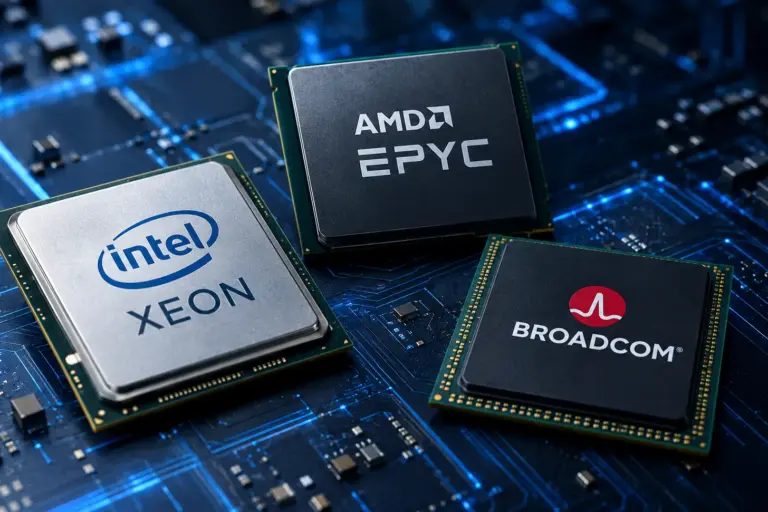
Shares of Intel, Advanced Micro Devices AMD and Broadcom fell sharply on Friday as investors reassessed semiconductor demand following a dismal forecast from Intel.

The retreat was led by Intel after the chipmaker issued a weaker-than-expected forecast, while Amazon’s latest results added to concerns over the cost of building AI infrastructure.

At 11:30 AM EST, Intel shares plunged as much as 28%, putting the stock on track for its worst one-day decline on record. The selloff erased more than $120 billion from its market value.

AMD fell roughly 9.5%, while Broadcom declined around 5%. The Philadelphia Semiconductor Index dropped 6.65%.

Intel’s outlook disappoints investors

Intel’s third-quarter results beat expectations on adjusted earnings, but its forecast for the current quarter fell well short of Wall Street estimates.

Revenue rose 21% from a year earlier to $16.5 billion, matching forecasts. Adjusted earnings came in at 52 cents per share, above the consensus estimate of about 40 cents.

The outlook overshadowed that performance.

Intel expects fourth-quarter revenue of $15 billion to $16 billion, compared with analysts’ estimate of around $17 billion. It forecast adjusted earnings of 25 cents per share, against expectations of roughly 43 cents.

The company also warned that gross margins would come under pressure.

A key weakness is the personal computer market, which remains a significant source of Intel’s revenue.

The company expects PC-related sales to fall by more than 20% sequentially in the current quarter.

Management pointed to a memory-chip shortage, as strong demand from AI data centres tightens supplies and raises component costs.

Higher costs and limited availability are weighing on consumer and business PC purchases. Intel expects the pressure to persist at least through the first half of 2027.

The forecast prompted analysts to lower expectations and renew questions about Intel’s competitive position.

BofA Securities downgraded the stock to Neutral from Buy and cut its price target to $100 from $145, saying Intel had yet to show enough progress in attracting outside foundry customers.

Roth Capital analyst Suji Desilva also moved to Neutral from Buy and reduced his price target to $70 from $120.

Morgan Stanley analysts led by Joseph Moore said the shares remained unattractive despite the steep decline, citing the risk that Intel could lose market share to fabless rivals with lower capital spending needs.

AMD and Broadcom caught in the selloff

AMD fell alongside Intel as investors considered the read-across for PC demand and competition in server processors.

AMD is due to report quarterly results on November 3.

BofA said weakness in the PC market could create a headwind of as much as $750 million for AMD, although stronger server CPU revenue could partly offset the impact.

Broadcom, a major supplier of networking equipment and custom AI chips, fell less sharply but was caught in the wider semiconductor retreat.

Despite its exposure to AI infrastructure demand, the stock moved lower alongside other chipmakers as investors reassessed valuations and spending expectations.

Recently, William Blair trimmed Broadcom from Outperform to Market Perform, highlighting increased valuation risks as the stock trades at over 40 times earnings. This puts shares at risk during sector-wide technology sell-offs.

Amazon adds to AI spending concerns

The pressure on the broader market intensified after Amazon reported its third-quarter results on Thursday.

The company recorded a substantial free-cash-flow drain linked to heavy investment in AI data centres, sending trailing 12-month free cash flow deeply negative. Amazon shares also fell.

The results revived questions about how quickly spending on data centres, chips and related infrastructure will generate returns.

Intel’s weaker outlook raised concerns about demand for traditional computing, while Amazon’s cash-flow figures highlighted the financial burden of AI expansion.

Together, the developments weighed on semiconductor stocks and broader technology sentiment.

The post Why Intel, AMD and Broadcom are falling on Friday? appeared first on Invezz

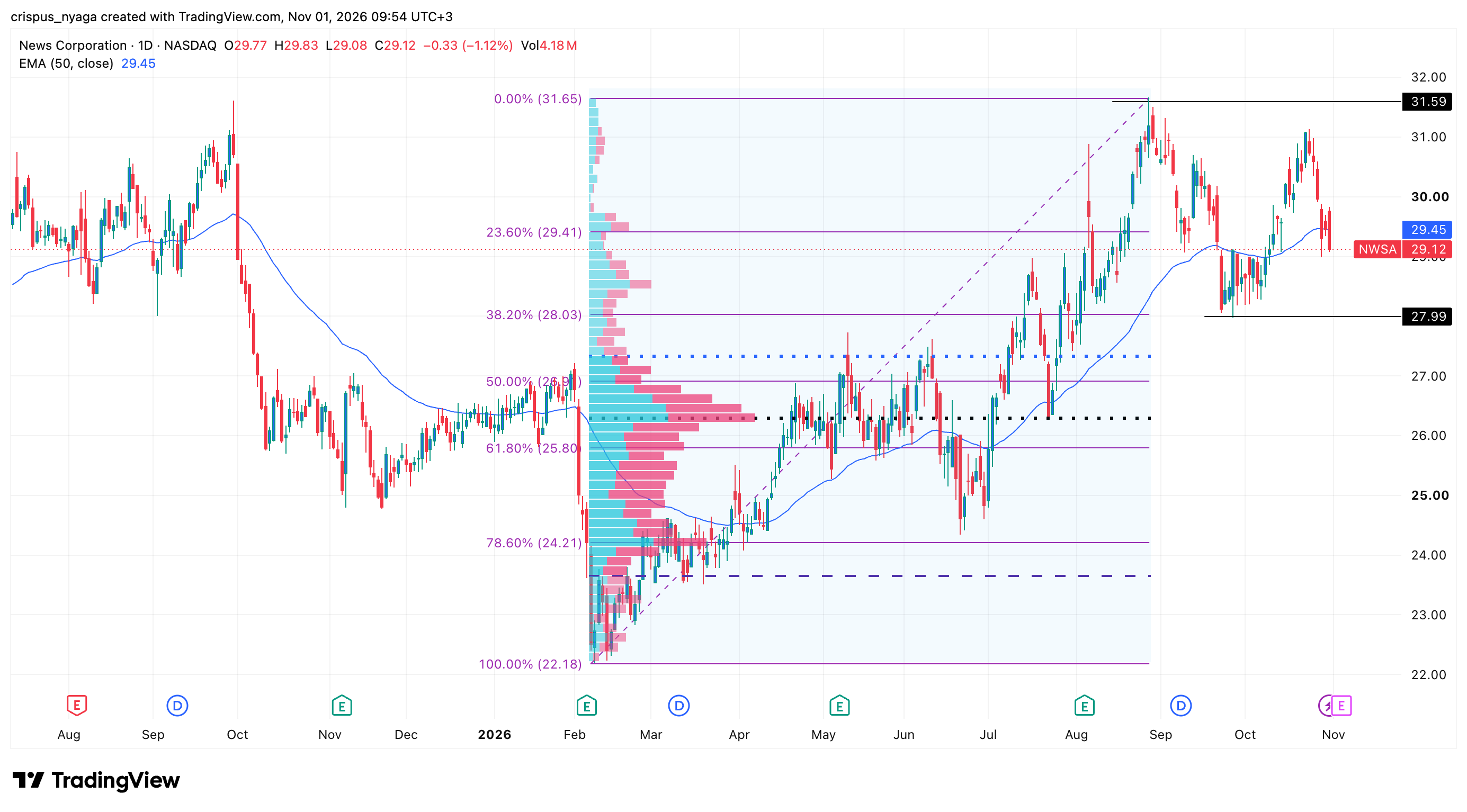
News Corp’s stock price has pulled back over the past few months, falling from a high of $31.59 in August to the current $29.12. The retreat has coincided with broader weakness in the US stock market, with the S&P 500 and Dow Jones both well below their year-to-date highs. 

Will the NWSA stock rebound as its earnings approach and as President Trump’s case against the Wall Street Journal comes to an end?

Judge tosses Trump’s $10 billion lawsuit against Wall Street Journal

News Corp is one of the biggest media companies in the world. It owns brands like the Wall Street Journal, Barron’s, MarketWatch, and Investor’s Business Daily. These brands are part of the Dow Jones business. It also owns HarperCollins Publishers, Realtor.com, REA Group, and several media brands from Australia and the United Kingdom. 

The News Corp stock will be in the spotlight after a US judge tossed a $10 billion frivolous lawsuit brought by President Donald Trump. Trump sued the Wall Street Journal after it published a letter allegedly sent to Jeffrey Epstein. In her statement, Judge Darrin Gayles said that the suit runs counter to the First Amendment, which protects freedom of press.

A $10 billion victory for Trump would be a major setback for the company, which has a market value of over $15 billion. As such, in theory, the judge’s decision suggests that the stock will rally on Monday. 

READ MORE: As the AI model race heats up, who will come out on top?

In reality, however, the ruling may prompt only a mild reaction, since most analysts expected the lawsuit to end soon. Few expected the judge to award the full $10 billion. At worst, the WSJ could have chosen to settle, as other companies have done in the past.

News Corp to publish its earnings

The next important catalyst for the News Corp stock is the upcoming earnings report, which will provide more hints on its business. The last report showed that the company’s revenue rose by 11% in the fourth quarter to $2.34 billion, helped by its digital real estate services, book publishing, and Dow Jones. Its annual revenue jumped by 7% to $9.03 billion, with its free cash flow reaching $811 million.

Analysts expect the upcoming report to show that its revenue rose by 5.54% in the first quarter to $2.26 billion. Its earnings-per-share (EPS) is expected to move to 26 cents from 22 cents in the same period last year. 

News Corp stock technical analysis

News Corp stock

NWSA stock chart | Source: TradingView

The daily chart shows that the News Corp stock has pulled back in the past few weeks. It has slumped below the 50-day moving average and the 23.6% Fibonacci Retracement level.

The stock has also formed a double-top pattern, a common bearish reversal sign in technical analysis. Therefore, these patterns suggest that the stock may continue falling as sellers target the key support level of $27.9. A drop below that level will point to more downside, potentially to the 50% retracement level of $26.9.

READ MORE: Big Tech’s AI bill meets a ‘Big Cash Burn’ issue: are investors’ fears justified?

The post News Corp stock analysis as judge tosses Trump’s WSJ lawsuit ahead of earnings appeared first on Invezz

Investors and policymakers are increasingly debating whether the AI bubble is starting to burst. The uncertainty has weighed on leading AI stocks, from chipmakers like Nvidia and AMD to neoclouds like CoreWeave and Nebius, which have seen sharp pullbacks.

In China, the AI bubble has burst

China has become one of the biggest markets in the artificial intelligence industry, with the number of companies rising. 

As Americans debate on whether the AI bubble is about to burst, there are signs that the Chinese one has already burst. 

One way of looking at this is publicly traded companies in the country. MiniMax, which went public in Hong Kong in January, tumbled to $161 on Friday, down by over 84% from its all-time high. 

Z.ai. another company that creates models similar to Anthropic and ChatGPT, ended the week at $483, down by over 80% from its all-time high. It crashed recently after seeking to raise $5 billion from investors.

Even the biggest companies in the industry have tumbled. CXMT, a company that provides memory solutions, has dropped to $41.80 from a record high of $61. Alibaba has tumbled to $97 from a high of $185 earlier this year.

Other top companies in the industry like Tencent, Xiaomi, and Lenovo Group have all slumped in the past few months.

There are signs that the AI revolution in China is following the same approach that the electric vehicle industry followed. At its peak, China had over 600 electric vehicle companies that sought to become the biggest players globally.

Today, many of those companies have disappeared, and the remaining ones, like Li Auto, XPeng, BYD, and Polestar, are struggling. They have all plunged by double digits this year, erasing billions of dollars in value.

Chinese EV companies are facing substantial competition, leading to a price war that has eroded their margins.

READ MORE: As the AI model race heats up, who will come out on top?

US AI companies are facing major risks

Turning to the United States, there are signs that companies in the AI space are facing major headwinds. For example, OpenAI has just completed a fundraising in which it raised $11 billion, well lower than its expected $30 billion. Its planned valuation of $1.4 trillion was slashed to $1.25 trillion.

Top American AI companies have also slumped. Nvidia, the biggest name of them all, plunged to $200 last week, down sharply from the year-to-date high of $243. Micron stock dropped to $884 from the year-to-date high of $1,255.

The worst affected of these are neocloud companies like CoreWeave, Nebius, IREN, MARA Holdings, and Riot Platforms. In a recent statement, Elon Musk warned that over 200 neocloud companies would collapse because of the funding issue.

There are signs that funding is becoming an issue, with bond yields for top AI companies such as CoreWeave soaring above 15%. Even Anthropic, one of the biggest names in the industry, is expected to receive a junk rating if it goes public, according to Blackstone.

Similarly, investors are pushing back against AI valuations. Firmus, an Australian company, pulled its IPO, with its investors complaining about its valuation. Nscale is also expected to launch its IPO at a much lower valuation than expected. 

Therefore, there are signs that the AI bubble is about to burst, a move that will affect many companies in the United States and globally. A key reason for this is that, as in the Chinese EV industry, the AI industry is becoming highly competitive, with more companies launching their products. 

In the US, this includes companies like Meta Platforms, SpaceX, Alphabet, Perplexity, Anthropic, and OpenAI. All these companies will compete with their Chinese counterparts, including Moonshot, DeepSeek, and Z.ai.

READ MORE: Big Tech’s AI bill meets a ‘Big Cash Burn’ issue: are investors’ fears justified?

The post Is the AI bubble bursting? In China, it has already burst appeared first on Invezz

For more than thirty years, Texas Democrats have existed in a state of perpetual longing, watching statewide victories slip through their fingers while the Lone Star State remained a fortress for the GOP. That cycle of heartbreak may finally be nearing an end as James Talarico enters the final stretch of a Senate race that has evolved into the most expensive contest in American history. With over half a billion dollars poured into the fight, the stakes transcend a single seat in Congress; they represent a potential psychological collapse for a Republican Party that long viewed Texas as untouchable.

Talarico is an unconventional choice for a party trying to break a generational losing streak. A former teacher and aspiring minister with deep ancestral roots in the state, he has leaned heavily into his Texan identity to bridge the gap with skeptical voters. From quoting Lyle Lovett to adopting slogans from Friday Night Lights, Talarico is presenting himself not as an outsider imposing liberal values, but as a homegrown alternative to an establishment he claims is fueled by corruption and indifference toward working families. His ability to draw massive crowds in traditionally red strongholds like Lubbock suggests that his message of stability and reform is resonating in places where Democrats previously feared to tread.

The anxiety within the Republican camp is palpable and public. While Donald Trump continues to rally behind candidate Ken Paxton, emphasizing strength and traditional wins, other GOP figures are sounding alarms about voter turnout. Some warn that losing Texas would be akin to cracking the foundation of the entire national Republican infrastructure, potentially triggering a domino effect across other southern states. The fear is that a victory for Talarico would provide the blueprint and motivation for a wave of future Democratic challengers, effectively ending the era when Republicans could simply wave off blue trends as impossible fantasies.

Ultimately, this race appears to be caught in what strategists call a perfect storm of timing and frustration. Voters are increasingly weary of high living costs and perceived political greed, creating an opening for someone like Talarico to position himself as a breath of fresh air. For young Texans who have grown up seeing their preferences ignored at the ballot box, this election feels less like another predictable loss and more like a genuine opportunity for change. Whether Talarico can actually cross the finish line remains to be seen, but for the first time since 1988, the prospect of a blue Senate seat in Texas feels like more than just a daydream.

Republicans entered the final stretch of the midterm campaign in a state of visible urgency, launching a desperate effort to stave off what polls suggest could be a significant Democratic surge. With voters poised to potentially hand control of the House of Representatives to the opposition, President Donald Trump has taken to the trail personally, campaigning in traditionally safe red states like Iowa and Kansas. His strategy relies on a mix of alarmist rhetoric regarding communism and an ambitious promise of five thousand dollar payments to citizens if his party prevails, though critics argue these tactics may not outweigh widespread disapproval of his administration.

Despite the confidence projected by the White House, recent data paints a challenging picture for the incumbent president. An NBC poll indicates that sixty percent of Americans disapprove of his performance, driven largely by inflation and a sputtering conflict with Iran. While early voting numbers have hit a record fifty three million ballots, Democrats admit they are only nauseously optimistic about their chances. The prospect of regaining the House represents more than just a legislative shift; it would provide the first genuine political check on a presidency characterized by an aggressive expansion of executive authority and unconventional spending projects within the White House itself.

Beyond the lower house, an unexpected battle for the Senate has emerged as one of the cycle’s biggest wildcards. Although Republicans currently hold a slim lead and only thirty four seats are up for grabs, surprising momentum in deep red territories suggests that a Democratic flip is now entirely possible. Such an outcome would allow opponents to block key judicial appointments and launch wide ranging committee probes into allegations of systemic corruption and personal controversies surrounding the president. These high stakes have fueled an astronomical eleven billion dollars in ad spending, including massive contributions from figures like Elon Musk.

As election day arrives, a shadow of uncertainty hangs over whether the results will be accepted peacefully. Drawing parallels to the turmoil following the 2020 election, observers worry that any Republican loss could trigger another constitutional crisis. This anxiety was amplified over the weekend when official presidential social media accounts dismissed standard explanations regarding how ballot counting works in complex districts, further eroding public trust in the electoral process just hours before millions head to the polls.

President Donald Trump entered his second term with a clear promise to lower costs for American families, but as the midterm elections approach, that mandate appears to be slipping away. Voters are feeling the pinch of rising prices fueled by aggressive tariffs and a costly conflict with Iran, leaving many to feel they are merely treading water. While the wealthy continue to profit from an AI-driven stock market boom, regular citizens are struggling with stagnant wages and climbing interest rates that have made owning a home or a car feel like an impossible dream. Recent polling underscores this frustration, showing that only a small fraction of Americans believe their financial situation has improved.

This economic discontent is compounded by deep dissatisfaction with the administration’s hard-line immigration policies and sweeping cuts to essential healthcare programs like Medicaid. These issues are alienating critical swing voters and energizing a Democratic base that has already shown strength in recent special elections. Historically, the president’s party rarely fares well in midterms, and the trend is significantly worse when approval ratings dip below fifty percent. With Trump currently facing record-low popularity and high levels of opposition intensity, history suggests Republicans could face a substantial loss of seats in the House.

Despite these headwinds, Democrats face their own internal struggles as they attempt to unify a fractured coalition of voters. There remains tension within the party regarding ideology and direction, yet common opposition to Trump seems to be acting as a powerful glue. Many voters view their ballot not necessarily as an endorsement of Democratic policy, but as a necessary check on executive power. This dynamic is further complicated by strategic redistricting efforts designed to protect Republican incumbents, meaning that while Democrats are favored to take back the House and potentially flip the Senate, structural hurdles may limit the scale of their victory.

As the country looks toward November, the stakes extend far beyond immediate legislative control. These midterms serve as the unofficial starting gun for the 2028 presidential race, marking the first open contest in decades without any established political dynasties on the ticket. While Republican turnout in red states could still provide a lifeline for the GOP, current trends suggest a shift in momentum. Unless there is a massivepolling error or an unprecedented surge in conservative turnout, it would be an extraordinary surprise if Democrats fail to reclaim leadership in Congress.

The Michigan political landscape was thrown into chaos this weekend after Representative Haley Stevens shocked her colleagues by crossing party lines to endorse Republican Senate nominee Mike Rogers. The move comes at a critical moment, just days before the election, and follows a period of escalating tension between Stevens and the Democratic nominee, Abdul El-Sayed. What was intended to be a demonstration of party unity during a Sunday church service in Detroit instead became a backdrop for betrayal, as Stevens opted to skip the event entirely to align herself with the opposition.

Democratic leaders have reacted with swift and searing condemnation, describing the endorsement as an act of betrayal toward both the party and working-class voters. Michigan Democratic Party Chair Curtis Hertel dismissed Stevens’ claims that she felt unwelcome in El-Sayed’s camp, arguing that personal grievances should not supersede the needs of constituents. New York City Mayor Zohran Mamdani echoed these sentiments on social media, stating that Stevens abandoned people whose basic necessities like healthcare and rent are currently at stake in the upcoming vote.

While her own party reels from the defection, Republicans have wasted no time celebrating the win. House Speaker Mike Johnson praised Stevens for standing for truth and noted that he had personally reached out to express his appreciation. Even President Donald Trump weighed in, stating he would love to have Stevens join the Republican Party and insisting she did the right thing. Amidst the praise from the right, Johnson also mentioned a heightened threat environment, noting that Stevens and her fiance have already faced significant threats following her public break from the Democrats.

Despite the surrounding noise and high-profile drama, Candidate Abdul El-Sayed appears determined to keep his eyes on the prize. Speaking to supporters shortly after the news broke, El-Sayed largely ignored the controversy involving his former primary rival, telling reporters that he does not spend his time thinking about Stevens. Instead, he used his platform to call for mutual investment among citizens regardless of faith or background, urging voters to ignore the internal friction and focus on the broader stakes of the election.

The golden age of the political conspiracy thriller arrived during the shaky foundations of the 1970s, a decade defined by Watergate and a sudden, sharp decline in public trust toward government institutions. Films from that era captured a specific kind of atmospheric dread, where an ordinary citizen would stumble upon a hidden truth only to find themselves hunted by an invisible, omnipotent power. These stories were less about the specifics of a plot and more about the crushing weight of systemic corruption and the feeling that the people in charge were operating on a different set of rules than everyone else.

Fast forward to today, and the landscape of suspicion has shifted dramatically. While seventies cinema focused on secret cabals hiding information from the masses, we now live in an era where misinformation is broadcast openly across social media feeds and echoed by high ranking officials. The mystery is no longer about uncovering a hidden document in a dark basement but rather navigating a digital wilderness where contradictory truths coexist side by side. We have moved from an age of institutional secrecy to an age of strategic noise.

Looking back at these vintage thrillers offers more than just nostalgia; it provides a mirror for our own anxieties. By analyzing how past generations processed their distrust through art, we can better understand why modern conspiracy theories gain such powerful traction. Those old movies taught us how paranoia feels when it becomes a cultural baseline, reminding us that while the medium of delivery has changed from celluloid to algorithms, the underlying fear of being manipulated remains constant.