Archive

November 23, 2026

Browsing

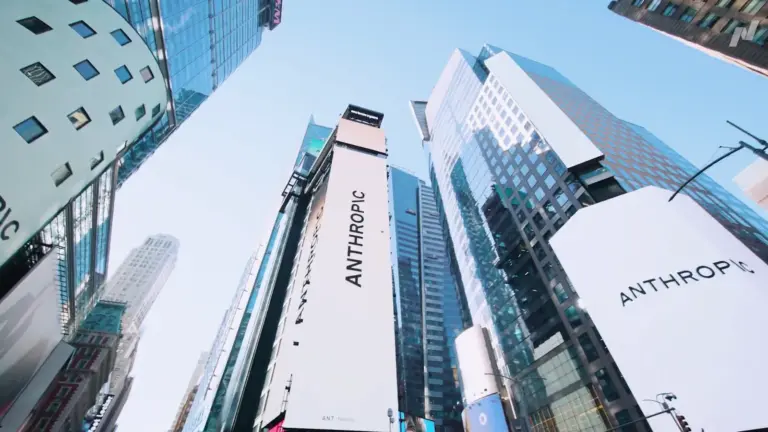
Anthropic ANT shares fell sharply in premarket trading on Friday, giving back more of their gains a day after the AI company made a record-breaking debut on the Nasdaq.

The stock was down close to 9.5% at the time of writing, as broader concerns around the artificial intelligence trade continued to fuel a selloff across the sector.

Chip stocks also remained under pressure, with Nvidia headed for another weak session while AMD struggled following a short-seller attack.

Anthropic’s big day

The maker of Claude opened at $111.50 on Thursday, 34.3% above its $83 initial public offering price, and climbed as high as $114.99.

However, the early enthusiasm faded as the session progressed. The stock closed at $97.17, still 17.1% above its offer price.

Anthropic raised $81.34 billion by selling 980 million shares, after increasing the size of the offering and pricing it above the original range of $70 to $78.

The IPO became the biggest on record, surpassing SpaceX’s previous milestone.

The total includes shares sold by investors, meaning not all the proceeds will go to the company. Anthropic has also arranged a separate $26 billion private placement involving major technology groups.

Trading began shortly before noon in New York. The opening surge briefly lifted Anthropic’s fully diluted valuation above $2 trillion, compared with about $1.5 trillion at the offering price.

But the rush did not last. Shares lost $14.33 between the open and the close, surrendering just over half of their initial $28.50 premium above the IPO price.

Anthropic’s business is expanding at a remarkable pace. Revenue reached $33.2 billion in the first nine months of 2026, up more than twelvefold from a year earlier.

Even so, the company recorded an operating loss of about $1.3 billion. It also disclosed $900.9 billion in purchase and lease commitments, mainly tied to computing infrastructure, extending over multiple years.

Anthropic spent nearly $14 billion on computing infrastructure during the first nine months of 2026.

The scale of that spending is likely to remain a concern for investors, who are increasingly questioning whether companies can sustain their high valuations while committing such vast sums to AI infrastructure.

AI stocks face pressure

Anthropic’s IPO came at a difficult time for the wider AI trade.

Nvidia, the heart of the AI boom, is facing questions over its leadership crisis following Jensen Huang’s departure, which has severely impacted its stock.

Investors have also grown more cautious about AI-related expenditure and are paying closer attention to whether massive investments in data centers and computing infrastructure are delivering commensurate returns.

The Democrats’ victory in the recent midterm elections has added to those concerns, with investors worried that it could slow data-center construction in the US and disrupt the flow of business and revenue for companies tied to the AI infrastructure boom.

Wall Street remains bullish on Anthropic

Despite the volatility, analysts see considerable upside in the stock.

Melius Research initiated coverage with a Buy rating and a $155 price target. The brokerage described Anthropic as a leading developer of frontier AI models.

Needham also initiated coverage with a Buy rating and a $150 price target.

The outlook for AI stocks will depend on whether companies can demonstrate that their substantial investments in computing infrastructure are generating sustainable financial returns.

According to Saxo, its base case for the broader AI trade through the end of the year is one of choppy stabilisation and selective rebounds, rather than a return to indiscriminate buying.

“Some crowded positioning has already been reduced. If bond yields stabilise and liquidity conditions improve, quality AI companies with resilient earnings and strong balance sheets could benefit from renewed interest,” wrote Charu Chanana, chief investment strategist at Saxo.

However, she cautioned that a sustained recovery would require greater confidence in the financial returns generated by AI investments.

AI disclosure: AI tools assisted with research and drafting of this piece. An Invezz editor reviewed the facts, sources and wording before publication. Any opinions or analysis are Invezz’s, not those of an automated system.

The post Anthropic slides over 9% in premarket after blockbuster debut: what’s going on? appeared first on Invezz
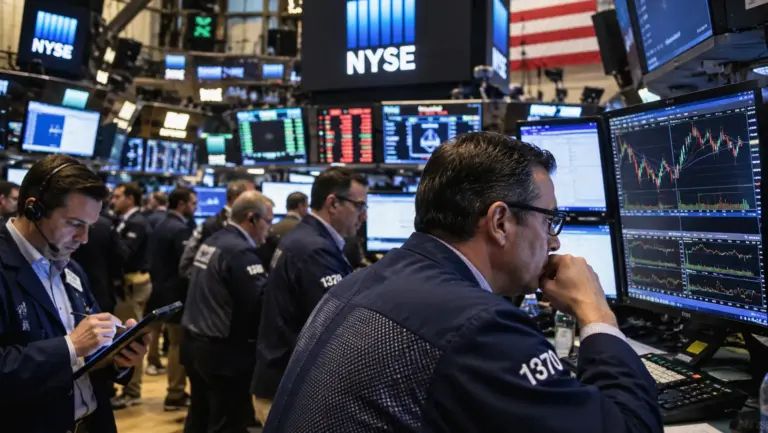
US markets opened lower on Friday as Anthropic shares fell after its blockbuster debut, dashing investor hopes of it reviving the AI trade.

The AI lab’s initial public offering and Nvidia’s latest earnings were seen as key tests of whether battered investor confidence in artificial intelligence stocks could recover.

However, neither event was enough to restore enthusiasm after weeks of concerns about the profitability of massive AI infrastructure spending, rising borrowing costs and regulatory risks.

The Dow Jones Industrial Average opened 100 points higher while the S&P 500 fell 0.46%. The Nasdaq Composite dropped 1.33%.

Anthropic shares fell 9.3% in trading after surging in their Nasdaq debut on Thursday.

The decline weighed on other AI-linked stocks, with Nvidia falling 3.66% and Advanced Micro Devices dropping 6.3%.

AI stocks extend weekly losses

The weakness in Anthropic shares added to a broader selloff in technology and semiconductor stocks.

Among major technology companies,

Amazon and Microsoft declined, while Meta fell 2.5% and Alphabet gained 1.45%.

Amazon and Alphabet are among Anthropic’s biggest investors.

Chipmakers Advanced Micro Devices, Broadcom, Marvell Technology and Micron fell between 2.6% and 7%.

Neocloud companies CoreWeave and Nebius also dropped 6% and 7%, respectively.

Data centre stocks were under pressure, with IREN, Applied Digital and Core Scientific falling approximately 7%.

Nvidia shares were down 3.6%, putting the chipmaker on track for its longest weekly losing streak since 2008.

The declines followed Thursday’s broad market selloff, when all three major US indexes lost more than 2%.

The Dow closed below 50,000 for the first time since June, while the S&P 500 recorded its sixth consecutive daily loss, its longest losing streak since April 2024.

The Nasdaq was 13.6% below its October 6 record closing high as of Thursday’s close.

For the week, the Dow had fallen 6.2%, while the S&P 500 and Nasdaq were each down about 5%.

All three indexes were on track for their steepest weekly declines since April 2025, when US President Donald Trump announced his Liberation Day tariffs.

The CBOE Volatility Index, commonly known as Wall Street’s fear gauge, rose by three points to 30 on Friday, its highest level since March 30.

Inflation and Fed rate outlook in focus

Investors are also assessing the outlook for US interest rates after renewed concerns about persistent inflation.

Federal Reserve Bank of Philadelphia President Anna Paulson said on Thursday that the central bank would need to raise interest rates again because inflation remained too high.

Markets are pricing in a 99.2% probability of an interest rate hike at the Fed’s December meeting, according to CME Group’s FedWatch tool.

Attention will also be on a speech by Fed Governor Lisa Cook later on Friday.

Next week’s personal consumption expenditures (PCE) inflation figures could provide further clues about the central bank’s monetary policy path, following a hotter-than-expected October inflation report last week.

Elsewhere, Intuit shares fell 5.1% after the company lowered its annual revenue growth forecast and agreed to sell Mailchimp to Bending Spoons for about $3.68 billion.

Intuit acquired the email marketing platform five years ago for nearly three times that amount.

AI disclosure: AI tools assisted with research and drafting of this piece. An Invezz editor reviewed the facts, sources and wording before publication. Any opinions or analysis are Invezz’s, not those of an automated system.

The post Nasdaq falls as Anthropic slides, dragging AI stocks into weekly selloff appeared first on Invezz

AMD shares extended their losses on Friday, falling more than 6% in early trading as investors continued to digest allegations about the chipmaker’s business links with China.

The stock had already dropped 7.7% on Thursday after Hunterbrook Media, an investigative publication affiliated with short seller Hunterbrook Capital, published a report questioning AMD’s exposure to blacklisted Chinese companies.

The report has raised concerns that AMD could face the same geopolitical and regulatory risks that have increasingly weighed on rival Nvidia.

At the same time, lawmakers might soon turn their focus to AMD as House China Select Committee Chairman John Moolenaar made clear that congressional scrutiny will not be limited to Nvidia.

US approved nearly 900,000 Nvidia and AMD chips for China

Latest data released by the House Foreign Affairs Committee showed that the US government approved export licences covering 879,000 advanced AI chips for Chinese companies between December 2025 and May 2026.

The approvals included Nvidia’s H200 and AMD’s MI325X processors. Companies had sought permission to ship more than 3.4 million chips during the period.

It remains unclear how many of the authorised chips actually reached China. Some transactions were listed as approved but not shipped.

The disclosure has intensified questions about how US export controls are being enforced, particularly where Chinese companies with alleged military links are involved.

Scrutiny extends beyond Nvidia

House China Select Committee Chairman Rep. John Moolenaar warned that AMD too remains in their sight as scrutiny grows around Nvidia.

“I have concerns across the board because there has been a very strong advocacy for just not having safeguards when it comes to these technologies and advocacy for selling as many chips as we can to China,” Moolenaar told CNBC.

“I do think the story is bigger than Nvidia,” he added.

That broader scrutiny could create uncertainty for AMD as it seeks to expand its AI chip business.

Hunterbrook flags AMD’s China links

The real pressure on the stock came from Hunterbrook’s short selling as it revealed that AMD was as much exposed to the China risks as Nvidia.

Hunterbrook alleged that AMD’s firmware, which enables its chips to operate in servers, continued to appear in products made by IEIT Systems, a Chinese server manufacturer placed on the US Commerce Department’s Entity List in March 2025.

According to the publication, IEIT incorporated at least six newer versions of AMD’s firmware into its products after being blacklisted, with the latest appearing in an update posted on October 19.

The investigation also identified three companies closely linked to IEIT that allegedly use nearly identical firmware in servers sold under their own brands.

Hunterbrook also questioned other financial and commercial links.

It said AMD reported $67 million in licensing income in 2025 that it traced to two Chinese chip ventures blacklisted in 2019.

The publication also pointed to a server listed under the name Cancon in AMD’s February 2026 product catalogue, identifying the company as an alias of blacklisted firm Suma.

“In sum: AMD appears no less at risk from China chip restrictions than Nvidia, despite the recent surge of positive coverage,” Hunterbrook said.

The publication’s affiliated investment fund disclosed that it held a short position in AMD alongside long positions in a basket of comparable stocks.

AMD rejected the report’s claims, saying they misrepresented its business practices and relationships.

AI disclosure: AI tools assisted with research and drafting of this piece. An Invezz editor reviewed the facts, sources and wording before publication. Any opinions or analysis are Invezz’s, not those of an automated system.

The post Why AMD shares are tumbling over 6% on Friday? appeared first on Invezz

The Anthropic IPO has formally closed at $93.5 billion after underwriters bought every extra share they were allowed to, Anthropic said on 20 November 2026.

With a $26 billion private placement to seven chip and cloud groups alongside it, the total raised comes to about $119.5 billion.

The closing statement confirms 1,127,000,000 Class A shares sold at $83 each. That includes the full exercise of the underwriters’ option to buy 147,000,000 additional shares from the company, the so-called greenshoe.

Anthropic IPO raise rises to $93.5 billion

When the deal priced on 18 November, the headline raise was about $81.3 billion from roughly 980 million shares. The greenshoe adds about $12.2 billion at the $83 offer price, an Invezz calculation, lifting gross proceeds to roughly $93.5 billion.

Of the 1.127 billion shares, 1,103,351,354 were sold by Anthropic and 23,648,646 by existing stockholders. Anthropic received about $91.6 billion before underwriting discounts and expenses. The selling stockholders’ portion, worth just under $2 billion at $83, does not go to the company.

That extends the Anthropic IPO’s lead as the largest listing on record, ahead of SpaceX’s debut in June. It also gives a newly public company one of the deepest cash cushions in the market as it scales up spending on computing power.

The $26bn private placement

Alongside the public offering, Anthropic closed the sale of 313,253,007 Class N shares at the same $83 price, for about $26.0 billion. The buyers were AMD, Broadcom, Google, Micron, Microsoft, Nvidia and TSMC Partners.

Those shares were sold in a private placement and were not registered under the Securities Act. They do not form part of the Class A stock that trades on the Nasdaq under the ticker ANT.

Including the selling stockholders, the IPO and the placement together raised about $119.5 billion before fees. Most of the companies that bought in are also Anthropic’s suppliers of chips, memory, cloud capacity or manufacturing.

Who led the deal

Goldman Sachs and Morgan Stanley were the lead book-running managers. JPMorgan, Citigroup, Barclays, Wells Fargo Securities, BofA Securities, Deutsche Bank Securities, RBC Capital Markets and UBS Investment Bank were also bookrunners.

A further seven banks acted as additional bookrunners and five as co-managers. The registration statement was declared effective by the Securities and Exchange Commission on 18 November, and the shares began trading the following day.

What the close means for ANT investors

A fully exercised greenshoe is usually a sign of strong demand. Underwriters normally sell extra shares at the outset and use the option to cover that position, which they tend to do in full when the stock trades above the offer price.

ANT did that on day one. The stock opened at $111.50 on 19 November and closed at $97.17, about 17% above the $83 offer price. At that close, the 1.127 billion IPO shares were worth roughly $109.5 billion, an Invezz calculation, a paper gain of about $16bn for buyers in the deal.

For the strategic investors, the 313 million Class N shares were worth about $4.4 billion more at Thursday’s close than they paid, on the same basis. That cushion has been tested on Friday, as ANT fell about 10% in early trading amid a wider AI selloff, covered in our Anthropic stock price report for day two.

Morningstar, which holds a $92 fair value estimate on the stock, said the capital raised, together with $132 billion of cash on the balance sheet, should allow Anthropic to meet its compute commitments even if revenue growth stalls. Those commitments are one of the biggest questions hanging over the shares.

Lock-up and what to watch next

Insiders cannot sell freely straight away. The lock-up runs until after results for the third quarter of next year, Bloomberg News reported, which limits the supply of new stock that could reach the market in the near term.

The next catalysts are Anthropic’s first quarterly report as a public company and the start of research coverage from the banks that ran the deal, which are restricted from publishing for a period after the IPO. Independent firms have already set targets, as tracked in our Anthropic stock forecast and ANT price target roundup.

For the full timeline, valuation and share structure, see our Anthropic IPO hub. If you are looking to trade the shares now that they are listed, our guide on how to buy Anthropic stock explains the options.

AI disclosure: AI tools assisted with research and drafting of this piece. An Invezz editor reviewed the facts, sources and wording before publication. Any opinions or analysis are Invezz’s, not those of an automated system.

The post Anthropic IPO closes at $93.5B after full greenshoe, $119.5B with placement appeared first on Invezz

The first Anthropic stock forecast numbers from Wall Street point higher. Seven firms have published price targets on ANT, ranging from $100 to $155, and their average sits about 28% above Thursday’s $97.17 close, on an Invezz calculation as of 20 November 2026.

Not everyone is convinced. Morningstar’s fair value estimate is below the closing price, and Seaport Research has started coverage at Neutral without a target. The banks that underwrote the IPO have not yet published research.

Anthropic stock forecast: the price targets so far

The highest target comes from Melius Research. Analyst Ben Reitzes started ANT at Buy with a two-year target of $155, about 6 times his projected 2029 revenue of roughly $430bn. That implies about 60% upside from the first-day close.

Needham’s Scott Berg rates the stock Buy with a $150 target, about 54% above the close. The target equals 18 times Needham’s fiscal 2027 revenue estimate, and Berg sees a $5.6tn market if businesses redirect 10% of labour spending to generative AI.

Wolfe Research started at Outperform with a $135 target, about 39% upside. Analyst Alex Zukin called Anthropic “not only America’s Next Top Model, but rather its next BEST business”.

Citizens rates ANT Market Outperform with a $125 target, about 29% above the close. Analyst Patrick Walravens forecasts revenue of $52.5bn in 2026 and $137bn in 2027.

ANT price target list versus the $97.17 close

Upside figures below are Invezz calculations against the 19 November close of $97.17:

Firm Rating Target Upside
Melius Research Buy $155 (two-year) 59.5%
Needham Buy $150 54.4%
Wolfe Research Outperform $135 38.9%
Citizens Market Outperform $125 28.6%
New Street Research Buy $105 (12-month) 8.1%
Freedom Broker Buy $101.90 4.9%
KGI Securities Outperform $100 2.9%
Morningstar Fair value estimate $92 -5.3%

The simple average of the seven price targets is about $124.56, an Invezz calculation. Morningstar’s $92 is a fair value estimate rather than a price target, so it is not included in that average.

The three lowest targets were set before the IPO priced, when the expected range was $70 to $78. Unless New Street, Freedom Broker and KGI revise them, they now sit only slightly above the closing price.

William Blair’s $130 to $150 range

William Blair has started Anthropic at Outperform without a formal price target. Analysts led by Arjun Bhatia said a multiple of 17 to 20 times revenue “would not be unreasonable”, implying a price of $130 to $150.

That range is about 34% to 54% above the close, an Invezz calculation. William Blair said the stock trades at 9 times its 2027 revenue estimate and 6 times 2028, and called Anthropic “a generational company driving a generational technology shift”.

The fundamentals behind the targets

The bull cases rest on growth. Anthropic’s run-rate revenue reached $81bn as of 31 October, according to its filings, about three years after its first commercial product.

Profitability is less settled. Anthropic reported an operating loss of $567m for the third quarter, which is why most targets are framed on revenue multiples rather than earnings.

The cautious calls

Morningstar has kept its $92 fair value estimate, about 5% below the close. It has a bull case of $188 and a bear case of $25, which shows how wide the range of outcomes still is for a company with more than $900bn of compute commitments.

Seaport Research’s Jay Goldberg started at Neutral with no target. “Anthropic is an incredible company, but it is also asking for an incredible leap of faith by investors,” he wrote, pointing to revenue growth that slowed sharply in the third quarter.

What the Anthropic stock forecast leaves out

Most of Wall Street has yet to weigh in. Goldman Sachs, Morgan Stanley and the rest of the underwriting syndicate are restricted from publishing research for a period after the IPO. Their initiations, likely to arrive in the coming weeks, could reset the consensus. Index demand is another possible catalyst: ANT could be added to the Russell 1000 and Nasdaq-100 as soon as December if it qualifies, Bloomberg reported.

Targets also move with the market. ANT fell about 10% in early trading on Friday as an AI selloff hit Nvidia and AMD, which is covered in our Anthropic stock price report for day two. A weaker share price makes the existing targets look more generous, but it can also prompt analysts to revisit them.

The raise behind the stock is now final at $93.5bn, as set out in our report on the Anthropic IPO close. For the valuation history and timeline, see our Anthropic IPO hub, and for access to the shares, our guide on how to buy Anthropic stock.

Price targets are opinions, not guarantees. Anthropic’s first quarterly report as a public company will be the first real test of these forecasts.

AI disclosure: AI tools assisted with research and drafting of this piece. An Invezz editor reviewed the facts, sources and wording before publication. Any opinions or analysis are Invezz’s, not those of an automated system.

The post Anthropic stock forecast: ANT price targets point to 28% upside on average appeared first on Invezz

Economists and financial titans are locked in a heated debate over whether the United States is drifting toward a formal recession. Recent proposals to overhaul global trade via aggressive tariffs have reignited anxieties, as analysts worry that increased business costs and disrupted supply chains could stifle spending. This atmosphere of uncertainty has led firms like Goldman Sachs to fluctuate on their predictions, raising the probability of a downturn to twenty five percent as geopolitical tensions and trade policies cloud the horizon.

Adding to the tension, BlackRock CEO Larry Fink has pointed toward volatile energy markets and potential stalls in artificial intelligence infrastructure as hidden triggers for inflation. He warns that if data center construction slows, it could create unexpected economic pressures. On the other side of the aisle, leaders such as Bank of America CEO Brian Moynihan argue that these fears are overstated, citing a resilient American consumer who continues to spend despite high interest rates and stubborn inflation.

Defining a recession remains a complex task since experts rarely agree on which metrics matter most. While some focus strictly on two consecutive quarters of negative gross domestic product, others prioritize rising unemployment or an inverted bond yield curve as more reliable warnings. Historically, shocks ranging from asset bubbles to runaway debt have sparked crashes, but today’s primary concern centers on whether government policy will act as a catalyst for contraction or if existing economic strength can absorb the blow.

For those navigating this instability, the prevailing sentiment echoes a famous mantra from former GE chief Jack Welch regarding the opportunities found within downturns. Rather than panicking, savvy investors are studying historical patterns and diversifying into safe havens like gold to protect their wealth. Whether the U.S. manages to dodge a slump depends largely on how trade wars evolve and whether consumer confidence holds steady heading into 2027.

Molten Industries has officially launched a groundbreaking demonstration plant in Oakland, California, marking a significant step toward reducing American reliance on foreign battery materials. The facility represents the first of its kind globally, utilizing a specialized process to convert natural gas directly into battery grade graphite. According to the company, a single modular reactor can produce 300 metric tons of anode material annually, which is enough to power roughly 4,300 electric vehicles.

The strategic goal for the startup is to break the dominance of Chinese suppliers who currently control nearly all synthetic graphite production. Co founder and CTO Caleb Boyd noted that while current output reaches cost parity with Chinese supplies when U.S. tariffs are factored in, future facilities aim to match those prices even without government protections. This ambition comes as the United States struggles with a total dependence on overseas sources for these critical components.

To achieve this efficiency, Molten employs a method developed by Stanford materials scientists that splits methane into carbon and hydrogen using electrical resistive heating. By avoiding traditional combustion and eliminating the need for expensive graphitization furnaces, the company claims its process uses significantly less electricity and cheaper feedstock than conventional methods while generating zero process emissions. What began as an effort to create clean hydrogen eventually pivoted toward graphite when the team discovered how to manage carbon buildup within the reactor.

Despite the technological breakthrough, Molten enters a volatile market where long term demand remains uncertain. Some industry analysts warn that alternative materials like silicon or lithium could displace graphite as the preferred anode choice over the next decade. For now, however, Molten is focused on scaling its Oakland design and providing samples to undisclosed customers who are currently testing the domestic material in their battery cells.

California paused this week to bid a final farewell to Dolores Huerta, a titan of labor rights and civil rights whose influence reshaped the American landscape. At the State Capitol, crowds gathered in long lines to pay their respects as state leaders remembered the woman they called the mother of the Latino civil rights movement. From high ranking officials to the workers she spent her life defending, those in attendance described Huerta not just as an activist, but as a force of nature who proved that ordinary people possess a power far greater than wealth or fear.

Assembly Speaker Robert Rivas and Senate President pro tempore Monique Limón emphasized that while Huerta has passed away at ninety six, her mission remains unfinished. The sentiment throughout the ceremonies was one of continuity rather than conclusion, with many pledging to carry her baton forward into future struggles for justice. Governor elect Xavier Becerra noted how Huerta’s voice echoed from the dusty fields of California all the way to the halls of Congress, demanding that the United States finally live up to its own promises of equality.

The celebrations eventually returned to Bakersfield in the Central Valley, bringing Huerta back to where her lifelong battle for farmworkers rights first ignited decades ago. Local mourners recalled her rare combination of fierce commitment and deep compassion for the most vulnerable members of society. For many, her famous rallying cry, Si se puede, serves as more than just a slogan; it stands as a permanent reminder that through integrity and collective action, meaningful change is always possible.

Huerta leaves behind a sprawling family legacy including thirteen children and dozens of grandchildren and great grandchildren. As prayers were offered during a recent rosary service, speakers thanked God for gifting the world with a woman who spoke truth to power across borders and generations. While she died at home on October twenty eighth, her presence continues to linger in every field and courtroom where laborers still fight for dignity and fair treatment under the law.

President Donald Trump has issued a stark warning to Iran, suggesting that military strikes could be imminent after the new year if diplomatic efforts fail to produce a concrete agreement. In an exclusive conversation with Fox News, the president dismissed current negotiations as fundamentally meaningless, claiming that Iranian officials are merely stalling for time while simultaneously ramping up their aggression since the U.S. elections.

Trump did not mince words when describing his counterparts in Tehran, labeling the negotiators professional tap dancers who engage in endless chatter without any intention of reaching a real resolution. He characterized their diplomatic approach as deceptive and insisted that the rhetoric coming from the Iranian government lacks substance and sincerity.

The tension comes at a precarious moment as the United States continues its naval blockade of Iranian ports amidst an ongoing conflict in the Strait of Hormuz. Challenging Tehran to test the strength of the American presence, Trump suggested that any attempt by Iranian naval forces to break the siege would result in them ending up at the bottom of the sea.

While external pressures mount, internal instability is also growing within Iran through renewed anti-government protests across several cities. Addressing these domestic uprisings, Trump voiced his support for those risking their lives to challenge the regime, telling demonstrators directly to keep protesting as part of their struggle for change.

Democrats now find themselves at a crossroads following their recent success in the midterms, grappling with a fundamental question about how to wield their newfound power. The central tension lies between two competing instincts: the desire to launch aggressive investigations into the previous Trump administration and the urgent need to address an economy that is squeezing middle class families. For many lawmakers, the pull toward accountability is strong, but there is a growing fear that focusing too heavily on past grievances could look like political theater to a public struggling with inflation.

Some political strategists caution that diving deep into retrospective inquiries could be a costly mistake. Analysts such as Bill Galston suggest that when voters prioritize the price of groceries and rent over courtroom dramas, they may view extensive congressional oversight as a distraction from real world problems. From this perspective, leaning too hard into payback risks alienating a broad coalition of swing voters who care less about constitutional precedents than they do about their monthly bank statements.

On the other side of the debate, some experts argue that ignoring systemic abuses creates a dangerous precedent for American democracy. Scholars like Ruth Ben-Ghiat maintain that leaving misconduct unchecked essentially invites future leaders to push boundaries even further, potentially leading to long term democratic decay. To these observers, holding powerful figures accountable isn’t just about settling scores; it is an essential safeguard against authoritarianism.

Ultimately, the survival of this legislative strategy depends on whether Democrats can bridge the gap between high minded legal battles and kitchen table issues. The party must convince its constituents that rooting out government corruption and ending wasteful spending actually leads to lower costs for the average citizen. If they cannot connect the dots between institutional integrity and individual affordability, they may find that their quest for justice comes at a steep political price.