Archive

November 2026

Browsing

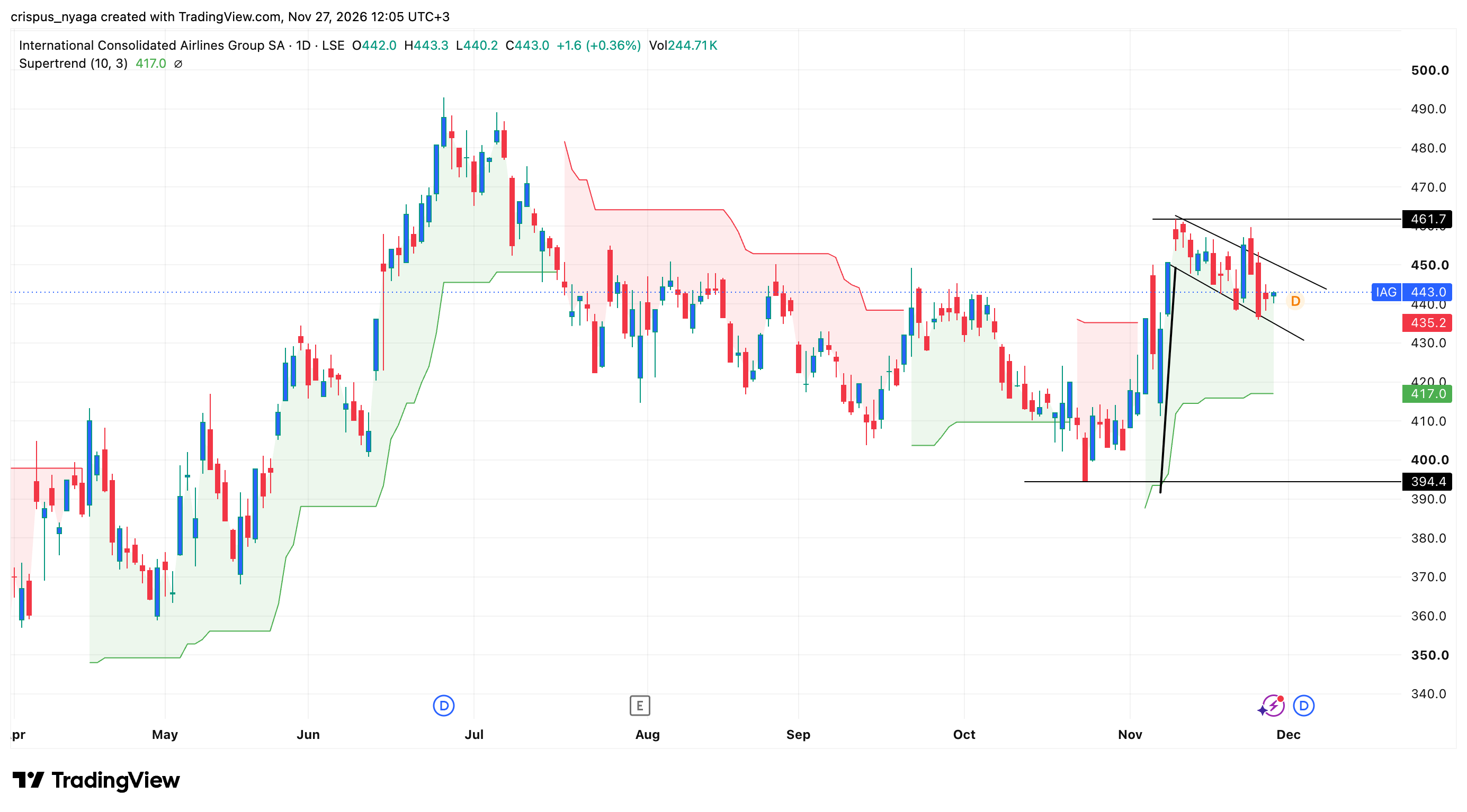
IAG share price remains under pressure this week, even as jet fuel costs continue to fall. It dropped to 441p on Friday, about 4.38% below its highest point this month. It has also formed a highly bullish pattern, which points to more upside in the coming months.

Jet fuel prices have continued falling

IAG, the parent company of British Airways, has come under pressure in the past few weeks as the company grapples with the elevated jet fuel prices. 

On the positive side, there are signs that jet fuel prices are now falling. IATA data shows that the average jet fuel price has dropped by nearly 20% from where it was last month. Most of the drops are in Europe and North America, where IAG has large operations.

There is a likelihood that jet fuel prices will continue falling in the coming weeks or months. For one, crude oil prices remain in a bear market after falling by over 20% from the October high. 

There are signs that President Donald Trump is no longer interested in going back to war. He told the New York Post that he plans to hit Iran hard in January, when the funding will run out. He hopes to blame Democrats for defunding the war. 

Another possibility is that there will be a short war in the coming months. Iran may restart the war to force the US to end the blockade. Alternatively, there is a likelihood that Israel will attempt to restart the war. 

All in all, there is a likelihood that the war will end at least in 2026, which will push oil prices much lower over time. Such a move will benefit IAG and other airlines, which have suffered substantial losses in the past few months.

IAG’s business has done well despite the challenges

IAG, which owns brands like British Airways, Aer Lingus, and LEVEL, has done relatively well this year. The most recent results showed that revenues jumped by 4.5% in the third quarter to €9.7 billion. Its cargo revenue rose by 3.9%, while the passenger revenue rose by 3.8%. 

The company’s revenue did well because of the rising passenger and cargo volume and prices. Like other airlines, IAG boosted prices to cover the rising costs of doing business. Even so, its profit after tax dropped by 16.2% to €2.26 billion, while its operating profit fell by 15%. 

The management lowered its forward guidance, noting that the absence of Middle East capacity would have an impact on its business. It also expects that the fuel costs will be about €8.9 billion. 

These challenges will likely be milder than expected since jet fuel has fallen and traffic in the Middle East has been relatively encouraging.

IAG share price technical analysis

iag share price

IAG chart | Source: TradingView

The daily chart shows that IAG stock has done well in the past month. Recently, however, it has formed a descending channel. This channel is part of the bullish flag pattern, a common continuation sign in technical analysis. 

IAG has remained above the 100-day Exponential Moving Average (EMA) and the Supertrend indicator. Therefore, the stock will likely have a strong bullish breakout in the coming weeks. If this happens, the next level to watch will be at 461p, the highest level on November 10.

The post IAG share price flashes bullish flag as jet fuel costs tumble appeared first on Invezz

US stock futures surged on Friday as investors returned from Thanksgiving with renewed appetite for beaten-down technology shares, even as stubborn inflation and fresh tariff proposals threatened the recovery.

Nasdaq 100 futures jumped 2.47%, S&P 500 contracts gained 1.65% and Dow futures rose 1.33%, or 656 points.

The rebound followed Wednesday’s volatile session, when the Nasdaq Composite recovered from a drop of more than 4% to close 0.6% lower.

5 things to know before Wall Street opens

1. Black Friday offers a test of consumers and retailer margins

Adobe Analytics forecasts $12.9 billion in US online spending on Friday, up 9.2% from a year earlier, followed by $15.1 billion on Cyber Monday. That would contribute to a record $275.1 billion holiday shopping season.

Shoppers had already spent $82.5 billion online between 1 and 22 November, Adobe estimates. But discounts were 8% deeper than a year earlier, according to Salesforce.

Amazon, Walmart, Target and Best Buy will be judged on margins as well as sales. Higher sales may reflect inflation or bargain hunting, rather than stronger demand.

2. December Fed rate hike bets remain near certainty

Wednesday’s data reinforced expectations of further tightening. Headline personal consumption expenditures inflation reached 3.8% in October, while the core measure increased 3.3%, above the Fed’s 2% target.

Third-quarter economic growth was revised to an annualised 4.3%, from an initial estimate of 3.4%.

Futures markets assigned roughly 99% probability to a quarter-point December rate increase. The next major test is the 4 December employment report.

Stronger growth supports company profits, but sustained high yields can depress valuations, particularly among technology businesses.

3. Trump’s proposed tariffs threaten corporate profit margins

Washington proposed duties on 14 economies, including China, India, Japan and the European Union, following an investigation into manufacturing overcapacity.

The US Trade Representative outlined rates of up to 20% on some Chinese goods and 25% on Indian imports, subject to exemptions and existing duties. EU goods face a proposed 15% rate.

These are proposals, not tariffs already collected. Public comments are due in January.

Retailers, carmakers and industrial companies face uncertainty over input costs, while an increase in import prices could complicate the Fed’s inflation fight.

4. Nvidia recovery faces a fresh credit-rating test

Nvidia stock rose before Friday’s opening bell after November’s steep losses.

However, S&P Global Ratings has placed the chipmaker’s AA credit rating on watch for a possible downgrade, pointing to governance and succession concerns following Jensen Huang’s reinstatement.

Anthropic has slipped below its IPO price, adding to AI valuation concerns.

Kathleen Brooks, research director at XTB, argues the rebound may reflect technical buying rather than resolution of the industry’s central questions over spending and returns.

Thin holiday trading could magnify moves in either direction.

5. Oil rebounds as OPEC+ prepares its supply decision

Brent climbed 1.2% to $97.71 a barrel at 07:45 GMT, heading for its first weekly gain in four weeks. WTI stood at $86.27, up 3.1% from Wednesday’s settlement because US markets were shut Thursday.

Attacks on shipping and Saudi energy infrastructure are reviving supply concerns ahead of Sunday’s OPEC+ meeting. Members may hold output targets through early 2027, although no decision has been announced.

Higher crude could lift US energy shares, but it also risks adding to inflation pressures.

AI disclosure: AI tools assisted with research and drafting of this piece. An Invezz editor reviewed the facts, sources and wording before publication. Any opinions or analysis are Invezz’s, not those of an automated system.

The post Dow futures surge 650 points: 5 things to know before Wall Street opens appeared first on Invezz

Chip stocks were rallying in premarket trading on Friday as investors bought the dip following the Thanksgiving holiday.

Intel and AMD gained roughly 4% and Broadcom jumped 3% in early premarket trading at 6:45 AM ET.

All three stocks, alongside major names in the artificial intelligence trade, have been under pressure in recent weeks, with the tech-heavy Nasdaq briefly entering bear-market territory in the previous session.

Intel had shed 0.6% on Wednesday to close at $54.47, AMD had lost 1.75% to $406 while Broadcom stayed almost flat at $300.86.

The broader market was also looking set to jump, with futures linked to all three major indexes rising ahead of the shortened trading session to close the week.

However, with fundamental questions around the sustainability of the AI trade still looming, analysts are unsure whether the rebound will be durable.

“The recovery in stocks seems technical. The questions that caused the market panic are still unanswered,” Kathleen Brooks, research director at XTB, told Reuters. “If these gains can be sustained on Friday, it would suggest that enthusiasm for the AI trade is back.”

There have nevertheless been some positive developments for individual chipmakers that could help support sentiment.

Intel gets two important customer wins

Intel has secured two important customer developments that could support its manufacturing ambitions.

CEO Lip-Bu Tan announced Thursday that the company had signed its first external customer for its advanced 18A-P chip manufacturing process.

Intel has not disclosed the customer’s identity, but the agreement marks progress in its effort to compete with Taiwan Semiconductor Manufacturing Co.

Separately, Microsoft became the first publicly named customer for Intel Foundry’s EMIB advanced packaging technology, which will be used for Microsoft’s Azure first-party silicon.

AMD jumps from Hunterbrook-triggered selloff

AMD has also made progress in its efforts to secure a larger share of the AI infrastructure market even as it struggles with allegations of links with blacklisted Chinese firms.

On November 16, AI infrastructure provider TensorWave announced a six-year agreement with OpenAI to supply 457 megawatts of dedicated computing capacity across multiple US data-center locations.

AMD has also completed its acquisitions of AI research startup World Labs, led by Fei-Fei Li, and specialised inference-chip developer Taalas.

China’s extension of the pause in controls on critical minerals till January is another good news for chipmakers, even though it is only a short-term relief.

Minerals like gallium and germanium are critical inputs in semiconductor manufacturing.

Analysts also remain bullish on the stock with TipRanks data showing 27 out of 30 analysts keeping a ‘buy’ rating and three suggesting ‘hold’.

Broadcom has a major Anthropic deal

Broadcom has also faced significant pressure recently and investors chipped in on Friday to buy the stock, pushing it up before the opening bell.

It recently secured a significant development in its AI business through a financing arrangement involving some of Wall Street’s biggest financial institutions.

Bank of America, Blackstone, Citi and Morgan Stanley announced a $63 billion financing structure in October to fund the purchase of Broadcom’s custom AI accelerators and networking equipment for Anthropic.

Several Wall Street firms, including StoneX, UBS, and Rosenblatt have reiterated their Buy ratings on Broadcom, but some like Rothschild Redburn have also downgraded the stock with concerns over AI financing and the sustainability of earnings.

Broadcom is scheduled to report its fourth-quarter and full-year 2026 financial results on December 9, giving investors another opportunity to assess whether its AI business can sustain growth despite recent concerns about chip demand.

AI disclosure: AI tools assisted with research and drafting of this piece. An Invezz editor reviewed the facts, sources and wording before publication. Any opinions or analysis are Invezz’s, not those of an automated system.

The post AMD, Intel, Broadcom rally in premarket trading Friday as AI stocks rebound appeared first on Invezz

CoreWeave (NASDAQ: CRWV) and Nebius (NASDAQ: NBIS) stocks rallied in Friday’s premarket trading amid renewed buying interest in AI infrastructure companies after weeks of heavy selling.

CoreWeave advanced 6.5%, while Nebius gained 7%, despite persistent concerns about the financial sustainability of debt-funded data centre expansion.

The rebound comes as CoreWeave’s bankers prepare a $4.5 billion Meta-linked loan at an indicative interest rate substantially below the yield on its corporate bonds.

Meanwhile, Nebius expects customer prepayments and contract-backed borrowing to cover most of its planned $40 billion to $45 billion infrastructure investment in 2027.

Why CoreWeave and Nebius stocks are rallying today

CoreWeave and Nebius had lost 22% and 45% in November through Wednesday.

Jensen Huang’s reinstatement as Nvidia chief executive this week helped ease concerns surrounding the AI infrastructure industry. The chipmaker supplies computing hardware to both companies and has invested in them.

Goldman Sachs analyst Vincent Lin said hedge fund clients had added short positions during November, according to the Financial Times. That positioning could amplify a rebound, although there is no confirmation that short covering drove Friday’s gains.

Cantor Fitzgerald analyst Brett Knoblauch retained his Overweight rating on CoreWeave on Wednesday, despite cutting his price target to $96 from $100. The revised target implies approximately 125% upside from Wednesday’s close.

Citi analyst Tyler Radke also maintained his Buy rating on Nebius earlier this month while lowering his target from $265 to $215.

How CoreWeave and Nebius could secure cheaper funding

Banks are preparing to market CoreWeave’s $4.5 billion loan, secured against graphics processing units destined for a facility serving Meta, as early as next week, Bloomberg reported on Wednesday.

Indicative interest rates of 7% to 7.5% contrast sharply with yields approaching 18% on CoreWeave’s corporate bonds maturing in 2031.

The difference illustrates how collateral and customer contracts could help CoreWeave access cheaper funding.

CoreWeave’s revenue backlog reached $132.5 billion in the third quarter, while management expects approximately $9 billion in customer prepayments and deposits over the three months following its earnings announcement.

Nebius expects $17 billion to $20 billion in customer prepayments in 2027.

Combined with contract-backed borrowing, these advances could cover 75% to 85% of planned capital expenditure, leaving between $6 billion and $11.25 billion to be funded from other sources.

CoreWeave, Nebius stocks: Why Wall Street’s AI debt concerns are far from over

CoreWeave’s five-year credit default swap spread reached 1,314 basis points on Wednesday, reflecting elevated default concerns.

Outstanding debt principal totalled $47.5 billion at September’s end, with nearly $11 billion due in 2027.

Third-quarter GAAP operating income of $207 million was less than a quarter of its $846 million net interest expense, although this accounting comparison does not measure cash available for debt repayments.

Expansion also continues to outpace operating cash generation. During the first nine months of 2026, CoreWeave generated $5.6 billion in operating cash flow against $23.6 billion in cash infrastructure purchases. Nebius generated $4.2 billion against $15.4 billion in expenditure.

Customer advances already contribute to reported operating cash flow and should not be counted again as separate funding.

Nebius held $7.4 billion in cash and cash equivalents at September’s end, providing a cushion against its remaining funding requirements.

AI disclosure: AI tools assisted with research and drafting of this piece. An Invezz editor reviewed the facts, sources and wording before publication. Any opinions or analysis are Invezz’s, not those of an automated system.

The post Why are CoreWeave and Nebius stocks soaring despite mounting debt risks? appeared first on Invezz

For much of 2026, as artificial intelligence fuelled stock market rallies in the US and parts of Asia, particularly Taiwan and South Korea, India’s equity market found itself in the shadows.

With relatively little direct exposure to AI hardware and semiconductors, Indian stocks struggled to attract the same investor enthusiasm.

The US war with Iran compounded the pressure.

Rising oil prices heightened concerns over inflation and the impact on corporate profit margins, while the rupee came under pressure.

As one of the world’s largest crude oil importers, India was particularly vulnerable to the energy shock.

Between January and October, foreign institutional investors (FIIs) withdrew more than $30 billion from Indian equities, according to data from Kotak Neo, as investors channelled money into markets with greater exposure to the AI value chain.

The Nifty 50 fell 3,093.45 points, or 11.83%, in 2026 through October 30.

However, November has brought a dramatic reversal in sentiment.

As the global AI trade began to lose momentum amid concerns that spending could outstrip the revenue and profits it ultimately generates, India emerged as a relative safe haven.

Fears of slower data centre construction in the US, following a Democratic sweep of Congress, and expectations of higher interest rates also weighed on technology stocks.

Foreign investors have poured more than $15 billion into Indian shares so far in November, marking the largest monthly inflow on record.

This follows more than $60 billion in net selling between September 2024 and October 2026.

The Nifty 50 has surged 12.5% this month, although it remains down about 2% for the year.

Why foreign investors are returning to India

A combination of lower oil prices, improving corporate earnings and a shift in global investment preferences has helped revive interest in Indian equities.

“Firstly, we saw a cool-off in crude oil prices, they came down from hovering over $100 to between $90 and $100. Secondly- earnings revival. The Q2 corporate earnings were good. Finally, India has come to be seen as a hedge against the global AI trade led by US and other Asian markets. As the euphoria there cooled, in the reallocation, India seems to be a convenient long term story and this is why FIIs have started to allocate towards India again,” Kranthi Bathini, equity strategist at WealthMills, told Invezz.

Indian companies delivered their strongest earnings growth in 12 quarters in Q2FY27, reflecting a broad-based recovery in corporate profitability.

The country had slipped down investors’ rankings as subdued economic expansion and a weak rupee weighed on earnings growth.

However, a resilient economy and a stabilising currency have also helped improve earnings in dollar terms this year.

The shift is also reflected in the investment decisions of global asset managers.

Aberdeen has increased its exposure to two large Indian asset managers over the past three months, citing improved valuations and earnings growth, Reuters reported.

India has “a combination of OK valuations and earnings growth coming back – that’s a reasonable setup,” said Isaac Thong, Aberdeen’s senior investment director for Asian equities, Reuters reported.

Ashmore and Artemis Fund Managers have also increased their exposure to India.

For the first time since January, investors overweight India outnumbered those underweight, according to a Bank of America survey conducted this month.

Why the revival is unlikely to be smooth

The revival, however, has already encountered some resistance.

Indian shares paused their four-week winning streak on Friday as investors booked profits following a sharp rally.

A renewed rise in crude oil prices also tempered sentiment ahead of the Reserve Bank of India’s monetary policy decision next week.

Both the Nifty 50 and the Sensex fell by more than 1% on Friday.

The benchmarks lost about 0.7% each over the week, following a nearly 15% surge in the preceding four weeks.

Brent crude futures rose 5% over the week to around $97 a barrel, as attacks on tankers in the Strait of Hormuz and Saudi energy infrastructure heightened concerns about oil exports from the conflict-hit region.

Meanwhile, sentiment towards technology stocks stabilised elsewhere.

South Korea’s Kospi gained more than 4% on Friday, while the Nasdaq was up 1.2% and the S&P 500 traded nearly 1% higher at the time of writing.

“Indian equities took a breather after a strong four-week rally, as higher crude prices, a weaker rupee and rising domestic bond yields prompted profit booking in index heavyweights,” said Vinod Nair, head of research at Geojit Investments.

“Renewed Middle East tensions pushed Brent higher, raising concerns over supply and domestic inflation. At the same time, a revival in Asian AI stocks could divert some flows away from India, which had benefited from its relatively domestic-oriented growth profile amid crowded global AI trades,” he said.

The concern is that India’s recent gains may not yet represent a durable shift in foreign investor sentiment.

Some of the inflows could instead reflect a temporary reallocation of capital away from technology-heavy markets.

Sustaining the recovery will require further improvement in domestic economic and corporate fundamentals.

Crude price, earnings, and RBI policy will determine whether the rally lasts

According to Bathini, a decisive cooling in crude oil prices will be crucial for the Nifty 50 to sustain its gains at current levels.

“We also need to see how the RBI monetary policy goes,” he said.

The Reserve Bank of India’s Monetary Policy Committee is scheduled to meet on December 2-4.

Market participants are expecting the central bank to raise the repo rate.

More importantly, Bathini stressed that the improvement in corporate earnings would need to continue to support the market.

“The macroeconomic data for India is good. Also, look at the auto sales figures, they are consistently rising. These are strong consumption figures that could ultimately translate into better earnings,” he said.

Nair, however, expects near-term consolidation, with Q3FY27 earnings growth likely to moderate and uncertainty surrounding proposed US tariffs continuing to weigh on sentiment.

“Nevertheless, strong foreign inflows and expectations of 7.7% Q2FY27 GDP growth continue to support a constructive medium-term outlook,” he said.

“From the near-term perspective, some consolidation should not come as a surprise after the magnitude and speed of the recent rally,” said Shrikant Chouhan, head of equity research at Kotak Neo.

JPMorgan forecasts Nifty 50 to reach 29,000 by 2027-end

Despite the near-term risks, JPMorgan has forecast the Nifty 50 to reach 29,000 by the end of 2027 in its base-case scenario, implying about 12% upside from Thursday’s close.

Its bull- ​and bear-case targets stand at 31,000 and 22,000, respectively, analysts led ​by Rajiv Batra said in a note.

The brokerage favours domestic cyclicals over exporters, citing lower oil prices and a firmer rupee.

It also sees scope for $100 billion in net foreign inflows if long-only investors return to benchmark weights, following about $15.5 billion in overseas buying so far in November.

“The earnings story is improving; the valuation story is less forgiving,” JPMorgan said.

The brokerage has forecast three consecutive 25-basis-point RBI rate hikes and flagged risks from potential US rate increases, weak monsoon rains, El Niño-linked food inflation, rural stress and fiscal consolidation.

JPMorgan is overweight on financials, industrials, healthcare and consumer discretionary stocks.

It has downgraded materials to underweight, including a two-notch downgrade of metals and mining, and retained its underweight rating on IT.

Bathini, meanwhile, favours defence, aerospace, power and nuclear power, as well as consumer-facing sectors, including automobiles.

The November rally has therefore improved India’s standing among global investors, but the recovery is not without vulnerabilities.

Whether the market can hold on to its gains will depend on the trajectory of crude oil, the RBI’s policy stance and, above all, whether earnings growth can justify the renewed investor interest.

The post Indian shares rallied in November as FIIs returned, but will the revival sustain? appeared first on Invezz


Copper prices have retreated significantly from their yearly peaks, sliding to levels not seen since March and erasing much of the optimism that fueled a massive rally earlier this year. Market analysts suggest this dip is primarily driven by a cocktail of macroeconomic headwinds, including a surging US dollar, typical seasonal fluctuations, and a slight cooling of the initial frenzy surrounding artificial intelligence infrastructure. While investors may see this as a sign of weakening demand, industry insiders argue that the price drop is merely surface noise masking a far more systemic issue regarding how the world sources the metal.

Beneath the current volatility lies a precarious supply chain defined by dwindling ore grades and a stagnant pipeline of new projects. Experts note that extracting copper has become exponentially more difficult over time, with ore grades plummeting from historical highs to fractions of a percent in many modern deposits. This means miners must move vastly more earth to retrieve the same amount of metal, driving up operational costs and complicating efforts to scale production despite high global needs.

The disconnect between immediate price swings and long term availability is further complicated by the sheer inertia of the mining industry. Developing a new mine is a grueling process involving years of permitting and immense capital expenditure, meaning supply cannot simply pivot upward when prices spike. Data suggests that even significant price increases result in negligible supply growth within any single year, leaving the market vulnerable to sudden shocks if existing mines fail or production stalls in key regions like Chile or the Democratic Republic of Congo.

Ultimately, while short term traders are focused on currency shifts and industrial data from China, the structural reality remains grim for producers. With few viable new discoveries and an aging fleet of primary mines, the industry faces a looming gap between what can be extracted and what is required for the global energy transition. The current price correction may offer temporary relief for buyers, but it does little to solve the fundamental problem of where tomorrow’s copper will actually come from.

The global zinc market is navigating a complex tug of war between dwindling supplies and sluggish demand throughout 2026. While the industry continues to struggle with a downturn in the Chinese housing sector, which has stifled the need for galvanized steel in construction, supply chain disruptions have pushed prices upward. Major operational hurdles have squeezed stockpiles at London Metal Exchange warehouses, sending costs soaring past 4,000 US dollars per metric ton this September. Despite these volatility markers, analysts expect a brief contraction in supply before a projected rebound toward growth in 2027.

Leading the charge among Canadian firms is Teck Resources, a powerhouse currently finalizing a massive merger with Anglo American. This combination aims to create Anglo Teck, which would stand as the largest company in British Columbia’s history. With significant output from its Red Dog mine in Alaska and operations at the Trail refinery in B.C., Teck remains a dominant force despite declining grades at some sites. The company recently expressed confidence that its annual production figures will hit the higher end of its estimated guidance ranges as it integrates into this new corporate entity.

Other major players like Hudbay Minerals and Eldorado Gold are diversifying their portfolios to maintain stability. Hudbay has focused on extending the lifespan of its Snow Lake operations in Manitoba, successfully pushing reserve mine life out to 2043 by integrating new deposits. Meanwhile, Eldorado Gold significantly expanded its footprint earlier this year through the multi billion dollar acquisition of Foran Mining. This move granted them access to the McIlvenna Bay project in Saskatchewan, allowing them to produce fresh zinc concentrates and strengthen their position across North America and Europe.

The fragile attempt to normalize relations between Switzerland and North Korea has suffered a sharp setback following the expulsion of the head of the Swiss diplomatic office in Pyongyang. Only weeks after Swiss Foreign Minister Ignazio Cassis visited the capital to discuss renewed cooperation, North Korea declared Sylvain Astier persona non grata, ordering him to leave the country within forty eight hours. The sudden escalation follows Switzerland’s decision to impose sanctions on the Songdowon International Children’s Camp, a move that Pyongyang views as an open hostile act and a violation of its national sovereignty.

At the heart of the conflict is a grim accusation involving children abducted from occupied Ukrainian territories by Russian forces. Swiss authorities joined the United Kingdom and the European Union in sanctioning the Songdowon camp, alleging that the facility is used to expose these children to pro Russian propaganda and systematic indoctrination. While Kim Yo Jong, sister to leader Kim Jong Un, defended the camp as a site for legitimate cooperation between North Korea and Russia, she stopped short of addressing the specific claims regarding deported Ukrainian minors.

Despite this dramatic fallout, Switzerland maintains that its overall diplomatic ties with North Korea remain intact. The Swiss foreign ministry expressed regret over the expulsion but noted that communication will continue through their respective embassies in Beijing and Bern. This friction marks a surprising turn given the historical links between the two nations; Switzerland remains one of the few Western countries with long standing ties to Pyongyang, bolstered further by reports that both Kim Jong Un and his sister spent part of their teenage years studying in Switzerland during the nineties.

For too long, white liberals have developed a habit of avoiding political conversations with their own families, opting instead to distance themselves from conservative relatives rather than engage in difficult dialogues. This tendency toward avoidance has created a cultural chasm where Democrats are statistically more likely to end relationships over politics than their Republican counterparts. However, a recent shift in voter data suggests that the window for reconciliation is opening. For the first time in decades, midterm exit polls show white voters splitting nearly evenly between parties, signaling that the ideological divide may be narrower than many assume.

There is a historical precedent for why this outreach matters. Looking back to 1964, when a majority of white voters supported a Democratic president, the United States saw an explosion of landmark legislation including the Voting Rights Act and Medicare. Today’s progressive movement often focuses its strategic energy on mobilizing minority voters to combat systemic injustice, yet there remains a glaring blind spot regarding the responsibility of white liberals to persuade their own peers. Relying solely on marginalized communities to dismantle oppression ignores the fact that these challenges must be addressed within the communities where they originate.

Recent electoral successes offer a roadmap for how to bridge this gap without descending into conflict. Winning candidates in traditionally red areas have found success by ditching academic jargon in favor of common sense and localized values. By emphasizing shared roots and expressing genuine empathy for rural struggles—focusing on healthcare access and land protection rather than partisan talking points—these politicians proved that identity and geography do not have to be barriers to political alignment.

As another holiday season approaches, the challenge for white liberals is to enter family gatherings not as critics or outsiders, but as neighbors. Whether it is framing social justice through the lens of faith or focusing on shared formative experiences, the goal is to move away from disdain and toward connection. If lasting societal change is truly the objective, it cannot happen through isolation; it requires the courage to stay at the table and convince those closest to them that progress benefits everyone.

Jared Kushner, serving as the US Special Envoy for Peace, sparked significant conversation following a wide ranging discussion with Axel Springer CEO Mathias Döpfner. During the hour long video interview, Kushner offered high praise for Russian President Vladimir Putin, specifically highlighting what he described as Putins restraint regarding the use of nuclear weapons.

Beyond the comments on global security and weaponry, Kushners admiration extended to Putins overall approach to leadership and governance. He went so far as to characterize the Russian leader as a historic figure and referred to him as a grandmaster of politics, suggesting a deep respect for Putins strategic capabilities on the world stage.

These remarks come at a time of heightened international tension and scrutiny over diplomatic relations between Washington and Moscow. By framing Putins decisions through such positive descriptors, Kushner provides a striking contrast to much of the prevailing rhetoric surrounding the Kremlin’s actions in recent years.