Archive

November 2026

Browsing

Adobe shares ADBE rose on Wednesday despite another downgrade from Wall Street, as investors weighed concerns about the software company’s growth outlook against expectations for its upcoming quarterly results.

The stock gained as much as 3.5% during mid-morning trading before trading 0.96% higher at $248.50.

The advance came after Citi Research analyst Tyler Radke cut his rating on Adobe to Sell from Hold and lowered his price target to $207 from $250.

The downgrade adds to a series of increasingly cautious assessments of Adobe, whose shares have faced pressure this year amid concerns that artificial intelligence tools could make some of its products less relevant.

Citi warns of weaker growth in fiscal 2027

Radke said Adobe faces downside risks to consensus growth estimates entering fiscal 2027, partly because of leadership changes and uncertainty surrounding its creative business strategy.

“Incoming CEO Anil Chakravarthy assumes the role amid key leadership vacancies, including CFO and the head of Digital Media,” Radke said in a Wednesday investor report.

The analyst expects Adobe to provide a weaker fiscal 2027 outlook when it reports its fourth-quarter fiscal 2026 results in early December.

He said a potential strategic reset could weigh on the shares in the near term but give the company an opportunity to rebuild its leadership team and refine its strategy.

Radke also highlighted Adobe’s increased focus on monthly active user growth, which he believes could put pressure on annual recurring revenue in fiscal 2027 and 2028.

The company has been prioritising user acquisition and directing new customers towards lower-average selling price offerings rather than relying on price increases, according to the analyst.

He expects the impact to be most pronounced in Adobe’s core Creative business, amid weaker small and medium-sized business demand and competition from web-based and AI-native tools.

Citi lowered its estimates for net new annual recurring revenue by $470 million for fiscal 2027 and $500 million for fiscal 2028.

The revised estimates stand at $1.5 billion and $1.45 billion, respectively.

Adobe faces a series of Wall Street downgrades

Citi’s move follows similar rating cuts from other major financial institutions in October.

HSBC downgraded Adobe to Hold from Buy and reduced its price target to $267 from $310.

The bank cited pressure on business growth and the possibility that some users could move away from Adobe’s creative software suite.

Wells Fargo also lowered its rating to Underweight from Overweight, an equivalent of Sell, while cutting its price target to $225 from $270.

Analysts led by Michael Turrin pointed to worsening organic growth and execution risks during a major management transition.

They also highlighted a shift away from pricing-led monetisation towards a freemium model, in which users receive basic features for free before potentially becoming paying subscribers.

The concerns reflect broader uncertainty about Adobe’s ability to maintain growth as AI-native competitors and alternative software tools challenge its established products.

Despite the downgrades, the average analyst rating on Adobe remains Hold, according to FactSet.

December earnings could provide the next direction

Investors will get another indication of Adobe’s growth trajectory when the company releases its fourth-quarter fiscal 2026 results on December 9, after the market closes.

Analysts expect adjusted earnings per share of $6.33 on revenue of $6.83 billion.

In the same quarter last year, Adobe reported adjusted earnings per share of $5.50 and revenue of $6.19 billion.

The upcoming report will also give investors an opportunity to assess management’s outlook for fiscal 2027, particularly as the company navigates leadership vacancies, changes to its Creative business strategy and competition from AI-powered tools.

Adobe shares had already declined 16% through Tuesday from their August 31 closing price of $292.79, adding context to Wednesday’s advance.

AI disclosure: AI tools assisted with research and drafting of this piece. An Invezz editor reviewed the facts, sources and wording before publication. Any opinions or analysis are Invezz’s, not those of an automated system.

The post Adobe stock rises despite Citi downgrade as growth concerns persist appeared first on Invezz


Gold prices reached an unprecedented milestone on Wednesday, surging past the four thousand dollar mark per ounce as the dust settled on the US midterm elections. Spot gold climbed to 4,063 dollars, while silver followed suit with a jump to 52.32 dollars. This rally came alongside a dip in the US dollar index and falling treasury yields, reflecting immediate investor anxiety following a sweeping victory for Democrats who now hold control of both the House and the Senate.

The newfound legislative divide leaves President Donald Trump facing a Congress dominated by the opposing party for the rest of his term. Market analysts suggest that this political deadlock, combined with expectations of increased government spending and larger deficits under Democratic leadership, has shaken confidence in the greenback. Economist Peter Schiff noted that such a takeover could force the Federal Reserve to monetize government debt through quantitative easing, a scenario that typically drives investors toward safe haven assets like gold.

While some experts view this as a short term spike fueled by political uncertainty among Republican investors, others argue it signals a deeper systemic issue. Rich Checkan of Asset Strategies International pointed out that unless there are meaningful cuts to government spending, gold is likely to continue its upward trajectory regardless of which party holds power. Persistent overspending and rising national debt remain primary catalysts for those hedging against currency devaluation.

Further adding to the volatility, analyst Craig Hemke warned that anticipated investigations into the Trump administration and general political gridlock could further erode trust in the US Treasury market. While predicting exact market movements remains difficult given the complexity of global finance, many observers agree that until fiscal discipline returns to Washington, precious metals will likely remain an attractive alternative for worried investors.

All eyes are turning toward Parliament Hill this Thursday as the federal government prepares to table its latest budget. For investors eyeing Canada’s defense and aerospace sectors, the primary focus is whether high-level rhetoric regarding national security will finally translate into hard cash and firm contracts. This budget arrives shortly after the release of The Plan for a Stronger Canada, a landmark security strategy that signals a renewed commitment to upgrading the Canadian Armed Forces and bolstering Arctic sovereignty.

Despite these promising policy shifts, the stock market has shown some hesitation. Amar Pandya, a portfolio manager at PenderFund, notes that several prominent players saw their share prices dip in the third quarter even as their operational health improved. Companies like MDA Space and Kraken Robotics experienced significant slides despite showing encouraging signs of growth. According to Pandya, this disconnect serves as a reminder that immediate market volatility often diverges from long-term spending trends, suggesting that while shareholders may be nervous now, the fundamental business case remains strong.

The actual movement of money is already becoming visible in certain corners of the industry. Recent wins for firms like Magellan Aerospace and Draganfly indicate that specific procurement decisions are beginning to materialize beyond mere policy statements. Furthermore, MDA continues to find success through commercial channels, specifically via its work on Telesat’s Lightspeed network. This diversification suggests that Canadian space and defense firms aren’t solely dependent on domestic whims but are integrated into broader international and commercial cycles.

Looking ahead, analysts believe we are entering a multi-year investment cycle driven by aging equipment and NATO obligations that extend far beyond a single budget window. However, caution remains necessary as many major projects stay in the proposal phase rather than being fully funded commitments. While the general trajectory points toward increased spending on sovereign communications and surveillance, investors are encouraged to remain selective, distinguishing between theoretical pipelines and signed checks as Ottawa defines its financial priorities.

The political landscape of the United States has undergone a seismic shift following the 2026 midterm elections, with Democrats surging toward a house majority not seen in nearly two decades. By flipping over forty seats, the party is now on the verge of surpassing the historic benchmarks set at the beginnings of both the Clinton and Obama administrations. This sweeping victory comes amid a clear rebuke of President Donald Trump’s agenda, fueled by voter dissatisfaction over global conflicts, rising fuel costs, and perceived broken promises.

The momentum extends deep into traditionally red territory, where unexpected shifts occurred in states like Texas, Georgia, and South Carolina. In Texas specifically, some Republicans are pointing fingers inward, suggesting that overly aggressive immigration enforcement tactics alienated critical Hispanic voting blocs. Internal party friction is further evident as some GOP members criticize candidate selections in key races, arguing that resources were mismanaged while other competitive states were neglected.

While many races have been called, high stakes remain in Mississippi where Democratic nominee Scott Colom currently holds a slight lead over Senator Cindy Hyde-Smith. With ninety six percent of the vote tallied and thousands of provisional ballots remaining, Colom has expressed confidence that he will secure the seat, urging his opponent to accept the emerging will of the voters as the final count continues.

The fallout from the election is already manifesting within the executive branch and global markets. Three senior Justice Department officials have resigned since Tuesday’s vote, signaling instability within the administration’s legal wing. Meanwhile, Wall Street experienced a sharp sell off as investors feared that a dominant Democratic Congress might stifle current booms in artificial intelligence investments. As lawmakers look toward 2028, figures such as JB Pritzker and JD Vance are already positioning themselves for future presidential bids amidst this new legislative era.

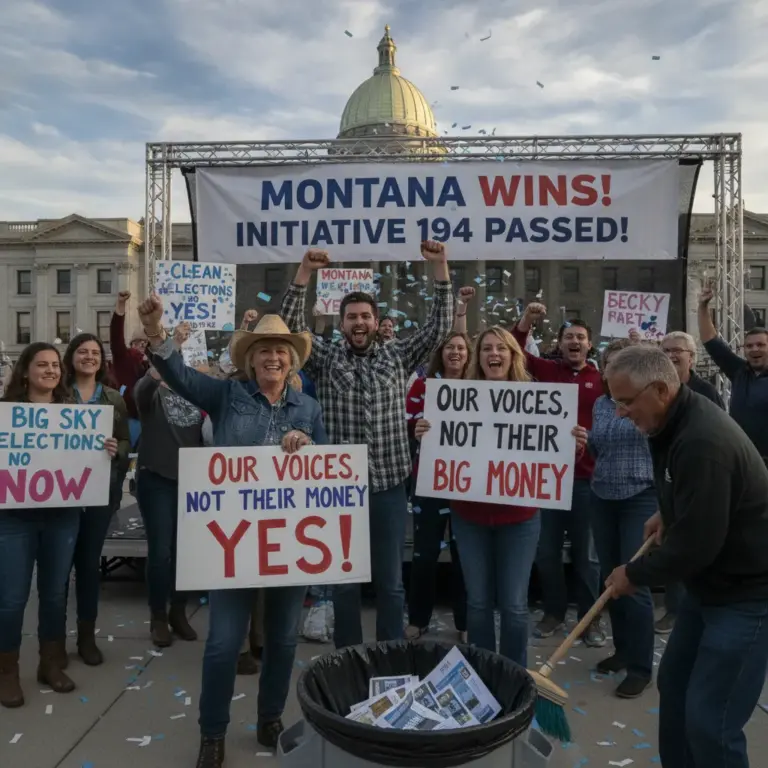
Montanans have sent a clear message about the role of big business in their elections, voting overwhelmingly to pass Initiative 194, better known as the Montana Plan. In a state that remains a stronghold for Republicans, roughly 65 percent of voters approved a daring new strategy designed to scrub corporate money from the political landscape. Rather than attempting to limit free speech, which has been largely protected since the Citizens United ruling, the plan targets the legal privileges granted to corporations by the state.

The mechanism of the law is straightforward yet aggressive. By stripping corporations, labor unions, and trade associations of their power to spend money on elections, Montana aims to eliminate corporate funded attack ads and bankrolled referendums. Companies that ignore these rules risk losing critical protections like limited liability, meaning shareholders could potentially be held personally responsible for corporate debts until any illegally spent funds are returned. This approach attempts to bypass previous court rulings by arguing that while corporations may have rights, those rights exist only because the state allows them to operate.

However, the victory comes with significant contradictions and looming obstacles. While intended to curb elite influence, the push for the Montana Plan was fueled by wealthy donors themselves, including figures linked to Walmart and LinkedIn fortunes. Furthermore, the law creates a distinct gap between institutional wealth and individual riches; billionaire donors can still pour unlimited personal sums into races, whereas their companies cannot. Critics argue this selectively silences smaller community organizations and local trade groups while leaving doors wide open for the ultra wealthy.

The battle now shifts toward a likely collision with the U.S. Supreme Court. Opponents claim the move is an unconstitutional attempt to circumvent established law by using business licenses as leverage against political expression. With over 30 other states exploring similar measures, Montana has become a primary testing ground for whether states can reclaim control over their democratic processes or if Citizens United remains an immovable wall in American politics.

The final tallies from the 2026 midterms offer a complicated lesson for the Democratic Party, suggesting that while progressive candidates can survive in competitive areas, they often struggle to maximize their appeal. High profile wins by figures like Michigan Senator elect Abdul El Sayed demonstrate that left leaning platforms can still secure victory under certain conditions. However, deeper analysis reveals a troubling gap between those winners and their more centrist colleagues, raising questions about whether the party’s shift toward the left is creating unnecessary vulnerabilities in swing districts.

The disparity was most glaring in Senate races where endorsements from Bernie Sanders seemed to correlate with lower performance margins. Candidates such as Maine Senator elect Troy Jackson and Florida’s Angie Nixon struggled significantly when measured against previous benchmarks set by Kamala Harris in 2024. While much of the party enjoyed wide cushions of success, these progressive stalwarts frequently lagged behind both the party average and their own state’s gubernatorial candidates, indicating that a far left platform may alienate critical blocks of undecided voters.

Conversely, moderate Democrats delivered some of the night’s most impressive over performances. Figures like North Carolina Senator elect Roy Cooper and Mississippi’s Scott Colom surged well beyond expected margins, proving that pro law enforcement and center seeking rhetoric continues to resonate deeply in purple territory. Even candidates with more liberal histories found greater success when they pivoted toward a moderate tone during the general election campaign, further highlighting a clear preference among swing voters for stability over systemic overhaul.

This pattern extended into the House races where membership in groups like the New Democrat Coalition or Blue Dog Democrats typically yielded stronger results than affiliation with the Congressional Progressive Caucus. Although some democratic socialist candidates fared well in deep blue strongholds, they faltered in truly contested regions. A poignant example occurred in Maine’s second district where a Sanders backed candidate lost a seat previously held by a moderate representative, turning what should have been a winnable area into a loss for the party. For Democratic strategists, the data suggests that while progressives provide energy to the base, moderates remain the safest bet for holding power across a diverse electoral map.

President Donald Trump has signaled a sharp turn toward his most ardent supporters by naming Stephen Miller as his new chief of staff. The move follows a bruising midterm election cycle in which Republicans suffered significant losses, surrendering control of both chambers of Congress to the Democrats. Miller, previously serving as deputy chief of staff and known as the primary architect of the administration’s aggressive deportation policies, replaces Susie Wiles, a seasoned operative with deep roots in the political establishment. According to White House sources, Wiles submitted her resignation on Thursday night before Trump announced the transition via Truth Social.

The appointment suggests that rather than moderating his approach after electoral setbacks, the president intends to double down on his MAGA base during his final two years in office. Allies describe Miller as a fierce executor who does not shy away from conflict and is prepared to aggressively shield the administration from congressional scrutiny. This sentiment was echoed by former aide Steve Bannon, who characterized Miller as someone capable of seizing immediate control of the White House operation. However, the choice has already ignited a firestorm among Democrats, with incoming Speaker Hakeem Jeffries calling Miller a dangerous extremist and demanding he be removed from government entirely.

This internal restructuring arrives amid a broader reflection on why the Republican coalition crumbled during the midterms. Analysis indicates that many of the independent and minority voters who supported Trump in 2024 felt betrayed by unmet promises regarding inflation and cost of living, leading them to swing back toward the Democratic party. While Democrats now hold a powerful mandate in Congress, analysts warn that neither party has achieved a permanent realignment. Instead, these results suggest an electorate increasingly exhausted by the status quo on both sides, leaving Republicans to sift through the wreckage of their defeat while Democrats struggle to manage their own internal divisions heading into 2028.

The atmosphere surrounding American politics has grown increasingly volatile following recent midterm results, shifting from heated rhetoric to physical confrontation. This trend was on full display during a recent Turning Point Action event in New Hampshire, where an encounter between attendees turned violent when a volunteer was reportedly slapped. The incident serves as a stark reminder that the ideological divide is spilling over into public spaces, creating an environment where civil discourse is becoming harder to maintain.

Appearing on Fox News at Night with Trace Gallagher, political commentator Joe Sweeny analyzed the fallout from the altercation and what it suggests about the current state of national tension. Sweeny noted that such outbursts are rarely isolated events but rather symptoms of a deeper hostility fueling both sides of the aisle. As supporters find themselves more entrenched in their positions, the threshold for conflict appears to be lowering, leading to unpredictable clashes at grassroots gatherings across the country.

Beyond the immediate violence in New Hampshire, Sweeny also addressed broader strategic warnings being issued to Democratic leadership. He touched upon comments made by sports and political personality Stephen A. Smith, who cautioned Democrats against leaning too heavily into aggressive investigations of their opponents. According to this perspective, doubling down on legal scrutiny could further alienate moderate voters and exacerbate the very volatility seen at local rallies, potentially pushing the electorate toward even greater polarization heading into future cycles.

Tesla is officially pulling the plug on the Cybertruck, bringing a quiet end to one of Elon Musk’s most polarizing ventures. What began as a futuristic promise of indestructible utility eventually devolved into a cautionary tale of overambition and engineering hurdles. From its inception, the vehicle was plagued by manufacturing struggles, as Musk pushed for an impossible level of precision that simply could not be replicated on a mass scale. This gap between the CEO’s vision and the actual product resulted in a truck defined more by panel gaps and recalls than by innovation.

The decline became apparent long before the final decision to cease production. While early hype suggested hundreds of thousands of units would fly off the lots, real world demand remained stagnant. Musk himself hinted at the failure late last year, admitting in a candid moment that the company had essentially dug its own grave with the project. Even strategic internal maneuvers, such as shifting large volumes of inventory to SpaceX, failed to mask the fact that consumers were largely uninterested in owning what many viewed as a rolling piece of conceptual art rather than a functional tool.

Beyond the technical failures, the Cybertruck became an unintentional symbol of Musk’s increasingly contentious public persona and political influence. As his visibility shifted from tech visionary to governmental disruptor, the truck’s jarring aesthetic served as a loud signal of ownership that many buyers found alienating. With public sentiment souring toward Musk’s broader ambitions, the desire to advertise those affiliations via a stainless steel pickup plummeted. For those still determined to own a piece of this metallic experiment, time is running out quickly as current stock disappears from showrooms forever.

The high stakes world of artificial intelligence experienced a dizzying roller coaster ride this week as major tech stocks began to recover on Friday following a massive sell off that erased trillions of dollars in market value. The Nasdaq Composite led the rebound, climbing roughly 1.7 percent by midday to recoup some of the heavy losses suffered during a volatile session on Thursday. This sudden instability was largely triggered by investor anxiety surrounding the Democrat victory in the U.S. midterm elections, with many fearing that new legislative control would lead to stricter regulations and a slowdown in AI development.

Industry giants felt the brunt of the initial panic, particularly chipmakers who provide the essential hardware for generative AI. Nvidia saw its valuation plummet by hundreds of billions on Thursday alone, though it managed to claw back much of that ground with a steady rise on Friday. Other sector players like AMD and Micron followed a similar pattern, swinging from double digit losses to sharp recoveries as buyers returned to the market. However, this optimism did not extend globally, as markets across Asia and Europe remained in the red, leaving international investors far less confident than their American counterparts.

Adding complexity to the mood on Wall Street were fresh employment figures showing that the U.S. economy remains surprisingly resilient despite political shifts_ Employers added 165,000 jobs in September, comfortably beating analyst expectations and pushing the unemployment rate down slightly to 4.1 percent. Some economists suggest these robust numbers indicate that while stock valuations may fluctuate based on policy fears, the underlying real economy is continuing to run hot regardless of regulatory headwinds facing Big Tech.

Despite the Friday recovery, experts warn that the long term trajectory for AI investments remains uncertain. Critics argue that tech companies have failed to communicate how their massive spending will translate into tangible public benefits, especially as local communities grapple with rising energy costs tied to sprawling new data centers. With President Donald Trump voicing his support for super intelligence against those calling for caution, analysts believe next week will be the true test of whether this current rally is a sustainable turnaround or merely a brief pause in a larger correction.