Archive

October 26, 2026

Browsing

Oil’s return above $100 a barrel has made airline investing a tougher proposition.

As of writing, US crude sits comfortably above $100 while Brent is hovering around $114 as Middle East supply concerns intensify.

For air carriers, the challenge extends beyond crude – jet fuel prices and the ability to recover costs through fares ultimately determine profitability.

Against the current backdrop, Delta Air Lines, Ryanair, and United Airlines remain worth owning heading into 2027. Here’s what makes these airline stocks attractive despite elevated oil prices.

Delta Air Lines: a refinery provides an unusual buffer

Delta Air Lines offers something most airline stocks cannot – a refinery business that can partially offset the cost of turning crude into aviation fuel.

Its December-quarter outlook incorporates a refinery benefit of about 40 cents per gallon, bringing projected all-in fuel costs to about $4.25.

That provides a tangible cushion when jet fuel becomes particularly expensive relative to crude.

The September quarter demonstrated resilience. DAL generated $1.72 in adjusted earnings a share and a 9.4% adjusted operating margin.

Management still projects roughly $2.5 billion in full-year free cash flow.

That combination makes Delta Air Lines stock a compelling pick – it has both an operating buffer and cash generation to support its finances through the squeeze.

However, the refinery cannot neutralize every increase. Delta reduced its annual adjusted earnings forecast to $5.10–$5.60 per share, underscoring that resilience still comes with pressure on profits.

United Airlines: customers are helping absorb the fuel shock

United Airlines earns its place through demonstrated sales strength across several customer groups.

Q3 revenue increased 17% to a record $17.9 billion, while revenue per available seat mile climbed 16%. Premium revenue rose 17%, contracted business revenue advanced 26%, and cargo revenue increased 23%.

Despite a 62% jump in fuel expense, United delivered adjusted earnings of $2.54 per share, within its guidance.

Those figures support the investment case: UAL has multiple sources of additional revenue to help absorb expensive fuel.

It offers more ways to recover costs than a carrier dependent mostly on filling seats with discounted tickets.

Its outlook also explicitly allows for substantial fuel pressure.

United Airlines projects Q4 adjusted earnings of $0.50–$1.50 per share while assuming fuel costs of approximately $4.80 per gallon.

That leaves it exposed to further increases, but demonstrates a path to profitability under demanding assumptions.

Ryanair: fuel hedges buy valuable breathing room

Ryanair provides the most direct near-term protection of these three picks through its fuel hedges.

The European budget carrier has reported roughly 80% of its jet fuel requirements hedged through March 2027 at around $67 per barrel.

It has also reduced its fiscal-year passenger target to 214 million from 216 million and plans broadly flat winter capacity, limiting exposure to costly unhedged fuel.

That combination is the attraction: contracted fuel protection and a willingness to sacrifice growth when additional flying becomes less attractive.

Against less-hedged competitors, Ryanair has more breathing room to protect profitability.

The investment case becomes harder after March. CEO Michael O’Leary said on October 20 that only 15% of the following year’s fuel costs were secured at $85 per barrel.

He expects sharply higher European fares as industry costs rise.

Investors should therefore treat Ryanair’s current hedge advantage as time to adapt, with future returns depending on pricing and capacity discipline.

The post These airline stocks remain worth owning despite $100 oil appeared first on Invezz

US stocks edged lower on Friday as investors remained cautious following a sharp sell-off in technology stocks, while rising oil prices and concerns about renewed conflict in the Middle East added to market uncertainty.

The S&P 500 fell 0.51%, while the Dow Jones Industrial Average dropped 536 points.

The Nasdaq Composite declined 0.41%, signalling further pressure on technology shares after the Nasdaq Composite lost nearly 3% on Thursday.

Telecommunications stocks also came under pressure after reports that SpaceX was in discussions with cellular infrastructure companies about launching a nationwide wireless carrier programme.

Meanwhile, rising crude prices renewed concerns about inflation ahead of next week’s Federal Reserve policy meeting.

Telecom stocks fall as SpaceX explores wireless expansion

AT&T, Verizon and T-Mobile fell between 2% and 4% in trading following reports of SpaceX’s potential expansion into the US wireless market.

The development raised concerns about increased competition for established telecommunications providers.

The news had the opposite effect on cell tower operators. Crown Castle shares rose 13.6%, while American Tower gained 6.99%.

Technology stocks remained under pressure after Thursday’s sell-off, when Meta Platforms fell nearly 8% following its quarterly results.

The company reported its first cash outflow in more than a decade, intensifying concerns about the financial impact of its artificial intelligence investments.

CoreWeave, which has faced scrutiny over its debt burden and the cost of financing AI infrastructure, declined another 1.46% in trading on Friday. Microsoft and Meta shares were also slightly lower.

The latest weakness followed a brief recovery on Wednesday, when upbeat results from SpaceX and Super Micro Computer helped lift AI-related shares.

Chipmakers Micron Technology and Advanced Micro Devices were showing modest gains.

Investors are also looking ahead to earnings from Microsoft, Alphabet and Amazon next week, with results expected to provide further insight into technology spending and demand for AI infrastructure.

Oil prices rise as Middle East risks fuel inflation concerns

Oil prices continued to climb on Friday as concerns about potential disruptions to Middle Eastern supplies supported crude markets.

US West Texas Intermediate futures rose 1.89% to $101.35 a barrel, while Brent crude gained 1.59% to $114.94.

The increases followed reports that the US and Israel were considering plans for renewed attacks on Iran amid the regional conflict that began in late February.

Higher energy prices added to inflation concerns ahead of the Federal Reserve’s meeting next week.

Markets broadly expect the central bank to leave interest rates unchanged, while expectations of a rate hike this month have declined following comments from officials suggesting there is little urgency to tighten policy.

The 10-year US Treasury yield rose one basis point to 4.968% on Friday after falling sharply in the previous session as investors sought the relative safety of government bonds.

The 30-year yield was flat, while the two-year yield declined two basis points.

Earnings outlook improves as investors assess market volatility

Despite the recent technology sell-off, forecasts for corporate earnings have strengthened.

Growth in third-quarter S&P 500 profits is now projected at 32.3%, up from the previous estimate of 30.7%, according to LSEG data.

Other movers included American Express, which fell 2.2% despite raising its 2026 profit forecast after reporting strong third-quarter results.

Oilfield services provider SLB gained 1.3% after beating analysts’ profit estimates.

Gold miner Newmont dropped 1.18% after reporting quarterly results and warning that unit costs were expected to rise in 2027.

Bloom Energy declined 10% despite raising its fiscal 2026 forecast.

For the week, the Nasdaq was on track to lose 0.5%, while the S&P 500 was heading for a gain of less than 0.1%.

The Dow was positioned for a 1.7% advance, supported by defensive sectors as investors sought to limit exposure to technology-market volatility.

The post Dow opens 500 points lower as oil prices rise and tech stocks face renewed pressure appeared first on Invezz

Western Digital WDC reported strong fiscal first-quarter results and issued an upbeat outlook as demand for hard disk drives (HDDs) continued to benefit from artificial intelligence infrastructure spending.

However, concerns about rising capital expenditure, potential increases in industry supply, and the sustainability of demand prompted mixed reactions from Wall Street analysts.

The company’s revenue rose 55% year over year to $4.38 billion, beating analyst expectations of $4.14 billion, while adjusted earnings per share reached $4.64, above consensus estimates.

Western Digital shares rose 1.06% on Friday.

The stock had more than doubled in value during the year through Thursday’s close, leaving investors to weigh the company’s strong operating performance against its valuation.

Analysts split over Western Digital’s valuation outlook

Morgan Stanley raised its price target on Western Digital to $668 from $643 and maintained an Overweight rating.

The firm described the results as a “strong, pricing-driven beat” and highlighted the company’s robust guidance for the December quarter.

However, Morgan Stanley also cautioned that “the market continues to be fickle”.

UBS took a more cautious stance, lowering its price target to $435 from $470 while retaining a Neutral rating.

The firm acknowledged strong results and demand constrained by supply but warned that higher capital expenditure, accelerating industry supply and uncertainty about demand beyond the current cycle could put further pressure on the stock’s valuation.

Citi maintained its Buy rating, saying the results reinforced its positive outlook for the HDD storage cycle.

However, it lowered its price target because of a reduced valuation multiple for comparable companies.

Goldman Sachs also flagged valuation risks.

The firm said the shares could trade modestly lower despite strong results and guidance above consensus, citing elevated near-term capital expenditure and the possibility of competitors increasing capacity.

AI infrastructure supports demand and pricing

Western Digital’s results reflect continued demand for data storage linked to the expansion of AI infrastructure.

Chief Executive Irving Tan told analysts on Thursday that demand for the company’s HDDs remained strong and was increasingly coming from customers outside its traditional base, including neocloud providers and AI frontier labs.

The company’s blended average selling price per terabyte of storage increased 28% during the first quarter, indicating stronger pricing alongside higher revenue.

Tan said the company’s visibility into demand was extending further.

He added that Western Digital had visibility through 2030 or 2031 across its seven largest customers.

The outlook suggests that demand could remain supportive over the coming years, although analysts differ on how much of that potential is already reflected in the share price.

Strong second-quarter guidance and higher dividend

Western Digital expects fiscal second-quarter revenue of $5 billion to $5.2 billion, representing approximately 69% year-over-year growth at the midpoint.

It forecasts an adjusted gross margin of 60% to 61% and adjusted earnings per share of $5.60 to $6.

The company reported first-quarter profit of $1.78 billion, or $4.63 per share, compared with $1.15 billion, or $3.07 per share, a year earlier.

Western Digital also increased its quarterly dividend by 17% to 17.5 cents per share. The dividend is payable on December 17 to shareholders of record as of December 4.

The strong results and outlook underline the benefits of rising storage demand, but concerns over investment spending, competitive supply, and valuation continue to divide analysts.

The post Western Digital stock rises as strong earnings offset capex and supply concerns appeared first on Invezz

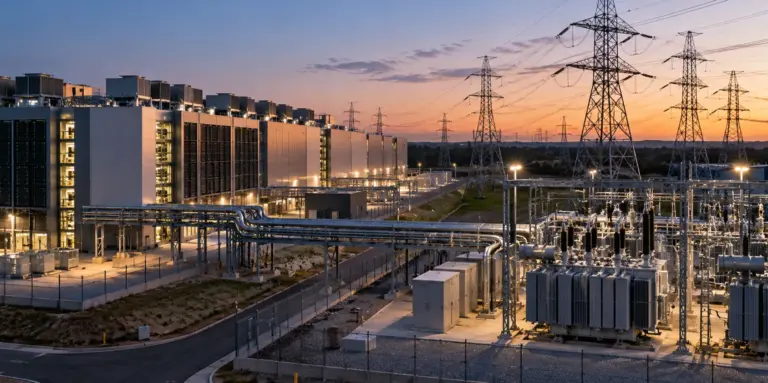
AI development is increasingly dependent on the physical infrastructure needed to power data centres, with electricity supply, grid connections and utility investment emerging as critical constraints on the industry’s expansion, according to Goldman Sachs.

While advances in AI models continue to drive demand for computing capacity, the infrastructure required to support that growth operates on a much longer timeline.

Transmission lines, substations, power generation facilities and data centres can take years to develop, potentially slowing the deployment of AI systems even as computing technology advances.

Goldman Sachs Research expects global data centre power demand to increase by 170% between 2025 and 2030, with more than 60% of the growth coming from the US.

However, supply-chain constraints, permitting requirements and limited grid capacity could moderate the pace of expansion.

“Power is probably the forever bottleneck,” said Jason Tofsky, global head of Digital Infrastructure Investment Banking at Goldman Sachs.

He noted that delivering a successful project requires coordination across numerous areas, including financing, over a period that can range from six months to two years.

AI growth depends on more than computing capacity

The AI industry requires substantial investment in computing hardware, data centres and power infrastructure.

Goldman Sachs estimates that aggregate AI capital expenditure could reach $7.6 trillion between 2026 and 2031 across these areas.

Financing this expansion will require substantial borrowing alongside other sources of capital.

Goldman Sachs Research projects that global hyperscaler debt issuance will reach $420 billion in 2027, more than 60% above its estimate for the 2026 financial year.

Hyperscalers, however, account for only around 40% of credit raised across the AI ecosystem, highlighting the broader financing requirements associated with the industry’s expansion.

These investments depend on more than the availability of capital.

Data centre developers must secure land, obtain regulatory approvals, source equipment, arrange electricity supply and complete construction before facilities can become operational.

The process creates multiple potential bottlenecks.

Delays in any one area can affect the entire project, regardless of how quickly AI models or computing hardware improve.

Grid capacity emerges as a critical constraint

The US electricity grid faces growing pressure as data centre developers seek access to large amounts of power.

One challenge is the volume of projects waiting to connect to the grid.

According to Goldman Sachs, the US interconnection queue contains roughly 2,600 gigawatts (GW) of generation and storage projects.

This is more than twice the installed capacity of the existing grid.

The size of the queue does not mean all proposed capacity will be built.

However, it illustrates the scale of demand competing for access to grid infrastructure.

The median time between submitting an interconnection application and reaching commercial operation is now approximately five years, with some projects taking longer.

Transmission infrastructure is another constraint.

Goldman Sachs Research data show that US construction of new high-voltage transmission lines declined from an annual average of 1,700 miles between 2010 and 2014 to just 350 miles between 2020 and 2023.

Equipment shortages can extend the timeline further.

Environmental reviews may take three to four years, while lead times for high-voltage substations and generation step-up transformers have stretched to roughly three to five years.

Utilities face rising investment requirements

The growing demand for electricity is changing the outlook for utilities, a sector traditionally associated with relatively low growth and defensive investment characteristics.

Goldman Sachs expects aggregate utility capital plans to reach $1.3 trillion between 2026 and 2030.

The projected spending reflects the need to expand infrastructure to accommodate rising electricity demand, including that generated by AI data centres.

Utilities must determine how to finance new generation capacity, transmission lines and substations while ensuring that infrastructure can support additional large-scale electricity consumers.

Hyperscalers and other large electricity users are increasingly considering arrangements in which they contribute directly to the cost of the generation and grid infrastructure required to serve their facilities.

These arrangements could help align investment in digital infrastructure with the capacity needed to supply it.

Tyler Miller, global co-head of Power, Utilities, and Infrastructure Investment Banking at Goldman Sachs, described the principle behind this approach as straightforward: “Growth enables growth.”

The idea is that investment in data centres can support additional investment in electricity infrastructure, provided that the costs and benefits are appropriately coordinated.

For utilities, the opportunity is accompanied by substantial execution and financing requirements.

Capital must be committed to projects that may take years to complete, while developers must manage equipment availability, regulatory approvals and uncertainty over the timing of future demand.

Behind-the-meter power offers an alternative

The constraints affecting grid connections have encouraged greater interest in alternative power arrangements, including behind-the-meter projects.

A grid-connected data centre must secure the necessary approvals to connect to the electricity network.

Behind-the-meter projects can avoid some of these grid constraints by arranging power supply outside the conventional grid connection process.

However, these projects do not eliminate the broader challenges associated with building power infrastructure. They may face air-permitting requirements and longer environmental reviews, depending on the project.

Goldman Sachs also identifies hybrid power arrangements and fuel cells as part of the changing mix of electricity sources supporting US data centres.

Its analysis of US data centre power demand indicates that grid-supplied electricity remains the dominant source, while behind-the-meter and fuel-cell power contribute increasing amounts in the later forecast years.

The relative appeal of these alternatives will depend on the constraints facing individual projects.

Avoiding some grid limitations does not remove the need to secure equipment, obtain permits, and finance construction.

For investors, the development of alternative power arrangements creates additional infrastructure opportunities.

Permitting and community opposition add to project risks

The expansion of data centres also depends on local regulatory decisions and community acceptance.

Large projects can place pressure on local infrastructure, including roads and public services.

Concerns about noise, emissions, water consumption, traffic and the potential effect on residential electricity bills can influence whether developments proceed as planned.

Goldman Sachs reported that, since January 2026, 86 projects had been cancelled or significantly delayed, with 76 directly linked to local opposition.

The figures show how community concerns can become a material constraint on infrastructure development, alongside grid capacity and equipment shortages.

The regulatory challenges also differ depending on how a project is structured.

Grid-connected facilities require regulatory approvals for their electricity connections, while behind-the-meter developments can face different permitting requirements.

Developers may improve their chances of progressing by addressing these issues early.

Goldman Sachs highlights the importance of credible community-benefit commitments and transparent plans for managing environmental impacts.

Skilled labour becomes another bottleneck

The AI infrastructure build-out also depends on the availability of workers capable of constructing and operating data centres and power facilities.

In some markets, competing projects are bidding up wages as developers seek to attract workers from a limited labour pool.

These shortages can disrupt projects even after developers have secured land, electricity arrangements and equipment.

The challenge extends across the infrastructure supply chain, from construction to the installation and maintenance of power systems.

Labour constraints could therefore add to project costs and delay the delivery of new capacity, affecting the timing of investment returns.

However, the expansion is also creating skilled, well-paying blue-collar jobs across the US.

This could broaden the economic benefits of AI infrastructure investment beyond technology companies and the digital economy.

Financing must adapt to longer project timelines

The growing complexity of AI infrastructure projects is increasing the need for financing arrangements that can accommodate different construction schedules and investment requirements.

Capital must be coordinated across land acquisition, development, power infrastructure, equipment procurement, construction and long-term operations.

These requirements bring together utilities, hyperscalers, infrastructure investors, private-credit providers, insurers and other long-term sources of capital.

Goldman Sachs’ projections for hyperscaler borrowing illustrate the scale of financing needed to support the industry’s expansion.

Yet access to funding alone does not guarantee that projects will be completed on schedule.

Delays in power connections, equipment deliveries, or regulatory approvals can push back the point at which infrastructure begins generating revenue.

Longer timelines can increase risk and widen the gap between projects that have secured electricity supplies and those still waiting for grid access.

The report also points to the possibility of a more measured investment cycle.

Although infrastructure constraints can delay growth, a slower build-out may allow demand to absorb new capacity over time, potentially reducing the risk of investing in assets that are not fully utilised.

Power availability could shape the AI race

The infrastructure constraints identified by Goldman Sachs suggest that the next phase of AI expansion will depend as much on the ability to coordinate physical systems as on technological progress.

AI models can improve over months, but expanding electricity generation, transmission capacity and equipment supply can take years.

This mismatch could result in a less linear build-out, with new capacity becoming available in stages as power infrastructure comes online.

The timing of these additions will matter for companies investing in data centres and computing capacity.

Projects with secured power may be better positioned to progress, while those awaiting grid connections could face extended delays.

The report also raises questions about whether markets with the ability to expand generation and grid capacity more quickly, such as China, could develop competitive advantages.

For utilities, the rising demand creates an opportunity to invest in infrastructure and support a growing digital economy.

For investors, however, the scale of the opportunity must be weighed against capital requirements, permitting risks, labour shortages and the time needed to deliver new capacity.

The post Why Goldman Sachs views Grid and Utilities as the key AI growth bottlenecks appeared first on Invezz


The debate over artificial intelligence has split the technology world into two camps that rarely seem to be describing the same technology.

On one side are those who warn that AI could pose an existential threat.

On the other are those who predict an era of unprecedented abundance and wealth.

For investors, businesses, and the public trying to make sense of it, the gap between the two can be overwhelming.

To better understand how to navigate this divide, we spoke with two experts who work with AI every day: Veni Dhir, Director of Corporate Venture Capital at ADP, and Ruchi Bhatia, Technical Product Marketing Manager at AWS.

Observe what AI can do now

Both the experts stressed paying attention to what AI can do now rather than worrying about what it can do in the future.

Veni Dhir said that while she has to price both the possibilities of existential threat and abundance, she was “not in the extinction camp as a base case.”

Dhir was speaking in her personal capacity as an investor and AI practitioner, and her views do not reflect those of her employer.

“The evidence that informs my view is deployment reality: AI systems are producing measurable productivity gains in specific domains — software development, customer support, document work — while hitting the same ceiling in the wild every time: edge cases, the need for human review, and the hardest last ten percent,” she added.

In her view, neither of the louder narratives is playing out on the schedule its supporters suggest.

“The abundance case is real but slower and more uneven than predicted; the extinction case rests on capability jumps that keep arriving later than the loudest forecasts said they would,” she said.

“I underwrite what I can observe in production, not timelines.”

Ruchi Bhatia also pointed out the distinction between present capability and future expectations.

“AI can already help people write code, summarize and research faster, and on some narrow tasks it matches or beats human performance.”

The expert pointed out that it doesn’t mean society is moving towards an “AI-powered utopia or mass unemployment in general. A lot of that debate jumps from what’s possible from a real capability point of view today to a large conclusion of what can happen 5 to 10 years from now.”

Why there is disagreement over AI’s long-term impact

The disagreement over AI’s long-term impact is not solely about what the technology can achieve.

It also reflects differing views on whether safety research, regulation, and governance can keep pace with its development, according to Veni Dhir.

She said experts can examine the same evaluations of AI systems and reach different conclusions because there are no reliable methods for predicting when broader capabilities will emerge.

However, Dhir argued that the divide also stems from differences in how people view institutions and their ability to manage technological risks.

“People who trust institutions see a manageable technology; people who don’t see a race to the bottom,” she said, describing the debate as a question of values that is often presented as a technical one.

Why AI capabilities do not automatically translate into economic gains

Ruchi Bhatia said the gap between an AI system demonstrating a capability and that capability being widely adopted is often overlooked when people assess the technology’s economic impact.

Adoption remains a significant hurdle, she said, noting that most organisations have not yet scaled AI beyond pilots.

Even when a system can perform a task effectively, businesses must consider whether they can afford to deploy it and whether it fits their operations.

“Running AI at scale still costs real money,” Bhatia said, pointing to the costs associated with running queries and generating text, images and videos.

“Cost also has to be weighed against quality, so there are trade-offs. Some industries have regulations that limit how freely AI can be used. Then there’s organizational change: are people ready for it? And is AI even needed for tasks that people already do well today?” she added.

Separate demonstrated results from forecasts and speculation

Bhatia said people assessing claims about AI should distinguish between 3 categories that include evidence of what has already happened, forecasts based on specific assumptions and speculation about possible future scenarios.

Evidence includes results from experiments, incidents within companies, labour-market data and productivity measurements.

For example, “a specific AI model outperforming another on a defined task,” the expert added.

She noted that forecasts, by contrast, depend on assumptions about how the technology might develop.

“If AI costs fall by a certain amount, adoption reaches a certain level and a share of tasks can be automated, what would the economic effect be?” she added.

Speculation goes further by exploring possible outcomes without presenting them as established predictions.

Bhatia said all three categories can be useful, but problems arise when they are presented with the same degree of certainty.

“The mistake is when these three get presented with the same level of certainty, and that’s when people get confused,” she said.

Headlines and benchmarks can distort perceptions of AI

Bhatia said headlines and benchmark results can contribute to misunderstandings about AI, particularly when strong performance on a specific test is interpreted as evidence that a system is ready for widespread use.

“A general model that performs well on healthcare overall may still struggle with a narrower, more specialized task that needs more domain-specific data. Strong benchmark results, even ones that beat human performance, don’t mean a model is ready for production,” Ruchi Bhatia added.

Bhatia said the gap between benchmark performance and practical application needs to be communicated more clearly, particularly as concerns about AI’s potential effects on jobs and society grow.

While public concern about technological change is understandable, she argued that people need more context about what AI systems can actually do and where their limitations remain.

The expert noted that the responsibility also lies with the people developing and deploying the technology to explain its capabilities and potential consequences, rather than allowing headline-driven narratives to dominate the discussion.

AI has the potential to improve a range of tasks, Bhatia said, but communicating how the technology could change existing processes is equally important.

How much of the AI debate is marketing?

Bhatia acknowledged that marketing plays a role in how AI capabilities and risks are presented, while arguing that claims made by companies can also be challenged and scrutinised.

“Claims can be challenged, and regulators have acted on false AI claims, so credible companies need evidence behind what they say,” Ruchi Bhatia said.

Veni Dhir said the safety warnings of AI models could be used to hype up the model’s capability.

“Safety warnings can function as a competitive moat (regulatory capture dressed as caution), and hype is how you raise the next round,” she said.

For investors and businesses, she recommended looking beyond public statements and examining what people are willing to stake their capital and careers on.

“When the people warning about risks are simultaneously raising billions to build the thing, take the warning seriously but discount the framing,” Dhir said.

She added that credible signals include predictions that can be tested against specific dates and statements that run counter to a person’s own commercial interests.

The post AI doom or AI abundance? Two tech insiders on how to tell evidence from hype appeared first on Invezz

The traditional allure of gold is finding a second life in the digital age, according to a comprehensive new study conducted by the World Gold Council and Boston Consulting Group. Researchers suggest that the shift toward digital gold could spark an incredible surge in demand, potentially adding up to 700 billion dollars to the market as accessibility increases and consumer trust grows. While the current market is estimated to be worth between 45 billion and 55 billion dollars, there is significant room for expansion if the industry can successfully bridge the gap between physical bullion and virtual portfolios.

Much of this projected growth is expected to come from a demographic that has historically avoided precious metals. The data reveals that about 65 percent of this potential demand stems from individuals who do not currently own any gold, with younger investors leading the charge. In particular, awareness of digital gold options is far more prevalent among adults aged 25 to 34 compared to those over 55. This suggests that intuitive digital platforms are turning gold into an entry point for a new generation of savers rather than just a legacy asset for veteran investors.

However, scaling this opportunity requires more than just appetite from buyers. David Tait, CEO of the World Gold Council, emphasizes that robust infrastructure and standardized regulations are essential to ensure investors feel secure in their purchases. He argues that while shared systems are being developed to help issuers launch compliant products more efficiently, true liquidity depends on the entire industry adhering to uniform standards. Without these safeguards, the leap from curiosity to widespread adoption may remain stalled.

Despite these hurdles, early indicators show promising momentum for tokenized versions of the metal. These assets have seen their value quintuple recently, with trading volumes hitting record highs in early 2026. Urs Rahne of BCG believes that gold’s inherent physical nature actually makes it one of the most credible candidates for digitization. By blending timeless stability with modern convenience, proponents believe gold can evolve into a cornerstone of the global digital asset landscape.

Eli Lilly is doubling down on its integration of artificial intelligence with a new strategic partnership aimed at revolutionizing how drugs are delivered within the human body. Through a high stakes deal with Hong Kong listed METiS TechBio, the pharmaceutical giant hopes to refine the use of lipid nanoparticles, which act as microscopic vehicles transporting medicine to specific cells and tissues. If the collaboration hits its marks, METiS could receive up to 1.1 billion dollars in milestone payments.

The core of the project relies on a proprietary AI platform called AiLNP developed by METiS. By utilizing generative and predictive algorithms, the team aims to optimize ionizable lipids to ensure that therapeutic payloads reach their intended destinations more accurately and efficiently. While neither company has specified which exact diseases they are targeting first, leadership at METiS suggests that improving tissue specificity is essential for the next generation of complex medical treatments.

This move is part of a much broader trend for Eli Lilly, which has been aggressively building an AI ecosystem to accelerate drug discovery. Earlier this year, the company signed another major agreement with Insilico Medicine to leverage automated platforms for creating novel oral therapeutics. This pattern shows a clear shift toward tech bio, where traditional chemistry is augmented by machine learning to reduce trial and error in the lab.

Beyond these partnerships, Lilly is investing heavily in its own hardware infrastructure to maintain a competitive edge. The company recently deployed a massive supercomputing system powered by Nvidia GPUs, creating what has been described as one of the most powerful private AI factories in the pharma world. Between these internal tools and external collaborations, Lilly is positioning itself at the intersection of big data and biology to fundamentally change how patient care is developed.

For years, the Republican strategy has relied heavily on a strong coalition of voters without college degrees, a demographic shift that has historically hampered Democrats in presidential contests. However, as the upcoming midterms approach, this educational divide may actually become a liability for the GOP. History shows that college-educated voters typically make up a larger portion of the electorate during midterm cycles than they do in general presidential elections. With President Trump’s approval ratings plummeting among these high-education voters, this predictable shift in turnout could provide Democrats with a critical advantage in otherwise competitive races.

This potential swing is amplified by a growing sense of disillusionment within Trump’s own base. While he once held an iron grip on white working-class voters, signs of erosion are appearing among rural residents and those without degrees who are frustrated by inflation and foreign policy decisions. If these traditionally reliable Republican supporters stay home while alienated college graduates turn out in droves, the result could move beyond a simple blue wave and evolve into something far more disruptive for the current administration.

The current political landscape represents the climax of a long-term realignment known as class inversion. For much of the twentieth century, Democrats were seen as the party of the working class, but that bond fractured during the civil rights era of the sixties. Since then, Republicans successfully courted blue-collar voters through cultural issues like gun rights and immigration, while Democrats gradually became more popular among professionals and academics. Donald Trump accelerated this trend to unprecedented levels, securing massive shares of non-college voters across various ethnic groups while facing stiff resistance fromThose with university degrees.

Now, that very polarization creates a precarious situation for Republicans in heartland states like Michigan, Ohio, and Iowa. To avoid significant losses in Senate races and House districts, the GOP must mobilize its non-college base to override the inherent midterm tilt toward educated voters. As polling indicates a staggering gap in approval ratings between different education levels, the ultimate outcome depends on whether disillusioned workers decide to hold their noses and vote or simply opt out of the process entirely.

Democratic state Representative Gina Hinojosa is banking on a growing sense of political exhaustion to propel her toward the governor’s mansion. Speaking on Face the Nation, the former civil rights lawyer argued that Texans are feeling a profound level of disappointment with both major political parties, creating an opening for a post-partisan approach to leadership. With Governor Greg Abbott currently holding a narrow lead in recent polling, Hinojosa believes that breaking away from traditional party lines is the only viable strategy to win over a diverse electorate in a reliably red state.

Rather than sticking to a standard Democratic platform, Hinojosa describes her vision as populist, focusing on issues she claims unite voters across the ideological spectrum. She specifically highlighted shared frustration over the state of public education and rising insurance premiums as catalysts for her campaign. By framing her goals around basic needs like healthcare access for children rather than partisan talking points, she hopes to build a coalition broad enough to overcome Texas’s Republican registration advantage.

One area where Hinojosa sees surprising common ground is in the pushback against expanding data centers in rural corridors. She noted that even those aligned with the MAGA movement are concerned about how these facilities impact local water supplies, electricity costs, and property rights. According to Hinojosa, rural Texans often feel exploited by these developments and are seeking a leader who will ensure they actually have a seat at the table when corporate deals are struck.

As the election draws near, Hinojosa is also ramping up pressure on Governor Abbott regarding his ties to billionaire Elon Musk. The candidate recently filed a lawsuit to uncover emails between the two men, citing the millions of dollars Musk has poured into Abbott’s campaigns as a reason for public transparency. Despite the uphill battle typical of any Democrat running statewide in Texas, Hinojosa remains optimistic, pointing to high voter enthusiasm and turnout numbers as signs that her message of systemic change is resonating.

In a stunning reversal of fortune, British Columbia has entered a new political era following a snap election that saw the Conservative Party sweep to power for the first time in nearly a century. At the center of this upheaval is Lorne Doerkson, a relative outsider whose path to the premiership was anything but planned. A former newspaper publisher and rodeo announcer, Doerkson found himself thrust into leadership under bizarre circumstances, learning during a flight home from South Africa last month that his colleagues wanted him to lead the party.

The road to victory began with a high stakes gamble by outgoing Premier David Eby. Hoping to capitalize on internal chaos within the Conservative ranks and secure a stronger mandate for his New Democratic Party, Eby called an election two years ahead of schedule. He argued that the province needed a firm shield against external economic pressures and volatile political trends. However, the strategy spectacularly backfired, turning what was meant to be a consolidation of power into one of the most significant political shakeups in decades.

While Eby’s NDP suffered heavy losses, Doerkson led his party to a commanding majority, securing 64 of the 93 available seats. In his victory speech on Saturday night, Doerkson spoke about the trailblazing spirit of British Columbians and their desire for a government that supports rather than hinders growth. He wasted no time outlining an aggressive agenda focused on deregulation, promising to slash red tape around mining and forestry permits while aiming to triple natural gas production over the next decade.

As David Eby stepped down as leader of the NDP and accepted full responsibility for the defeat, Canada finds itself facing broader shifts in regional governance. This result follows similar volatility in Quebec, suggesting a growing appetite across provinces for systemic change. For Doerkson, however, the focus remains local as he transitions from an accidental leader to the man tasked with steering B.C.’s economy through an uncertain future.