
Archive

October 22, 2026

Browsing

SpaceX shares SPCX surged 7% on Wednesday after the aerospace and artificial intelligence company reported stronger-than-expected third-quarter results and issued an upbeat revenue forecast, lifting sentiment across chipmakers and data-centre infrastructure suppliers.

Investors welcomed accelerating demand for AI computing, although analysts cautioned that financing, power availability and execution risks remain.

SpaceX stock jumps after earnings beat and upbeat forecast

SpaceX shares rose 7% to $159.13 in trading, following the company’s third-quarter results released on Tuesday evening.

Revenue increased 161% year over year to $14.58 billion, exceeding Wall Street’s estimate of $12.9 billion, according to LSEG data cited in the report.

The company reported net income of $4.4 billion, around $3 billion above analysts’ expectations and a turnaround from a net loss a year earlier.

It also forecast first-quarter 2027 revenue of $33 billion to $37 billion, well above the $22 billion analysts tracked by FactSet expected.

The company’s Super Intelligence division, which includes its AI computing business, generated $7.6 billion in revenue, up approximately 830% year over year.

It accounted for more than half of quarterly sales for the first time, overtaking Starlink’s connectivity business.

SpaceX rents computing capacity to AI developers, allowing customers to access its data-centre infrastructure.

The results offered investors evidence that demand for computing power is translating into substantial revenue.

Chief executive Elon Musk said the company was facing a potential shortage of AI computing capacity.

“I think we’re going to face a shortage of Super Intelligence compute. And that shortage is going to remain for a long time,” Musk said.

He added that SpaceX could rent out its computing resources several times over if it accepted every customer request.

AI stocks gain as SpaceX outlines expansion plans

SpaceX’s results helped lift shares across the AI supply chain. Micron Technology gained around 2.5%, while Nvidia rose approximately 2.2%. Intel also advanced, and power and infrastructure suppliers GE Vernova, Bloom Energy, Vertiv and Eaton posted gains.

Melius Research analyst Ben Reitzes described the earnings call as positive for chip stocks, writing, “Good night for AI bulls, hope it lasts.”

William Blair analyst Louie DiPalma said the AI boom was well suited to SpaceX’s business model.

RBC Capital Markets analysts, led by Ken Herbert, identified the Super Intelligence division as the standout performer in the quarter.

SpaceX ended the third quarter with 1.7 gigawatts of AI computing capacity.

Musk outlined plans to increase that to 3 gigawatts by year-end and potentially reach between 13 gigawatts and 20 gigawatts by the end of 2027.

The company also expects infrastructure spending to rise sharply.

It plans to spend between $35 billion and $40 billion in the December quarter, compared with $19.6 billion in the third quarter.

SpaceX said it was on track to reach an annual recurring revenue run rate of $100 billion by December.

Musk suggested that figure could reach between $500 billion and $1 trillion by the end of 2027, supported by adoption of Grok Bot.

Analysts raise price targets but flag financing risks

Several analysts raised their price targets following the results.

Cantor Fitzgerald increased its target to $345 from $246 and named SpaceX its top coverage pick, while Citi raised its target to $240 from $200.

JPMorgan lifted its target to $500 from $240, an increase of approximately 108%.

The average analyst price target rose to $244, according to FactSet.

However, Morgan Stanley analysts, led by Adam Jonas, said they were taking a conservative approach to their 2027 projections because of uncertainty around power availability, execution, and financing. Their model assumes AI computing capacity of 8.3 gigawatts by the end of 2027.

KeyBanc analyst Michael Leshock also highlighted SpaceX’s substantial AI spending and the need for external financing in the coming years.

The results strengthened the case for AI infrastructure demand, but investors will continue to monitor whether SpaceX can deliver its ambitious capacity expansion while funding its investment plans.

The post SpaceX stock soars, raising the AI trade: how high can it go? appeared first on Invezz
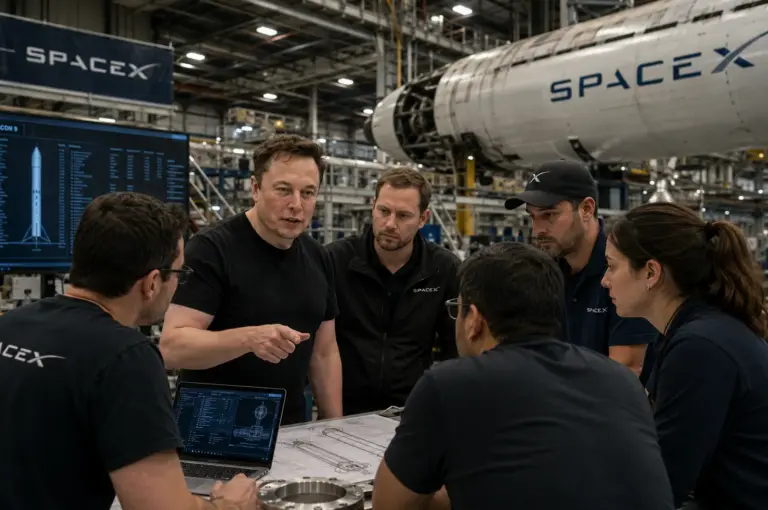
SpaceX shares climbed in trading after the company reported a 161% annual revenue increase, led by its artificial intelligence business and Starlink.

Oil prices were little changed as traders weighed possible progress in Russia-Ukraine peace talks against Middle East supply risks and declining US crude inventories.

Gold prices edged higher as falling Treasury yields supported the metal ahead of the Federal Reserve’s October policy meeting.

Netflix shares declined despite beating third-quarter earnings estimates, as a weaker revenue forecast and concerns about viewer engagement weighed on sentiment.

SpaceX stock: AI revenue drives earnings growth

SpaceX reported third-quarter revenue of $14.58 billion, up 161% year over year and above analysts’ expectations of $12.72 billion, according to LSEG data.

Net profit reached $4.4 billion, compared with a loss of $1.05 billion a year earlier, while operating income was $2.8 billion.

Its AI division, now called Super Intelligence, generated $7.6 billion in revenue, an 830% increase from a year earlier, surpassing Starlink for the first time.

Starlink revenue rose 69% to $5.2 billion, with its subscriber base reaching 13.6 million.

SpaceX primarily generates AI revenue by renting data-centre computing capacity to developers, including Anthropic, Google and Reflection AI.

Oil price: supply risks offset potential peace progress

Brent crude futures rose 1.09% to $109.95 a barrel, while US West Texas Intermediate was up 0.18% to $97.98.

Both benchmarks had gained as much as $2 earlier in the session.

Prices faced competing pressures as Russian President Vladimir Putin agreed to resume US-mediated peace talks with Ukraine, potentially easing concerns about diesel supplies.

However, continuing attacks on vessels and the lack of dialogue between Washington and Tehran kept supply risks in focus.

US crude inventories fell by 3.06 million barrels to 412.5 million last week, exceeding expectations for a decline of 820,000 barrels.

Distillate inventories, however, increased by 1.68 million barrels to 104.3 million, contrary to forecasts for a drop.

Gold price falls

Spot gold fell 0.06% to $4,121.98 an ounce. US gold futures settled 0.14% lower at $4,136.4.

The US 10-year Treasury yield fell for a second consecutive session, reducing the opportunity cost of holding non-yielding gold.

Investors are watching the Federal Reserve’s October 27-28 meeting and the upcoming personal consumption expenditures inflation report.

Markets were pricing in an 88% probability of a rate increase in December, according to CME FedWatch.

“I think gold prices will be range-bound for the time being. But I think the bias remains to the downside,” Zaner Metals vice president and senior metals strategist Peter Grant said in a Reuters report.

Netflix stock: Growth concerns persist after earnings beat

Netflix shares fell 4.79% on Wednesday despite adjusted earnings of 87 cents per share, above estimates of 82 cents. Revenue reached $12.9 billion, matching expectations, but its fourth-quarter revenue forecast of $13.4 billion fell short of the $13.5 billion consensus.

Shares have declined 27% in 2026 amid concerns about slowing growth, competition, and viewer engagement.

Analysts remain divided.

Morningstar maintained an $80 price target and highlighted advertising expansion as a potential growth driver.

Needham downgraded Netflix to Hold from Buy, expecting revenue growth to slow to single digits in 2027.

JPMorgan maintained an Overweight rating, while Bank of America pointed to Netflix’s subscriber base of more than 300 million and potential for margin expansion.

Investors will continue to assess whether advertising growth and content investments can offset intensifying competition.

The post Evening digest: SpaceX surges, oil steady, gold falls appeared first on Invezz

Meta Platforms (META) shares are extending gains in after-hours trading on Wednesday after its third-quarter revenue beat expectations, giving investors fresh confidence in its ads business.

But the October 21st report, brought more than an earnings update: the titan tightened its massive spending forecast and unveiled nonvoting shares.

A separate $25 billion New Mexico court judgment added another financial complication.

Investors now face a sharper question: how much of Meta Platforms’ growth will ultimately reach shareholders?

Strong sales and guidance drive Meta stock higher

META generated Q3 revenue of $64.60 billion, up 26% year-over-year and above expectations of about $63.3 billion.

Advertising contributed $63.06 billion, underscoring the durability of its core business.

Fourth-quarter revenue guidance of $73 billion to $76 billion puts the midpoint at $74.5 billion, ahead of the $73.57 billion consensus cited by Investing.com.

Reported earnings require more care. Diluted EPS was $3.83, including a $9.89 billion charge for August’s teen mental-health litigation settlement. META said EPS would have been $7.40 without that charge.

The distinction helps investors assess operating performance, although excluding the expense does not erase its economic cost. The results offer evidence that advertising remains resilient while Meta pursues its much broader AI ambitions.

Bigger spending commitments meet $25 billion legal threat

Meta lifted the bottom of its 2026 capital expenditure forecast to $135 billion from $130 billion – keeping the ceiling at $145 billion.

The cash demands are already visible: quarterly operating cash flow of $32.79 billion fell short of $34.91 billion in capital expenditures, producing negative free cash flow of $2.12 billion.

For shareholders, rising sales are therefore accompanied by substantial reinvestment requirements.

Separately, a New Mexico judge imposed a $25 billion penalty on Meta Platforms Inc following a “privacy case” linked to Cambridge Analytica.

This judgment is distinct from Q3’s settlement charge. Investors must consider potential payment obligations alongside infrastructure spending – while recognizing that an appeal could change the outcome and timing.

New shares and what they mean for the investment case

Meta’s proposed nonvoting Class C stock adds another consideration.

The company intends to establish the class effective January 19, 2027, and distribute one Class C share for every outstanding Class A and Class B share.

Record and payment dates remain undetermined.

Meta expects the distribution to have the market-price effect of a two-for-one split without changing existing shareholders’ voting power.

That distribution alone creates no additional business value.

The consequential issue is how Meta subsequently uses the shares: capital raising, employee compensation, and acquisitions could expand its resources while diluting existing owners’ economic stakes.

The structure also helps preserve Zuckerberg’s voting control.

Investors should judge future transactions by their contribution to value per share.

Greater financing flexibility can support growth, but the returns earned on that capital will determine whether Meta stock investors benefit.

The post Meta stock jumps on earnings – but $25B penalty raises stakes appeared first on Invezz

Tesla reported better-than-expected adjusted earnings for the third quarter on Wednesday.

A rebound in vehicle deliveries and growth in energy storage supported sales, while spending on artificial intelligence, robotics and autonomous driving remained a focus for investors.

The electric vehicle maker reported revenue of $28.05 billion for the three months ended September 30, compared with analysts’ average estimate of $27.88 billion, according to LSEG data.

Revenue was $28.10 billion in the same quarter a year earlier.

Adjusted earnings per share came in at 48 cents, surpassing analysts’ estimate of 43 cents.

Tesla shares TSLA rose around 2% in extended trading following the results.

Tesla deliveries rebound as automotive business faces competition

Tesla delivered 486,532 vehicles in the third quarter, exceeding Wall Street expectations of approximately 461,100.

However, deliveries declined about 2% from a year earlier.

Production reached 464,391 vehicles, meaning deliveries exceeded output by more than 22,000 units for a second consecutive quarter, contributing to an inventory drawdown.

The Model 3 and Model Y accounted for nearly all deliveries.

Other models, including the Cybertruck, accounted for 8,295 deliveries, down from 12,364 in the second quarter.

Tesla has discontinued production of the Model S and Model X at its Fremont facility as it prepares to replace their production lines with its first large-scale Optimus humanoid robot production line.

The company’s core automotive business faces increasing competition from rivals introducing newer and often cheaper electric vehicles.

Tesla has responded by offering lower-priced versions of the Model 3 and Model Y and launching a six-seat Model Y in the United States in July.

Cash flow beats expectations as AI spending remains in focus

Tesla reported capital expenditure of $4.73 billion in the third quarter, below expectations of approximately $7.5 billion.

The figure was down from $5.79 billion in the previous quarter but above the $2.25 billion reported a year earlier.

Free cash flow reached $1.53 billion, compared with analysts’ expectations for a cash outflow of $4.92 billion.

The figures offer some relief as investors assess Tesla’s plans to increase investment in artificial intelligence, robotics and autonomous driving.

The company had targeted capital expenditure of $25 billion this year and arranged $30 billion in loans and credit lines to support its growth plans.

Tesla’s energy storage business has also become an increasingly important contributor, benefiting from demand for grid-scale batteries from renewable energy developers and data centres.

However, the company has warned that the current tariff regime will have a greater impact on its energy business than on its automotive operations.

Potential SpaceX merger adds another dimension to Tesla’s outlook

Tesla’s earnings arrived as investors assess the possibility of a combination with SpaceX, Musk’s rocket and space technology company.

Musk confirmed that the two companies had formed special committees to explore a potential merger.

However, he said no agreement had been reached and warned that a deal might not materialise, as it would require approval from a majority of Tesla shareholders.

Tesla’s earnings release did not provide further details about the discussions.

Meanwhile, the company is expanding its autonomous driving operations.

Tesla said earlier this month that its Cybercab fleet in Austin had grown from fewer than 40 vehicles to more than 300 in about a month, with Dallas identified as the next location for expansion.

Tesla has also launched unsupervised robotaxi rides in Miami, Orlando and Tampa, following launches in Dallas and Houston.

Tesla shares have fallen about 14% this year. Despite the decline, the company remains the world’s most valuable automaker, with a market capitalisation of approximately $1.4 trillion.

The post Tesla stock rises as profit rises despite AI spending appeared first on Invezz

Wall Street closed higher on Wednesday as quarterly results from SpaceX and Super Micro Computer helped revive investor appetite for artificial intelligence-related stocks, while disappointing guidance from Netflix weighed on its shares.

The tech-heavy Nasdaq Composite gained 1.05% to 26,702.86. The S&P 500 rose 0.58% to 7,757.22, while the Dow Jones Industrial Average advanced 0.69% to 52,856.09.

The gains came as investors assessed fresh evidence of demand for AI infrastructure amid concerns about the sustainability of heavy spending on data centres and computing capacity.

Results from SpaceX and Super Micro provided some reassurance that demand across the AI ecosystem remained resilient.

SpaceX surges as revenue growth and merger developments lift sentiment

SpaceX shares climbed 7% after the rocket and space technology company reported a 161% increase in third-quarter revenue.

The company also recorded its first profit as a publicly traded business.

Chief Executive Elon Musk said SpaceX and Tesla had established special committees to discuss a potential merger.

His comments helped lift Tesla shares by approximately 3.4% ahead of the electric vehicle manufacturer’s quarterly earnings report, scheduled for after the market close.

SpaceX’s artificial intelligence business expanded ninefold, adding to investor interest in companies linked to the technology.

The results helped reinforce expectations that demand for AI-related infrastructure could continue to support growth across the sector.

The broader technology sector benefited from the improved sentiment.

The S&P 500 information technology sector gained 1.65%, while the Philadelphia Semiconductor Index advanced 1.96%, recovering some ground after a prolonged period of losses.

Advanced Micro Devices rose almost 4%, while Nvidia gained more than 2%.

Micron Technology and Marvell Technology also advanced by more than 1.7%, and the VanEck Semiconductor ETF increased 1.89%.

Super Micro forecast supports AI infrastructure stocks

Super Micro Computer was among the S&P 500’s strongest performers, with its shares rising more than 9% after the AI server maker issued an upbeat outlook.

The company forecast quarterly revenue and profit margins above Wall Street expectations, signalling continued demand for AI servers and related infrastructure.

Its results also supported gains among other hardware manufacturers, with Hewlett Packard Enterprise rising 3.7% and Dell Technologies gaining 5.2%.

The rebound followed a difficult period for AI-linked stocks, which faced selling pressure last week as investors questioned whether companies could generate sufficient returns from their substantial infrastructure investments.

Concerns intensified around debt-financed AI expansion, particularly among data centre operators such as CoreWeave.

Investors have increasingly focused on borrowing costs, capital requirements and whether future demand will justify current spending levels.

Wednesday’s gains suggested that stronger corporate results could help stabilise sentiment, although questions about the long-term profitability of AI investments remain relevant.

Netflix falls as forecast disappoints investors

Not all technology stocks participated in the rally.

Netflix shares fell 5.3% after the streaming company issued a weaker-than-expected fourth-quarter profit forecast. Its full-year revenue outlook also disappointed investors, and the company lowered its advertising revenue guidance for the year.

Alphabet shares declined 1.6%, while the S&P 500’s communication services sector fell 1.19%.

AT&T dropped 6.4% despite beating third-quarter revenue and profit expectations and raising its annual profit forecast.

Elsewhere, Abbott Laboratories fell 2.1% after lowering its 2026 sales growth forecast, citing weakness in its medical device business.

The latest results have offered support to AI-related shares, but investors remain focused on whether strong demand can translate into sustainable profits.

The post Nasdaq closes 1% higher as AI stocks rebound on strong earnings appeared first on Invezz

Hudbay Minerals and Mitsubishi have officially given the green light to move forward with the construction of Copper World, a massive new mining operation located just outside Tucson, Arizona. The announcement follows a detailed feasibility study that positions the site as a cornerstone for future domestic metal production. Under the terms of their partnership, Hudbay maintains a seventy percent stake in the project while Mitsubishi holds thirty percent, with both companies aiming to bring the mine into full production by the latter half of 2029.

The scale of the project is ambitious, with projections suggesting an average annual output of 102,000 metric tons of copper during its first decade. This figure represents a significant increase over previous estimates and underscores the strategic importance of the region. For Hudbay specifically, the activation of Copper World combined with other regional growth initiatives is expected to double its total consolidated copper production to roughly 250,000 metric tons per year.

Financial architects behind the deal highlighted a disciplined approach to funding that limits immediate risk. Eugene Lei, Hudbay’s president and CFO, noted that a clever capital allocation strategy allows the company to fund only twenty five percent of the initial costs, with primary contributions deferred until 2028. Beyond the initial ten year window, there is potential to extend the mine’s lifespan up to thirty seven years through further expansion onto federal lands, provided necessary permits are secured.

This development is part of a broader effort by Hudbay to dominate the American Southwest’s mineral landscape. By combining this venture with its acquisition of Arizona Sonoran Copper Company and the associated Cactus project, Hudbay intends to establish what it describes as one of North America’s largest copper districts. Executives from both firms emphasized that securing these critical minerals within U.S. borders is essential for long term industrial stability and corporate growth.

The Canadian and Ontario governments have unveiled a massive two billion dollar investment aimed at unlocking the vast potential of the Ring of Fire. During a joint appearance on Wednesday, Prime Minister Mark Carney and Premier Doug Ford announced that the federal government will match Ontario’s own one billion dollar contribution over the next three years. This capital is specifically earmarked for essential road infrastructure, which is necessary to access some of the most strategic mineral deposits in North America.

This ambitious push is about more than just paving roads; it is a calculated move to insulate the domestic economy from volatile US trade measures and tariffs. By strengthening the supply chain for critical minerals like nickel, copper, and platinum, officials hope to secure Canada’s place in the global shift toward electric vehicles and advanced manufacturing. Prime Minister Carney emphasized that these investments are designed to protect current jobs while building a more independent and resilient economic future from the mine to the assembly line.

To ensure these projects don’t get bogged down in bureaucracy, the two levels of government are introducing a streamlined permitting process to speed up approvals. Beyond the immediate funding, they are identifying priority projects that can tap into existing federal accelerators and tax credits. A dedicated working group will also be tasked with engaging First Nations communities, ensuring that development includes local economic opportunities and respects environmental conservation goals through Indigenous protected areas.

Located deep in Northern Ontario, far beyond Thunder Bay, the Ring of Fire represents an enormous economic opportunity. Provincial estimates suggest that fully developing this remote region could spark twenty-two billion dollars in economic activity and create upwards of seventy thousand jobs over three decades. Combined with previous initiatives like the five hundred million dollar Critical Minerals Processing Fund, this latest agreement signals a determined effort by Premier Ford and his partners to keep as much value as possible within provincial borders.

Justice Elena Kagan issued a stinging critique of her colleagues on Tuesday, arguing that the Supreme Court’s conservative majority has fundamentally damaged American democracy. Speaking at Catholic University’s law school in Washington, D.C., the liberal justice suggested that the court has become blind to the real world consequences of its legal interpretations, creating a dysfunctional political landscape where citizens lose their voice.

A central point of contention for Kagan is the court’s approach to redistricting and voter protection. She pointed specifically to a 2019 decision that stripped federal courts of the power to stop extreme partisan gerrymandering, claiming it sparked a race to the bottom between both political parties. By drawing maps that eliminate competitive districts, Kagan argued that politicians are now more concerned with satisfying their ideological fringes than appealing to moderate voters, which further polarizes an already divided nation.

Beyond mapping disputes, Kagan lamented what she described as the evisceration of the 1965 Voting Rights Act and the removal of campaign finance limits. She noted that many Americans view the influx of massive sums of money into elections as a nightmare, while simultaneously worrying about the erosion of protections for minority voters. This trend, she warned, risks leaving the public feeling disconnected from a system that no longer ensures voting equality.

Despite her sharp criticisms regarding executive power and judicial philosophy, Kagan stopped short of calling the court a mere puppet for any single politician. While acknowledging that the current bench is deeply conservative and cautioned against granting presidents too much authority over independent agencies, she reminded listeners that the court has occasionally pushed back against presidential overreach in various tariff disputes. Regardless, her overarching message remained clear: when laws ignore practical outcomes, democracy suffers.

Supreme Court Justice Elena Kagan delivered a blistering critique of her conservative colleagues this week, suggesting that recent judicial trends have pushed the American political system toward a state of dysfunction. Speaking at a discussion hosted by Catholic University’s law school in Washington DC, Kagan argued that the court’s current majority has ignored the damaging real world consequences of its rulings on campaign finance and redistricting. She contended that the legal framework currently being established has resulted in a version of democracy that simply does not function as it should.

A primary point of contention for Kagan is the court’s refusal to police partisan gerrymandering, a stance solidified in 2019. According to the justice, this hands off approach has sparked a race to the bottom where both political parties aggressively redraw maps to secure their own power. This process, she warned, strips millions of citizens of their right to voting equality and pushes candidates away from moderate positions toward ideological extremes. By focusing solely on avoiding primaries rather than appealing to a broad electorate, Kagan believes politicians are deepening an already dangerous national polarization.

Beyond mapping disputes, Kagan highlighted the corrosive influence of money in politics following decisions that loosened campaign finance restrictions. She noted that when voters see vast sums of wealth chasing political candidates, they view the entire system as a nightmare, asserting that those citizens are entirely correct in their assessment. For Kagan, these issues are not isolated legal technicalities but attacks on the foundational elements of a healthy republic.

These comments arrive at a particularly tense moment, coming just two weeks before midterm elections amidst ongoing battles over congressional boundaries. With several high profile cases splitting strictly along 6-3 ideological lines earlier this year, including moves that weakened parts of the Voting Rights Act, Kagan sees a direct link between the courtroom and the erosion of democratic stability. She concluded that without a well functioning political system, there can be no guarantee for any positive civic outcome moving forward.

Former President Donald Trump is preparing to touch down in South Carolina as part of a high stakes effort to campaign for Senator Darline Graham. The visit comes at a critical juncture in the election cycle, with both parties intensifying their ground games across key battleground states. While the former president focuses on rallying the base in the South, the national political landscape remains fractured by several contentious disputes involving candidates and voting integrity.

In Ohio, a bitter feud has erupted between gubernatorial candidate Amy Acton and her GOP opponent Vivek Ramaswamy. Following a controversial ad featuring Acton’s estranged mother, MK Pritzker, the wife of Illinois Governor JB Pritzker, pledged five hundred thousand dollars to Actons campaign. Mrs. Pritzker described Ramasamwy as arrogant and cruel, arguing that such tactics represent a dangerous trend in modern politics where personal pain is exploited for electoral gain.

Meanwhile, legal battles are heating up in Maryland over redistricting efforts. A super PAC known as Truth for Maryland is defying a cease and desist order from Governor Wes Moore regarding ads that urge voters to support him while rejecting a specific ballot question on congressional boundaries. Moores attorneys claim the advertisements are designed to confuse voters about his actual position on the issue, though the group insists they will continue their campaign against what they call extreme partisan gerrymandering.

Adding to the pre election tension, House Judiciary Committee Republicans have issued a subpoena to New Jersey officials over reports that thousands of noncitizens were erroneously registered to vote due to a software glitch. New Jersey Governor Mikie Sherrill dismissed the move as political theater played out just days before midterms, maintaining that her administration acted transparently once the motor vehicle commission error was discovered last year.