Archive

October 7, 2026

Browsing

Seagate Technology and Western Digital shares fell on Tuesday as investors assessed Toshiba’s potential expansion in the hard-disk drive market and a reported bidding contest for TDK’s magnetic-heads business.

Bloomberg reported that Seagate and Toshiba are competing to acquire the hard-drive magnetic-heads unit of TDK, the only independent manufacturer of magnetic-recording heads.

The deal could be worth several billion dollars, according to people familiar with the matter cited by Bloomberg.

The report follows a Nikkei report that Toshiba plans to double production capacity for data-centre hard drives during its fiscal 2027.

Seagate and Western Digital shares fell 10% on Friday following that report before recovering some of those losses on Monday.

Seagate, Western Digital shares decline

Seagate shares were down 8.9% at $808.08 on Tuesday, leaving the stock roughly 14% lower since Thursday’s close. Western Digital shares fell more than 6.4% to $413.16.

Both companies are major players in the global hard-disk drive market, while Toshiba remains a distant third.

Seagate and Western Digital have benefited from growing demand for storage linked to the expansion of artificial intelligence data centres.

Hard-disk drives remain a primary storage option for cloud providers in hyperscale data centres, as AI applications generate increasing volumes of data that need to be stored over longer periods.

Wedbush analyst Matt Bryson said in an Investor’s Business Daily report that Seagate would never receive antitrust approval to acquire TDK’s magnetic-head business because such a deal could leave the third-largest HDD vendor dependent on Seagate.

TDK shares rose as much as 7.3% in Tokyo on Tuesday, while Seagate and Western Digital declined more than 1% in premarket trading.

TDK deal could reshape HDD supply chain

TDK’s magnetic-head business is strategically important because the company supplies the component to Seagate, Western Digital and Toshiba.

Seagate and Western Digital both manufacture magnetic heads internally but also rely on TDK to manage increases in demand.

Toshiba, meanwhile, depends entirely on TDK for the component.

Toshiba also needs access to TDK’s technology as it works to mass-produce high-capacity heat-assisted magnetic recording hard drives.

The technology is considered important to the company’s efforts to narrow the gap with its larger competitors.

The winning bidder could gain greater control over an important part of the HDD supply chain, potentially increasing pricing power and affecting competitors’ ability to expand production.

A Toshiba spokesperson said the Bloomberg report was inconsistent with the company’s understanding and that of its principal backer, Japan Industrial Partners, without elaborating.

AI storage demand drives competition

The potential transaction comes as demand for hard drives rises alongside AI data-centre investment.

The companies are competing for a larger share of a market where storage capacity has become increasingly important as AI workloads generate large volumes of data.

According to TrendForce, Seagate and Western Digital each account for around 45% of the HDD market based on bits supplied, while Toshiba has about 10%.

The reported bidding process could also face antitrust scrutiny because of the concentration in the HDD market and the growing importance of data-centre storage capacity.

Representatives of the three companies also discussed ways to maintain access to magnetic heads, including a possible joint venture, according to people familiar with the matter cited by Bloomberg.

The talks remain preliminary and could fall apart.

TDK is also considering selling the HDD head business as it shifts resources towards batteries, passive components and sensors.

A sale could provide additional funds for investment in areas where the company expects stronger AI-related demand, including wearable devices such as smart glasses.

The post Seagate, Western Digital stocks are falling again on Tuesday: here’s why appeared first on Invezz

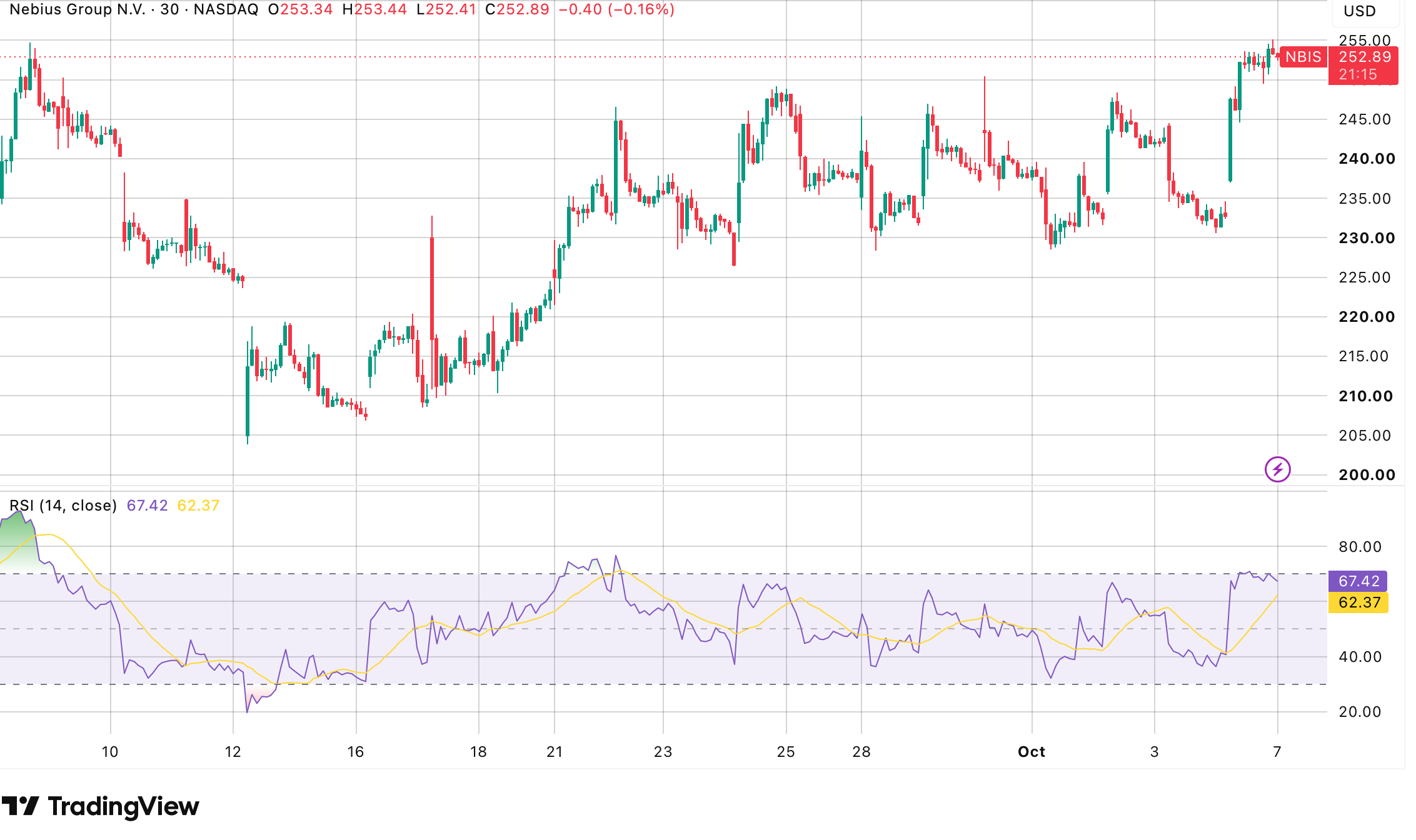
Nebius Group shares jumped about 8% to around $253.25 on Tuesday, reversing the previous session’s 4.22% decline and breaking above the $250 resistance zone.

The move followed a period of consolidation during which the stock repeatedly faced selling pressure around the $250 level.

Trading volume also pointed to strong participation, with about 16.52 million shares changing hands compared with an average trading volume of 19.99 million according to Yahoo Finance data.

Technical indicators also turned more supportive.

The moving average convergence divergence (MACD) moved above its signal line on the one-month chart, while the histogram turned positive, pointing to stronger bullish momentum.

The relative strength index (RSI) climbed to about 67.83, indicating strong buying pressure but also placing the stock close to overbought territory.

Nebius stock breaks above key resistance

The latest rally came a day after several insider-sale filings dated October 5. Nebius Chief Technology Officer Danila Shtan reported selling 14,550 shares at $234.16 on October 1.

The reported sale was linked to automatic withholding for restricted stock unit taxes. Ophir Nave’s proposed sale of 500,000 shares was made under a Rule 10b5-1 trading plan.

No new fundamental catalyst was cited for Tuesday’s move, making the technical breakout the clearest explanation for the gain.

The key level for investors now is whether Nebius can remain above $250 and establish the former resistance level as new support.

AI infrastructure expansion supports growth outlook

Nebius has continued expanding its AI infrastructure footprint as demand for cloud computing and inference capacity grows.

The company recently acquired Inferize to strengthen its Token Factory inference platform.

Inferize develops technology designed to reduce model launch times, lower idle GPU capacity, and reduce inference costs.

The Inferize team joined Nebius Token Factory to help integrate the technology into its production inference stack.

The acquisition follows Nebius’ earlier additions of Eigen AI and technology from Clarifai.

Nebius has also signed a binding agreement with AIB Data Centers for 50 megawatts of critical IT capacity at a southeastern US facility.

AIB plans to deliver the capacity across two data halls under an initial 12-year term.

The additional capacity is intended to support AI workloads as demand for computing infrastructure increases.

Higher GPU prices add to revenue opportunity

Nebius has reportedly raised GPU cloud prices by about 20% across several Nvidia models, including the H100, H200, B200 and B300 chips.

The price increases point to continued demand for high-end AI computing capacity and the company’s ability to charge more amid constrained GPU supply.

Nebius has also benefited from capacity expansion and its relationship with Nvidia, which previously invested $2 billion in the company to support its hyperscale AI cloud buildout.

BNP Paribas recently upgraded Nebius to Outperform from Neutral and raised its price forecast to $399 from $260.

The bank said its outlook for the company had meaningfully improved since initiating coverage in June.

BNP Paribas estimates Nebius could approach $22 billion in annual recurring revenue by the end of 2027 and said the company’s 2027 guidance could lead to a material reset in current estimates.

Nebius shares have gained almost 200% in 2026, compared with nearly 30% for CoreWeave and 9% for IREN.

AI cloud demand, higher GPU pricing, infrastructure expansion, and inference services remain key drivers of the company’s growth outlook.

The post Nebius stock jumps as technical breakout puts $250 level in focus appeared first on Invezz

Anthropic is expanding access to its most advanced AI models to selected organisations for high-risk cybersecurity testing in collaboration with the US government.

Oil prices were little changed as rising Middle Eastern exports and planned emergency stockpile releases eased supply concerns.

Gold prices rose as Treasury yields and the US dollar moved lower ahead of the Federal Reserve’s September meeting minutes.

US Treasury yields also declined after reaching multi-decade highs in the previous session.

Anthropic expands AI model access to cyber firms

Anthropic said Tuesday that verified organisations will be able to access its most capable AI models, including Claude Opus 5.5, Claude Sonnet 5.5 and Claude Mythos 5.1, as well as new models released in the future.

The selected organisations will be able to conduct high-risk offensive testing of safety systems protecting critical infrastructure, including power grids, banks and flight operating systems.

The latest programme expands Project Glasswing, under which Anthropic previously gave limited access to its Mythos model to US government agencies, financial institutions and major software providers.

Anthropic said every member of Project Glasswing would receive access under the latest programme, while new organisations will require review in partnership with the US government.

Different cybersecurity teams will receive different levels of access.

Red teams conducting authorised hacking tests will receive broader permissions, including for offensive testing, although Anthropic said it would continue blocking behaviour that could cause physical harm or mass disruption.

Verified defence cybersecurity teams will receive a lower level of access but will be able to perform tasks such as malware reverse engineering and incident response.

The expansion comes after concerns about the cybersecurity risks posed by increasingly capable AI models.

JPMorgan Chase CEO Jamie Dimon said Tuesday that Anthropic’s Mythos model had increased global cybersecurity risks tenfold.

Oil prices remain near $100 as supply concerns ease

Oil prices were little changed as markets weighed increased Middle Eastern crude exports and the planned release of emergency diesel and crude stockpiles by the Group of Seven.

Brent crude gained 0.66%, at $100.98 a barrel, while US West Texas Intermediate futures rose 16 cents, or 0.36%, to $89.75.

The higher flow of crude from the Middle East has eased some concerns about supply shortages.

Vitol’s CEO said around 12 million barrels per day of crude and 2 million barrels per day of refined products had left the region on tankers over the previous seven to 10 days.

Saudi Arabia’s East-West Pipeline had also transported 5.8 million barrels to the kingdom’s Red Sea export hub of Yanbu as of Tuesday morning, according to Saudi Energy Minister Prince Abdulaziz bin Salman.

However, concerns about further disruptions remained after attacks on two Saudi airports and continued fighting involving Yemen’s Iran-backed Houthis.

The G7 has agreed to release 100 million barrels of diesel and crude oil from emergency reserves, although details on the breakdown and participating countries have not yet been provided.

Gold rises as Treasury yields and dollar ease

Gold prices advanced as the rally in Treasury yields paused and the US dollar weakened.

Spot gold rose 0.66% to $4,166.65 an ounce, while US gold futures for December delivery settled 0.97% higher at $4,197.30.

The decline in 10-year Treasury yields and the weaker dollar provided support for the precious metal.

Gold can face pressure from higher interest rates because investors may favour yield-bearing assets.

Markets have reduced expectations for an October Federal Reserve rate increase following weaker-than-expected September job growth.

Traders now see a 22% chance of a rate hike this month and an 84% probability of an increase in December, according to CME’s FedWatch Tool.

Treasury yields retreat from multi-year highs

US Treasury yields declined on Tuesday after reaching their highest levels in more than two decades during the previous session.

The 10-year Treasury yield fell more than four basis points to 5.281%, while the 30-year yield declined about three basis points to 5.651%. The two-year yield fell three basis points to 4.802%.

The 10-year and 30-year yields had reached 24-year highs on Monday after data showed slower services growth, although the services PMI remained in expansion territory.

Investors are now focused on Wednesday’s release of the Federal Open Market Committee minutes from its September meeting for clues about future monetary policy.

The post Evening Digest: Anthropic expands AI access, oil, gold and yields retreat appeared first on Invezz

FuelCell Energy (FCEL) stock gained on Tuesday due to renewed enthusiasm surrounding the firm’s strategic partnership with Fit Energy.

In a press release this morning, Fit Energy said it plans on powering a new data center development in Pennsylvania, using FCEL’s natural gas fuel cells.

The announcement arrives at a time when FuelCell shares are already regaining momentum – now up more than 40% versus their recent low.

Here’s why FuelCell stock rallied today

The primary driver behind today’s price action is the market’s growing realization that electrical grid capacity bottlenecks are forcing tech giants right into the arms of distributed fuel cell makers.

With the rapid expansion of hyperscale cloud computing and artificial intelligence (AI) workloads requiring continuous baseline electricity, data center operators face multi-year queues for standard utility grid connections.

FCEL’s agreement with Fit Energy, which targets up to 380 MW of behind-the-meter generation, offers on-site, low-carbon power that bypasses grid interconnections.

This provides data center firms with a crucial “time-to-power” advantage.

Note that the sharp rally in FuelCell stock on October 6th drove it decisively above its 50-day and 100-day moving averages (MAs), indicating bullish momentum could sustain in the near term.

Should you invest in FCEL shares at current price?

While today’s surge in FCEL stock highlights strong bullish sentiment, prospective investors must carefully assess the risk-reward profile before jumping in.

On one hand, FuelCell boasts a “growing backlog” of multi-megawatt projects and clean power purchase agreements that position it directly at the intersection of AI energy demand and grid decarbonization.

But on the other hand, the company faces ongoing financial and execution scrutiny.

Recent class-action shareholder litigation detailed a $17.0 million charge in Q3 related to Phase 0 contractual pricing and an annualized production rate that dropped to approximately 37.1 MW.

Plus, net losses stood at $45.3 million on $33.0 million in revenue for the quarter ending July 2026, suggesting that buying at current levels requires a high tolerance for operational friction.

What would determine FuelCell’s trajectory?

Looking ahead, FuelCell Energy’s multi-year trajectory hinges on execution discipline rather than speculative demand.

Investors evaluating the clean energy stock today must look beyond headline momentum and focus on how efficiently the management team scales production capacity to meet its megawatt delivery commitments.

The critical metric to track over the coming quarters is not merely “non-binding project pipelines” or preliminary announcements – but the concrete conversion rate of those agreements into firm, high-margin commercial revenue.

For long-term investors seeking high-upside exposure to the global data center power crisis, FCEL shares present a compelling play, but short-term traders should prepare for sharp volatility as the market balances data center enthusiasm against near-term profitability targets.

Note that Wall Street currently rates FuelCell Energy at Moderate Buy.

The post What drove FuelCell stock higher today? appeared first on Invezz

US stocks ended higher on Tuesday, with the S&P 500 and Nasdaq Composite reaching record closing highs as technology stocks gained and Treasury yields eased from multi-year peaks.

The S&P 500 rose 0.60% to 7,820.47, while the Nasdaq Composite gained 0.46% to 27,604.74.

The Dow Jones Industrial Average advanced 0.49% to 51,531.57.

Falling Treasury yields and steadier oil prices helped ease some concerns that have weighed on markets in recent weeks.

AI stocks lead Wall Street higher

Chipmakers led gains as investors remained focused on the outlook for artificial intelligence and related infrastructure spending.

Marvell Technology climbed after the chip designer raised its 2028 revenue forecast, citing strong demand for data centre chips. AMD also advanced after CEO Lisa Su said the company plans to substantially increase chip supply in 2027 to meet growing AI demand.

Broadcom gained as the semiconductor sector continued to support the broader market. The Philadelphia Semiconductor Index also moved higher.

Other stocks advanced on company-specific developments.

Constellation Energy jumped after Alphabet entered into a 3,590-megawatt power deal with the company.

Option Care Health surged after McKesson and private equity firm Clayton Dubilier & Rice agreed to acquire the infusion therapy provider in a deal valued at about $5.8 billion, including debt.

Treasury yields ease as oil prices stabilize

The decline in Treasury yields provided additional support for equities. The 10-year Treasury yield fell more than four basis points to 5.262%, while the 30-year yield declined more than three basis points to 5.631%.

Both yields had reached levels not seen since 2002 on Monday.

Oil prices were little changed on Tuesday, helping reduce some concerns about energy-driven inflation. Brent crude settled 0.26% higher at $100.58 a barrel, while West Texas Intermediate futures rose 0.01% to $89.44.

Supply concerns have eased after the Group of Seven agreed to release emergency diesel and crude stockpiles.

Markets have also been monitoring oil prices because higher energy costs could contribute to broader inflation pressures.

Financial markets are now pricing in a lower probability of another Federal Reserve rate hike at the central bank’s next meeting.

Earnings season moves into focus

Investors are also turning their attention to the third-quarter earnings season, which begins next week. Several major financial companies are scheduled to report results next Tuesday.

Analysts expect aggregate S&P 500 earnings to rise 30.6% year over year in the July-to-September period, according to LSEG.

Energy earnings are expected to increase 114.7%, while technology earnings are forecast to rise 66.5%.

Markets are also awaiting the Federal Reserve’s September meeting minutes, due Wednesday.

The release could provide further insight into policymakers’ decision to raise interest rates and their outlook for future monetary policy.

The combination of strong AI-related investment, easing Treasury yields, and more stable oil prices has allowed investors to focus increasingly on corporate earnings and growth prospects.

The post S&P 500 hits record high as AI stocks rise and Treasury yields ease further appeared first on Invezz

Franco Nevada has made a significant move into the early stage exploration sector by securing a 12.42 percent stake in Kenorland Minerals. The acquisition was completed through a private block trade valued at 22.2 million US dollars, with the royalty leader purchasing 10 million common shares at a price of 2.22 dollars per share. This strategic entry allows Franco Nevada to align itself with one of North America’s growing project generators during a period of shifting priorities within its own global portfolio.

The deal involved a redistribution of ownership among Kenorland’s leadership and insiders. A large portion of the shares came from John Tognetti, who sold nearly eight million shares as part of a broader portfolio management strategy, effectively ending his status as a corporate insider. To finalize the trade, Kenorland President and CEO Zach Flood contributed over two million shares from his own holdings. Flood expressed enthusiasm about welcoming such a respected name in the streaming industry to the company’s shareholder base.

Kenorland is primarily recognized for its focus on greenfield exploration across North America, highlighted by its successful discovery of the Frotet Project in Quebec back in 2020. That particular asset boasts an impressive inferred mineral resource containing millions of ounces of gold. The addition of Franco Nevada further strengthens an already robust list of institutional backers, joining other major players like Sumitomo and Centerra Gold who have recently moved to maintain their proportional interests in the explorer.

For Franco Nevada, diversifying into high potential explorers comes at an interesting time as it navigates headwinds elsewhere. The company continues to manage uncertainty regarding its major stream at the Cobre Panama copper mine, where operations remain suspended amidst legal disputes and government commissions. By expanding its footprint with companies like Kenorland, Franco Nevada appears to be hedging its bets and seeking fresh growth opportunities in gold exploration while waiting for resolution on its larger industrial assets.

Australian junior explorer Gold Mountain is making a significant move into South America’s critical minerals sector after securing exclusive rights to acquire the historic Malhada do Angico tungsten mine. By signing a binding agreement with Emprogeo Mining Business, the company has gained control over more than 850 hectares in northeastern Brazil, strategically positioning itself within one of the region’s most productive tungsten districts. This new acquisition directly borders Gold Mountain’s current holdings in the Seridó province, creating a contiguous area of high potential.

To lock in the twelve month exclusivity window, Gold Mountain paid an initial sum of 183,000 US dollars. This period allows the firm to carry out essential legal and technical audits before finalizing the deal. Further payments are tied to official approvals from the Brazilian National Mining Agency, specifically concerning a long standing exploration report and the formal transfer of mining rights. Once these regulatory hurdles are cleared, the transition of ownership will be completed.

The project holds particular appeal because it shares similar geological characteristics with the Brejuí Mine, one of Brazil’s premier tungsten operations located just forty seven kilometers away. During World War II, Malhada do Angico was active under different management, and modern mapping suggests there is still plenty left to discover. Company executives have already identified several thousand meters of promising mineralized zones across their expanded land package.

Executive Director David Evans expressed strong enthusiasm for the site following a recent visit, noting that the company intends to fast track its exploration efforts. While waiting for full drilling permits, Gold Mountain has already begun sampling historical tailings to determine metal grades and perform metallurgical tests. These early steps are designed to build confidence in the site’s viability as they prepare for a larger scale drilling campaign.

Over a quiet breakfast on an Eastside Los Angeles patio, Ava DuVernay finds herself reflecting on a pivotal moment of mentorship from Steven Spielberg. Years ago, during the ascent of her historical drama Selma, DuVernay asked the legendary filmmaker how he managed the immense pressure of constant visibility and the risk of disappointing his audience. His answer was simple and enduring: you just make another one. That philosophy has become a guiding light for DuVernay as she prepares for the premiere of 14th, a provocative new documentary for Netflix that examines the fragile state of the Fourteenth Amendment in modern America.

The film serves as a spiritual successor to her acclaimed 2016 work, 13th, but documenting current events proved far more volatile than revisiting history. What began as an exploration of challenges to birthright citizenship quickly expanded into a broader study of due process and insurrection. DuVernay describes the process as building a plane midflight, noting that the story shifted almost daily as political winds changed. From following high profile figures like Carla Hayden and Lonnie Bunch to interviewing dozens of scholars and comedians, DuVernay used the project as an outlet for her own anxiety and anger regarding the social climate of the last three years.

Producing such an overtly political piece arrived at a precarious time for Hollywood, where studios are increasingly hesitant to touch sensitive material. As other streamers shelved projects or delayed releases to avoid controversy, DuVernay worried if Netflix would succumb to similar pressures. Despite conversations with executives that lacked certainty about the industry’s future or potential corporate mergers, she was encouraged to simply keep creating. While she acknowledges a growing sense of fear among artists and executives alike, DuVernay remains committed to truth telling in an era where creative freedom feels increasingly constrained.

A bombshell whistleblower complaint filed with the Senate Judiciary Committee alleges that Donald Trump bypassed standard protocols to order the FBI to investigate residents of Los Angeles protesting his immigration policies. The accusations come from Jill Fields, a former supervisory intelligence analyst at the FBI’s Los Angeles Field Office, who resigned her position last year. According to documents reviewed by NBC, Fields claims the White House pushed for investigations into individuals exercising their First Amendment rights, specifically targeting those using megaphones during immigration enforcement actions.

The complaint suggests a coordinated effort to pressure agency leadership into surveillance and investigation despite initial refusals from field agents. Fields alleges that Emil Bove, then serving as acting deputy attorney general, directed the head of the local field office to open probes into activities occurring outside federal buildings that were otherwise legally protected speech. Furthermore, she asserts that White House directives were relayed through FBI Director Kash Patel to ensure these protests were monitored regardless of whether criminal activity was suspected.

Adding another layer to the controversy, Fields claims that resources were diverted away from critical national security priorities to satisfy these political requests. She alleges that experienced agents based in Los Angeles were pulled off active cartel cases to instead focus on monitoring domestic demonstrators. This reallocation of manpower highlights what critics describe as a systemic misuse of federal law enforcement tools for personal or political retribution.

Democratic lawmakers have reacted with sharp condemnation toward the revelations. Senator Alex Padilla, who sits on the judiciary committee and leads its border security and immigration subcommittee, described the allegations as deeply alarming. In a public statement, Padilla argued that utilizing the FBI to target American citizens for peaceful protest fundamentally undermines the country’s founding values and vowed that he would continue seeking answers until full accountability is achieved.

Republican candidates across the country are leaning heavily into a law and order platform as they head toward what looks to be a grueling set of midterm elections. From television commercials warning of Democratic plots to defund police departments to campaign rallies flanked by law enforcement unions, the party is making public safety its central pillar. This strategic shift comes as Republicans struggle to maintain momentum while facing voter frustration over rising living costs and tensions surrounding the conflict in Iran.

The rhetoric has become particularly sharp in key battleground states including Georgia, Michigan, and Wisconsin. Candidates for governor and congress are frequently labeling their opponents as soft on crime or accusing them of harboring socialist tendencies that would jeopardize community safety. Former President Donald Trump has amplified these themes during his appearances, linking illegal immigration directly to spikes in violence and urging voters to remember previous eras of instability. Even House Speaker Mike Johnson has joined the fray, citing historically low violent crime rates as evidence that the Republican emphasis on the rule of law is working.

Democrats are fighting back by attempting to neutralize these attacks through tactical recruitment and policy pivots. Many have tapped candidates with deep roots in prosecution and policing to shield themselves from accusations of being lenient on criminals. For example, some challengers have released advertisements featuring endorsements from local sheriffs or detailed comprehensive safety plans that explicitly call for increased police funding and robust drug prevention programs. They argue that Republican claims regarding the defunding movement are misleading distortions designed to scare moderate voters.

Despite the unified front, there is quiet disagreement within the GOP about whether fear of crime remains a primary motivator for voters today. Some lawmakers acknowledge that because overall crime trends have remained relatively stable since the nineties, the issue may not carry as much weight as it once did. Additionally, critics and black political leaders have condemned certain tactics, such as the display of mugshots at rallies, describing them as racially charged echoes of old political playbooks intended to sway suburban whites through anxiety rather than policy.