Archive

October 13, 2026

Browsing

SpaceX (SPCX) stock remains in focus on Wall Street as analysts assess the potential of its Starship rocket programme and the company’s expansion into wireless communications through Starlink Mobile.

Morgan Stanley reiterated its Overweight rating and $300 price target on SpaceX, implying approximately 85% upside from the stock’s October 9 closing price of $162.57.

Lead analyst Adam Jonas said the next two Starship missions could significantly influence investor expectations for the company’s growth prospects.

The outlook comes as SpaceX prepares for its next Starship test flights while pursuing opportunities in satellite communications, orbital computing, and manufacturing.

SpaceX stock was up 0.78% at the time of writing on Monday.

Morgan Stanley sees Starship reusability as a growth driver

Morgan Stanley said the upcoming Starship Flight 15 could represent an important step towards making the next-generation rocket fully reusable.

The mission is tentatively scheduled for November 8, although SpaceX has not confirmed the date.

It could include an attempt to catch the returning spacecraft using mechanical arms at the launch tower, a manoeuvre that Chief Executive Elon Musk has indicated the company hopes to attempt.

Flight 16 could follow as early as December 10, according to preliminary air traffic notices cited by Morgan Stanley. That date also remains unconfirmed.

Successful reusability could reduce launch costs and increase the amount of equipment SpaceX can deliver into orbit.

These improvements could support the expansion of its Starlink satellite network and create opportunities in emerging markets such as orbital computing and manufacturing.

According to Morgan Stanley, a single Starship launch carrying next-generation Starlink satellites could deliver bandwidth capacity equivalent to one to more than two months of current deployments using Falcon 9 missions.

Each Starlink V3 satellite offers approximately 10 times the downlink capacity of the V2 Mini satellites launched aboard Falcon 9 rockets, the report said.

Starlink expansion could improve satellite network economics

Morgan Stanley expects Starship to accelerate Starlink’s deployment by carrying larger payloads into orbit.

Following the deployment of 26 Starlink V3 satellites during Flight 14, Jonas expects the next mission to carry a similar or potentially larger payload.

Starship has the capacity to carry as many as 60 of these satellites, potentially reducing the number of launches required to expand the network.

The developments could also support SpaceX’s broader ambitions in satellite communications and artificial intelligence.

Separately, Pivotal Research raised its SpaceX price target to $230 from $220 while maintaining a Buy rating after the company agreed to acquire nationwide wireless spectrum from Grain Management.

Analyst Jeffrey Wlodarczak said SpaceX had effectively created a “legitimate” new low-cost wireless carrier through Starlink Mobile, which could initially target rural and suburban customers by bundling the service with existing Starlink equipment.

The roughly $8 billion agreement covers up to 14 megahertz of paired spectrum in the 800 MHz band.

These lower-frequency airwaves can travel farther and penetrate buildings more effectively, potentially extending mobile coverage.

Engine problems remain a risk for Starship timeline

Despite the potential benefits, Morgan Stanley highlighted technical challenges that could affect the programme’s progress.

All three launches involving the V3 configuration experienced booster engine problems before splashdown, while two also encountered failures involving the spacecraft’s vacuum engines.

Although the number of booster engines successfully firing during landing attempts has improved, further setbacks could delay hardware reuse and constrain the launch cadence in 2027.

Investors will therefore be watching the next missions for evidence that SpaceX can improve reliability and move closer to routine reuse.

The outcomes could influence expectations for Starship’s role in expanding Starlink, reducing launch costs, and supporting SpaceX’s longer-term growth opportunities.

The post Why does Morgan Stanley see an 85% upside for SpaceX stock?  appeared first on Invezz

Meta Platforms META shares rose more than 4% on Monday after the company launched two new artificial intelligence models, ending a four-session losing streak even as the tech-heavy Nasdaq Composite declined.

Meta shares were trading at $749 at the time of writing, up around 4.3% from Friday’s close. The stock’s advance came as investors assessed the company’s latest AI developments and their potential to expand its business beyond its core advertising operations.

The launch of Muse Wonder and Muse Wonder Full marks another step in Meta’s push to develop AI systems capable of handling more complex tasks rather than simply responding to user questions.

Meta launches two new AI models

Meta announced Muse Wonder and Muse Wonder Full on Monday, describing them as its most powerful models.

Unlike traditional chatbots that primarily answer questions, the new models are designed to plan, reason and execute multi-step tasks across digital environments. Potential applications include online shopping, travel bookings and other activities that require users to complete several steps.

“Muse Wonder and Muse Wonder Full apply specialized knowledge to problems people encounter at work and in daily life, from understanding a lease to making sense of financial or health information. Our evaluations include tasks in law, finance, and health that test this ability,” Meta said in its release.

According to CNBC, users of the Muse personal agent app will need to sign up for a monthly subscription costing either $20 or $100 to access the models.

The launch represents an effort by Meta to expand its business model through AI-powered services. Advertising continues to account for the bulk of the company’s revenue, while AI agents could provide an additional avenue for growth.

Meta also said the new models include its strongest safeguards against “cyber misuse,” addressing concerns about the potential misuse of increasingly capable AI systems.

Muse user base draws attention

Meta’s Muse platform has already attracted a substantial user base, according to internal data reviewed by The Information.

The publication reported that Muse had more than 3 million weekly users who submitted at least one prompt, alongside more than 1 million daily users who did so.

The launch of the two new models could help Meta strengthen engagement with the platform as it seeks to expand the role of AI in users’ daily activities.

For investors, the key question will be whether the new services can translate into sustained adoption and contribute meaningfully to Meta’s business. The subscription-based access model also introduces a potential revenue stream alongside the company’s advertising operations.

Analysts remain bullish ahead of earnings

Analysts maintained a broadly positive view of Meta’s prospects ahead of the company’s third-quarter earnings report, expected on October 28.

Cantor Fitzgerald maintained its Overweight rating on Meta shares while lowering its price target to $840 from $860. The revised target remains above the stock’s trading level.

TD Cowen also maintained a bullish stance, retaining its Buy rating and $865 price target for Meta.

Meanwhile, Wells Fargo analyst Ken Gawrelski kept his Overweight rating and raised his price target to $1,000 from $796.

The analyst views suggest continued confidence in Meta’s longer-term prospects despite recent pressure on its shares. The introduction of the new AI models adds another development for investors to consider as they assess the company’s growth opportunities.

Meta’s upcoming third-quarter earnings report will provide investors with an opportunity to assess its financial performance and the progress of its AI strategy.

The post Why Meta stock is up 4% on Monday? appeared first on Invezz

Shares of Adobe (ADBE) declined on Monday after Wells Fargo downgraded the software company by two notches, citing concerns about deteriorating underlying growth, rising competition, and challenges in monetising artificial intelligence (AI).

Wells Fargo lowered its rating on Adobe to Underweight from Equal Weight and cut its price target to $225 from $270.

The revised target implies potential downside of more than 5% from current levels.

The brokerage said Adobe’s growth challenges appear increasingly structural rather than a temporary slowdown, with acquisitions contributing to reported growth while its core business faces mounting pressure.

Wells Fargo flags weakness in Adobe’s core growth

Wells Fargo pointed to Adobe’s full-year forecast of approximately 10.2% growth in annual recurring revenue (ARR) following its second-quarter results.

The forecast included about $480 million in revenue contribution from its acquisition of Semrush, making the underlying growth outlook less impressive, according to the brokerage.

ARR measures the annualised value of recurring subscription revenue.

Growth can come from acquisitions, known as inorganic growth, or from existing business operations, known as organic growth.

Wells Fargo estimated that Adobe’s organic net new annual recurring revenue (NNARR) declined by more than 40% in the third quarter.

The brokerage also estimated that Adobe would need to generate nearly twice as much net new ARR in the fourth quarter as in the previous quarter to achieve its full-year targets.

It warned that reaching this level could prove difficult because of competitive pressure and pricing constraints.

AI competition and management transition add risks

Wells Fargo analyst Michael Turrin outlined four key reasons for the downgrade, including weakening growth momentum, risks to fiscal 2027 guidance, pressure from AI competitors and intensifying competition in Adobe’s creative software business.

“3Q results suggest cracks starting to show, steep 4Q ramp looks difficult (4Q NNARR needs to ~2x q/q),” Turrin wrote in a note to clients.

He also highlighted incremental risks to Adobe’s preliminary fiscal 2027 outlook, citing the absence of a price increase and an ongoing management transition involving both the chief executive officer and chief financial officer.

The brokerage further pointed to a chief information officer survey that reportedly showed Adobe losing budget share during the AI evaluation cycle.

Competition in Adobe’s core creative business is also intensifying, according to Wells Fargo, adding pressure at a time when the company’s growth outlook is already facing challenges.

Turrin said he had “came away more cautious” on front-office and creative software, reflecting the brokerage’s concerns about Adobe’s competitive position and growth trajectory.

Wells Fargo forecasts slower ARR growth in fiscal 2027

Wells Fargo has lowered its expectations for Adobe’s recurring revenue growth in fiscal 2027, projecting negative growth in net new ARR and total ARR growth of approximately 7%.

That forecast is below the market consensus of more than 8% total ARR growth, according to the provided analysis.

The brokerage also reduced its margin forecasts, citing Adobe’s focus on adding users rather than prioritising near-term monetisation.

The post Adobe stock falls as Wells Fargo downgrades shares appeared first on Invezz

Oil prices climbed to near two-week highs as attacks in the Middle East heightened supply concerns, while gold prices declined amid a stronger US dollar and expectations for key inflation data.

Micron Technology and SK Hynix shares fell as China’s CXMT advanced its memory-chip technology, while economists Robert E. Hall and Michael Woodford won the 2026 Nobel Prize in Economics for their work on macroeconomic stabilisation.

Oil prices rise to near two-week highs

Oil prices rose on Monday, with Brent crude futures climbing 1.6% to $106.41 a barrel. Brent crude hit its highest level since September 29 in the session. US West Texas Intermediate crude gained 1.73% to $93.43 a barrel.

The gains came as attacks on Saudi Arabia and commercial vessels in the Strait of Hormuz heightened concerns about disruptions to Middle Eastern oil supplies.

Iran-aligned Houthis claimed responsibility for a Saturday strike on Riyadh’s international airport that killed 13 people and injured more than 300, with further attacks reported on Sunday.

The United Kingdom Maritime Trade Operations also reported that a tanker was struck by a drone near Oman’s Sohar, while another was damaged while transiting the Strait of Hormuz.

Meanwhile, US President Donald Trump highlighted additional Russian diesel supplies and an energy ceasefire agreement between Russia and Ukraine.

Russia was expected to release more than 300,000 metric tons of diesel to US and global markets, although analysts questioned the immediate impact.

Goldman Sachs raised its December Brent forecast to $90 a barrel from $85, estimating a risk premium of slightly more than $20 a barrel.

Gold prices fall as stronger dollar and inflation data weigh

Gold prices retreated on Monday after reaching a one-week high, as a firmer US dollar and rising oil prices pressured the precious metal.

Spot gold fell 0.61% to $4,168.10, while US gold futures for December delivery settled 0.58% lower at $4,191.80 an ounce.

Investors are awaiting US inflation data and remarks from Federal Reserve Chair Kevin Warsh for clues about the central bank’s monetary policy outlook.

The Consumer Price Index report is due Wednesday, followed by the Producer Price Index and retail sales data on Thursday.

Wyckoff said he did not expect the reports to show signs of easing inflation, which could weigh on precious metals.

Markets largely expect the Fed to hold interest rates steady later this month, although the probability of a rate hike by December stood at 87.7%, according to CME’s FedWatch tool.

Higher interest rates can make yield-bearing assets more attractive than gold.

Silver fell 1% to $60.22 an ounce, while platinum and palladium also declined.

Micron, SK Hynix stocks fall as China’s CXMT advances memory technology

Shares of Micron Technology, SK Hynix and SanDisk declined on Monday as investors assessed the competitive implications of China’s advances in memory-chip technology.

Micron and SK Hynix shares dropped nearly 4%, and SanDisk declined 6%.

Broader weakness in technology stocks and higher oil prices added to the pressure.

China’s ChangXin Memory Technologies (CXMT) announced progress in developing a “4F square” memory-cell architecture designed to increase storage density.

CXMT President Cao Kanyu said the company planned to introduce a server-memory product based on the technology by the end of 2026.

The design reduces the area occupied by individual memory cells, potentially allowing more data to be stored on a single chip.

Mainstream commercial dynamic random-access memory (DRAM) currently uses a 6F square-cell structure.

CXMT’s design uses a proprietary Vertical Surrounding Gate transistor intended to address current leakage while reducing cell size.

The company also expects to release a new generation of DDR5 registered dual in-line memory modules for enterprise servers by year-end, although detailed specifications and an exact launch date have not been disclosed.

SK Hynix unveiled its own 4F square development plan in 2025, while South Korean media outlet The Elec reported that Samsung planned to begin mass-producing sub-10-nanometre DRAM based on the design by 2028.

Hall, Woodford win Nobel Prize in Economics for macroeconomic research

Economists Robert E. Hall and Michael Woodford won the 2026 Nobel Prize in Economics on Monday for their work on the microeconomic foundations of macroeconomic stabilisation.

The Royal Swedish Academy of Sciences recognised their research into how household and business decisions influence the broader economy and how policymakers can account for those decisions when seeking to maintain economic stability.

Their work emphasises that households and businesses make forward-looking decisions based on expectations about future economic conditions.

These expectations influence current spending and saving, affecting overall economic activity.

The research also highlights the role of communicating future policy plans, as clear guidance from policymakers can shape expectations and influence behaviour.

The award committee said the models have helped policymakers manage major macroeconomic crises more effectively, including the pandemic and recent energy crises, which it said had not produced the same long-term consequences for growth and inflation as the economic disruptions of the 1970s.

The post Evening digest: Oil hits two-week highs as Micron, SK Hynix stocks fall appeared first on Invezz

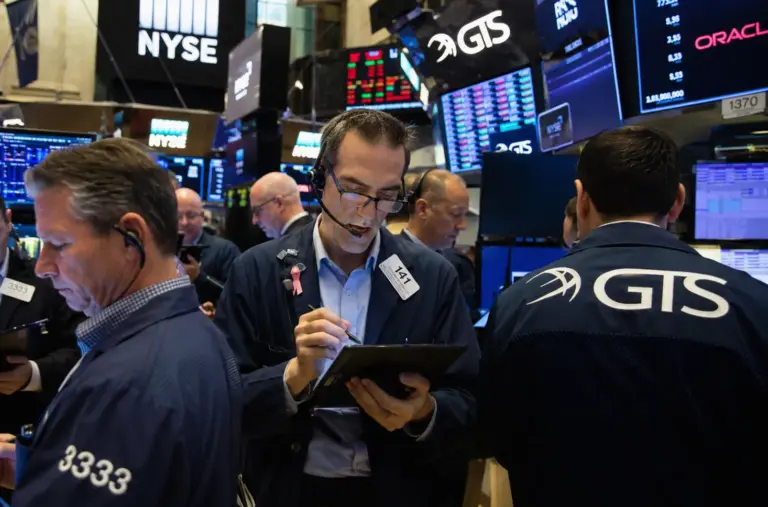
US stocks closed mixed on Monday as investors assessed rising oil prices and geopolitical tensions ahead of a busy week of corporate earnings and inflation data that could influence the Federal Reserve’s interest rate outlook.

The S&P 500 slipped 0.05% to 7,807.79, while the Dow Jones Industrial Average gained 0.38%, or 198.22 points, to close at 51,853.17.

The Nasdaq Composite fell 0.44% to 27,246.

The session came after all three major indexes recorded weekly gains, supported by technology stocks and optimism surrounding artificial intelligence investment.

Investors are now turning their attention to third-quarter earnings, with major US banks scheduled to report results, alongside September inflation figures and retail sales data.

Dow gains as technology stocks weigh on Nasdaq

The Dow outperformed the broader market, supported by a 2% increase in Salesforce shares after Bank of America upgraded the stock to Buy from Underperform.

Microsoft shares gained 0.9% after the company announced plans for a major deployment of its own artificial intelligence chips. Its market capitalisation briefly rose above $4 trillion for the first time in a year.

Meta also helped support the communication services sector, while energy stocks outperformed as crude prices climbed.

Technology and consumer discretionary stocks were among the weakest-performing sectors.

Micron Technology shares fell around 3% as investors assessed growing competition from China’s ChangXin Memory Technologies (CXMT), which reported progress on a new memory-chip structure.

The Philadelphia Semiconductor Index declined to a three-week low, reflecting broader weakness across chip stocks.

Chipotle Mexican Grill shares also fell after Starbucks said it was not acquiring the burrito chain.

The S&P 500 finished nearly flat, reflecting the balance between gains in selected large-cap stocks and pressure on technology shares.

Oil prices climb amid Middle East tensions

Oil prices rose as attacks in the Middle East heightened concerns about potential disruptions to global energy supplies.

West Texas Intermediate crude futures gained 2.06% to settle at $93.74 a barrel, while Brent crude futures rose 1.84% to $106.65.

The gains followed deadly attacks on Riyadh’s international airport over the weekend, which increased concerns about regional instability.

The developments overshadowed the prospect of additional Russian diesel supplies and a proposed Russia-Ukraine ceasefire covering energy infrastructure.

The increase in energy prices added to concerns about inflation, particularly as US Treasury yields have recently reached their highest levels in decades.

The Treasury market was closed on Monday for Columbus Day.

Cleveland Federal Reserve President Beth Hammack also indicated that the central bank should move relatively quickly towards a more restrictive monetary policy to address increasingly broad-based inflation pressures.

Traders were pricing in less than a 22% probability of a Federal Reserve rate hike in October, according to CME’s FedWatch tool, compared with 17.7% on Friday.

Bank earnings and inflation data in focus

Investors are preparing for a busy week of corporate results, with major financial institutions including JPMorgan Chase, Goldman Sachs, Citigroup, Bank of America, Morgan Stanley and Wells Fargo scheduled to report earnings.

Analysts expect strong third-quarter results, supported partly by continued investment in artificial intelligence infrastructure.

FactSet estimates cited by CNBC indicated that S&P 500 earnings growth could reach 29.6%, marking a fourth consecutive quarter of growth above 25%.

September consumer price index data is due on Wednesday, followed by the producer price index and retail sales figures on Thursday.

The reports could influence expectations for the Federal Reserve’s next policy decision, particularly as rising energy prices complicate the inflation outlook.

Investors will also assess whether corporate earnings can sustain the recent stock market rally amid geopolitical uncertainty and higher borrowing costs.

The post Dow closes 198 pts higher as US stocks close mixed ahead of earnings appeared first on Invezz

Sydney is gearing up to host the thirteenth edition of the International Mining and Resources Conference, where more than 12,000 professionals and fifty government delegations will gather at the ICC Sydney from October 27 to 29. This year’s event arrives at a pivotal moment for the industry, centering its focus on how to move projects from initial strategy to actual execution amidst a volatile global landscape. With representatives coming from over 120 countries, the conversation will lean heavily toward building resilient supply chains and ensuring that resource delivery remains viable despite geopolitical instability.

The urgency of these discussions is driven largely by Western nations seeking to diversify their sources of critical minerals away from dominant markets. According to Nicki Ivory, a mining and metals leader at Deloitte Australia, the country finds itself in the center of an unprecedented shift where mineral supplies are no longer just about enabling a green energy transition but are now essential components of national security. Industry leaders from giants like BHP and Evolution Mining will join hundreds of other speakers to navigate this delicate balance between fueling clean energy goals and supporting defense strategies.

Beyond the high level policy debates, the conference offers practical hubs for growth and innovation. The Mines and Money section will feature over one hundred junior mining firms pitching directly to investors, while the Innovation and Investment Alley provides a platform for startups showcasing new technologies aimed at improving mine safety and cutting costs. There is also a strong emphasis on the next generation of workers through STEM programs designed to bridge the gap between students and careers in earth sciences.

For those planning to attend, organizers have implemented a pre registration system with specific incentives for different roles within the sector. While corporate groups can take advantage of tiered discounts, eligible site operators may be able to secure free guest passes. As five hundred companies prepare to fill twenty thousand square meters of exhibition space, the event promises to be a comprehensive look at how technology and capital will shape the next cycle of global resource management.

Elon Musk has emerged as the most significant financial force in this year’s midterm elections, contributing more than 276 million dollars since July in an effort to protect Republican control of Congress. These figures, initially revealed by the New York Times and later confirmed by a spokesperson for Musk’s super PAC, mark some of the largest political contributions ever seen in United States history. The bulk of the funding was directed toward the Senate Leadership Fund, with another substantial sum fueling America PAC’s aggressive ground game to drive voter turnout.

This massive spending spree represents a sharp reversal from just a year ago when Musk suggested he would scale back his political involvement, claiming at the time that he had already done enough. While he has stayed further away from the campaign trail compared to his highly visible role during the 2024 election cycle and his brief tenure leading the Department of Government Efficiency, his checkbook remains wide open. His recent reconciliation with President Trump was punctuated last week when he received the National Medal of Science.

The influx of cash comes at a critical moment for the Republican Party, providing a vital financial cushion against a backdrop of mounting challenges. Despite their monetary lead, GOP strategists are facing steep headwinds due to widespread voter dissatisfaction regarding inflation and a volatile conflict with Iran. For now, however, Musk’s unprecedented wealth continues to provide a lifeline for candidates struggling to maintain their hold on Washington.

Home Secretary Shabana Mahmood has announced a significant expansion of police protection to include political figures who do not hold seats in the House of Commons. Speaking to MPs on Monday, Mahmood argued that current safeguards were insufficient for those dedicated to public life, confirming that the new measures will extend to peers, former members of parliament, and official party spokespeople. The move aims to shield individuals from the growing tide of harassment and violence that often accompanies political service.

While the specific details of the support remain under wraps, the Home Secretary noted that eligible individuals will now have access to a designated police officer and assistance in implementing broader security measures. This decision follows several high profile tragedies, including the murders of Jo Cox and Sir David Amess, as well as the recent death of former Conservative MP and Reform UK spokeswoman Ann Widecombe, who was found with serious injuries at her home in Devon.

Alongside these immediate changes, a comprehensive independent review into security arrangements for high profile figures, including royalty and politicians, has been launched. Led by former national security advisor Stephen Lovegrove, this root and branch investigation will examine physical threats and online risks exacerbated by an increasingly polarized society. The findings are expected within six months and will run parallel to an ongoing inquiry into the killing of Sir David Amess.

The announcement received broad support across the political spectrum, though some critics felt it arrived too late. Shadow Home Secretary Chris Philp described threats against representatives as attacks on democracy itself. Meanwhile, Reform UK spokesperson Zia Yusuf welcomed the review but expressed disappointment that it took repeated campaigns and personal tragedy before the government decided to act.

With only three weeks remaining until the November elections, the Republican Party has shifted its strategy from offensive expansion to a desperate triage operation. Once safe seats are suddenly becoming battlegrounds, sparking fears among GOP operatives that they could lose total control of Congress. This shifting landscape has forced leadership to divert critical funding away from Democratic-leaning areas and pour it instead into traditionally red districts that were previously considered guaranteed wins.

Internal tensions are mounting as some party members question whether Former President Donald Trump has become a liability on the campaign trail. While many had pushed for him to increase his visibility, some candidates now worry his plummeting popularity is actively hurting their chances. One House Republican went as far as to say that Trump is dragging the party down, reflecting a growing anxiety that his presence may be alienating moderate voters at a pivotal moment.

The crisis is compounded by public frustration over the ongoing conflict in Iran and the rising cost of living, both of which are fueling a surge in Democratic momentum according to recent polling. Even bastion states like Kansas and South Carolina are seeing unexpected competitiveness, prompting super PACs to scramble funds into regions where Republicans haven’t faced serious challenges in decades. In Texas, despite repeated visits from Trump, candidate Ken Paxton continues to struggle following a bruising primary and damaging leaked recordings.

Despite the grim projections and reports from analysts suggesting more seats are sliding toward Democrats, some within the GOP remain hopeful. Strategists argue that late-surging turnout from unengaged Republican voters and weak performances by far-left Democratic candidates could yet stabilize the results. Speaker Mike Johnson is currently attempting to stem the tide through an aggressive tour of dozens of districts, hoping to frame the election as a choice between stability and chaos rather than a referendum on the current administration.

Federal agents conducted a pre dawn raid on the Washington area residence of Representative Ilhan Omar early Monday morning, marking a rare and aggressive move by the Justice Department so close to an election. Neighbors reported being woken up around four thirty in the morning by the sound of banging on doors, while witnesses later saw Homeland Security Investigations officers removing boxes from the property. A spokesperson for the Department of Justice confirmed that the search was judicially authorized and is part of an ongoing federal criminal investigation, though officials declined to provide specific details regarding the nature of the probe.

Representative Omar immediately condemned the action as a calculated effort to intimidate her during her reelection campaign in Minnesota. Taking to social media, she described the raid as an attempt to weaponize federal law enforcement against political enemies and asserted that she has done nothing wrong. Her supporters and House Democratic leaders echoed these sentiments, calling the operation deeply disturbing and suggesting it represents a corrupt abuse of power designed to disrupt her candidacy less than thirty days before voters head to the polls.

The timing of the search has raised significant eyebrows among legal observers because of long standing Department of Justice policies that generally discourage overt investigative steps within sixty days of an election to avoid influencing outcomes. Despite these norms, sources say top leadership signed off on the warrant after extensive deliberation. While official charges have not been filed, White House border czar Tom Homan had previously hinted at investigations involving Omar, mentioning potential issues related to immigration or marriage fraud, although no evidence has been publicly produced to support those claims.

Omar, a Somali born immigrant and member of the progressive group known as The Squad, has spent years as a primary target of President Trump’s rhetoric. From accusations regarding her background to direct insults describing her as garbage, she has frequently faced intense personal attacks from the administration. As voting already begins in Minnesota, this latest encounter with federal law enforcement adds a volatile layer to an already tense political climate in her home district.