Archive

October 21, 2026

Browsing

Tesla (TSLA) stock has recovered rather significantly in recent months, but the derivatives market believes that momentum will only accelerate after the company reports earnings on October 21st.

Consensus estimates for the EV maker’s profit and revenue currently sit at $0.44 a share and $28.3 billion, respectively – indicating a 12% and less than 1% decline on a year-over-year basis.

Despite recent gains, Tesla shares remain down roughly 14% versus the start of this year (2026).

Options sentiment is bullish for Tesla stock

Despite the anticipated YoY decline, traders are increasingly betting on call options, which signals conviction in a potential post-earnings surge in TSLA stock.

In fact, the put-to-call ratio on contracts expiring end of this week sits at 0.47 currently, whereas a reading below 1.00 is typically characterized as in favour of the bulls.

According to the latest data from Barchart, the upper price on those options contracts is currently set at $397, indicating potential for a nearly 6% rally on the back of the quarterly release.

Even from a technical perspective, Tesla is currently trading well above its major moving averages (MAs), with an RSI in the mid-50s signaling significant room before the EV stock hits overbought conditions.

Why are options traders bullish on TSLA shares

The derivatives market remains constructive on Tesla shares irrespective of the expected weakness in the company’s Q3 results primarily because its valuation is now tied more to the AI initiatives.

While the Nasdaq-listed firm continues to face challenges in its core EV business, the stock price trajectory is broadly expected to be defined by billionaire Elon Musk’s commentary involving AI and autonomous driving.

The positive options market sentiment heading into the earnings release likely reflects confidence that updates on that front will be constructive on October 21st.

Last week, TSLA unveiled its much-anticipated “roadster” vehicle, which may help sustain momentum in the sessions immediately after earnings as well.

Cathie Wood dubs Tesla Inc a 10x opportunity

The aforementioned AI and autonomous initiatives are keeping influential investor “Cathie Wood” bullish on Tesla Inc as well.

In her latest report, the founder and chief executive of ARK Invest said the EV stock will be worth $5,000 within the next six years, indicating potential for a 10x growth through 2031.

Wood remains convinced that humanoid robots and robotaxis are a trillion-dollar opportunity that Tesla Inc is uniquely positioned to capitalize on in the years ahead.

That said, Wall Street analysts are nowhere near as bullish on TSLA shares for the next 12 months.

According to Barchart, the consensus rating on the electric vehicles specialist sits at Moderate Buy as of writing, with the mean price target of about $401 indicating potential for roughly 7% upside only.

The post Options data bullish on Tesla stock despite expected Q3 earnings decline appeared first on Invezz


SpaceX stock SPCX rose 2.2% in after-hours trading on Tuesday after Elon Musk’s aerospace and artificial intelligence company reported a 161% increase in third-quarter revenue, beating analysts’ estimates on growth in its AI and satellite-internet businesses.

Revenue reached $14.58 billion in the three months ended September 30, compared with analysts’ expectations of $12.72 billion, according to LSEG data.

Net profit came in at $4.4 billion, well above estimates of $1.57 billion.

The results marked a significant turnaround from the second quarter, when SpaceX reported a net loss of $541 million on revenue of $7.81 billion.

The company’s performance reflects growth across its businesses, although its expanding AI operations and space ambitions continue to require substantial investment.

SpaceX shares have been volatile since its initial public offering in June at $135 per share.

AI business drives revenue growth

SpaceX’s AI business has become a major area of investment, with revenue generated primarily through data-centre capacity contracts rather than its own AI models.

The company rents computing capacity to developers, including Anthropic, Google and Reflection AI.

Its broader AI operations also include xAI’s Grok chatbot and the social-media platform X.

However, SpaceX’s AI models face competition from OpenAI, Anthropic and Google.

The company has also cautioned that its AI unit is experiencing substantial operating losses and will require sustained investment before it can consistently generate profits.

The results highlight the growing contribution of AI infrastructure to SpaceX’s business, alongside its established satellite and launch operations. Its ability to convert rising demand for computing capacity into sustainable profits remains an important consideration for investors.

Starlink expansion supports connectivity business

Starlink and SpaceX’s broader connectivity operations remain central to the company’s financial performance.

The satellite-internet business continues to expand its subscriber base through additional satellite launches and a wider range of services for consumers, businesses, airlines, maritime customers and government agencies.

However, expanding into less affluent international markets could put pressure on average revenue per user as SpaceX introduces lower-priced plans.

Investors are watching whether this pricing pressure affects the economics of the network as the company expands its global reach.

SpaceX is also investing heavily in coverage, network capacity, and direct-to-device mobile services.

These initiatives could broaden its addressable market but add to the costs of maintaining and expanding its infrastructure.

The company’s ability to balance subscriber growth with improving network economics will remain a key factor in assessing Starlink’s contribution to future earnings.

Starship development remains a key long-term challenge

SpaceX’s launch operations include commercial missions, government contracts and the development of Starship, its next-generation reusable rocket system.

Starship has yet to enter commercial service but is expected to support the deployment of higher-bandwidth Starlink satellites and orbital AI-computing infrastructure.

Its successful development and reliable reuse are central to Musk’s longer-term plans.

Falcon launch activity has remained robust, although revenue can vary depending on the mix of internal Starlink deployments, commercial missions and government contracts.

SpaceX has increasingly prioritised launches for its own satellite network while absorbing the costs of Starship development.

Investors are also watching for Musk’s comments on a potential merger between SpaceX and Tesla, which is scheduled to report results on Wednesday.

Despite the strong quarterly results, SpaceX faces significant execution risks as it pursues expansion across AI, connectivity and space transportation.

Its ability to manage investment costs while translating growth into sustained profitability will remain central to its longer-term outlook.

The post SpaceX stock rises as revenue jumps 161% on AI and Starlink growth appeared first on Invezz

Netflix shares NFLX fell around 4% in after-hours trading on Tuesday after the streaming company reported third-quarter earnings that exceeded analysts’ expectations but forecast slower revenue growth for the fourth consecutive quarter.

The company reported revenue of $12.9 billion for the quarter, up 12% from a year earlier and in line with Wall Street expectations.

Earnings reached 87 cents per share, beating analysts’ estimates of 82 cents. Net income increased approximately 43.5% year over year to $3.66 billion.

However, Netflix forecast fourth-quarter revenue of $13.4 billion, below analysts’ expectations.

The company also projected full-year 2026 revenue of $51.1 billion, representing 13% growth and slightly below the midpoint of its previous forecast range of 13% to 14%.

The outlook comes as Netflix faces questions about viewer engagement, advertising growth and the quality of its programming.

Netflix forecasts slower revenue growth as advertising disappoints

Netflix’s revenue growth has slowed from 17.6% in the fourth quarter of last year to a projected 11.5% in the final three months of 2026.

The company attributed the advertising shortfall partly to a slower-than-expected rollout of some products for advertisers.

Netflix now expects advertising revenue of $2.7 billion this year, compared with its previous projection of approximately $3 billion.

The company said subscription revenue growth had exceeded its expectations.

The company’s operating margin improved to 34.6% in the third quarter from 28.2% a year earlier.

Free cash flow also increased to $2.9 billion from $2.66 billion in the same period last year.

Despite these improvements, investors remain focused on Netflix’s ability to sustain growth.

The company said in its shareholder letter that it recognised investor concerns about viewing hours but remained confident it could accelerate growth in time spent watching its content.

Netflix is expanding into live sports, podcasts and video games while adding third-party film and television programming.

The company is also seeking to increase engagement as competition for viewers intensifies across streaming platforms and other digital entertainment services.

Leadership changes follow concerns over programming quality

Netflix has made significant changes to its workforce and leadership as it seeks to improve its content offering.

Over the past week, the company cut approximately 6% of its workforce, or around 1,000 positions, and removed Chief Content Officer Bela Bajaria and film chief Dan Lin from their roles.

The company appointed Peter Rice, a veteran film and television executive who previously held senior positions at Walt Disney and 21st Century Fox, to replace Bajaria.

The changes follow growing concerns that Netflix has struggled to deliver major television and film hits capable of attracting widespread attention.

Its Emmy Awards haul fell to a 10-year low in 2026, while viewing activity has shown signs of slowing.

Netflix remains a leading global streaming platform, with more than 325 million subscribers.

However, ratings tracker Nielsen puts its share of US television viewing at 7.8%, compared with approximately 14% for YouTube.

According to figures cited by The Wall Street Journal, Netflix viewers watched only 2% more programming in the first half of 2026 than a year earlier.

Stock faces pressure as investors reassess growth prospects

Netflix shares have faced sustained pressure following the company’s unsuccessful bid to acquire Warner Bros. Discovery’s film and television studios and HBO Max.

The stock has fallen approximately 25% this year and more than 40% over the past year, according to the supplied reports.

Investor attention is increasingly centred on the company’s ability to increase viewing hours and generate growth without a major acquisition.

Netflix’s customer retention remains relatively strong. Research firm Antenna estimated that its subscription churn rate was around 2% in September, unchanged from August and the lowest in the industry.

The company also said customer responses to price increases this year were in line with expectations, indicating that engagement remained healthy.

Nevertheless, the weaker advertising outlook and slowing revenue growth have added to concerns about its near-term performance.

Netflix’s improving margins and cash flow provide some support, but investors will be watching whether its content strategy and new entertainment offerings can translate into stronger viewing activity and sustained growth.

The post Netflix stock falls 4% as slowing revenue growth raises investor concerns appeared first on Invezz

US stocks ended higher on Tuesday as stronger corporate earnings and a pullback in oil prices supported the Dow Jones Industrial Average, while concerns about artificial intelligence spending weighed on technology shares.

The Dow rose 1.05%, gaining 548 points to close at 52,513.98.

The S&P 500 added 0.31% to 7,714.52, while the Nasdaq Composite slipped 0.03% to 26,421.84, according to preliminary data.

Investors shifted towards healthcare, defensive and value-oriented stocks as they reassessed the outlook for AI-related investments.

The market also monitored developments in the Middle East after oil prices retreated from five-month highs.

Dow gains as healthcare and industrial stocks advance

Healthcare stocks led gains among the S&P 500’s 11 major sectors, with the sector reaching a record high. Eli Lilly, UnitedHealth, Merck, Johnson & Johnson and Amgen supported the broader market, while Moderna climbed to its highest level since 2022.

Defensive sectors, including real estate and utilities, also outperformed, alongside the small-cap Russell 2000 index.

The S&P 500 value index outperformed its growth counterpart, reflecting a shift towards companies outside the technology sector.

Industrial and safety products maker 3M was among the Dow’s strongest performers, with shares rising more than 5% after it reported better-than-expected earnings and raised its full-year profit forecast.

The company also announced an expansion of its data-centre partnership with Amazon and issued a warrant allowing an Amazon subsidiary to purchase 3M shares worth more than $521 million.

Northrop Grumman advanced more than 4% following an earnings beat.

Credit reporting firm Equifax gained after reporting third-quarter profit above analysts’ estimates, while Hasbro shares jumped after the toy company raised its annual revenue outlook.

AI concerns weigh on technology stocks

Technology shares lagged as investors continued to question whether heavy spending on AI infrastructure will generate sufficient returns.

The sector had rebounded on Monday following a selloff last week, but concerns over borrowing costs, demand and monetisation remained.

Sentiment weakened earlier on Tuesday after South Korean AI company Elice Group plunged more than 30% in its market debut.

The decline renewed concerns about valuations across AI-linked businesses and the sustainability of infrastructure investment.

However, some AI-related stocks recovered during the session.

Western Digital gained more than 3%, while Seagate Technology rose more than 2%. CoreWeave and Marvell Technology each advanced nearly 2%.

Declines in major technology companies weighed on the communication services sector.

Meta, Netflix and Alphabet were among its weakest performers as investors prepared for further earnings reports.

General Motors shares also fell after the automaker reported stronger-than-expected quarterly results but warned of pressure from higher commodity costs and lower truck sales.

Oil retreats as investors monitor Middle East tensions

Oil prices pulled back from earlier gains, helping ease pressure on markets.

West Texas Intermediate crude futures were down less than 1% at around $103 a barrel, while Brent crude fell about 1% to roughly $108.

Traders weighed diplomatic efforts involving Iran and Pakistan against continued Houthi attacks on Saudi infrastructure and reports of vessel attacks in the Gulf.

The situation continued to pose risks to regional energy supplies.

Investors are also looking ahead to corporate earnings for further clues about business spending and the economic outlook.

The upcoming results are expected to draw attention to AI investment returns, data-centre spending and capital expenditure plans as investors reassess the sector’s growth prospects.

The post Dow rises 1% as earnings gains and lower oil prices lift Wall Street appeared first on Invezz

Strategy (MSTR) stock has traded within a narrow range over the past few days as Bitcoin’s rally has lost momentum. The stock was trading at $142.70, down from its September high of $170. However, this period of consolidation could be the calm before the storm, especially after JPMorgan issued a bold prediction about Bitcoin’s future price trajectory.

JPMorgan expects Bitcoin to beat stocks

Bitcoin has underperformed stocks this year. After soaring to $126,200, it has dropped by over 30% to where it is today. In contrast, the stock market has soared, with the S&P 500 Index hovering near its highest level on record, helped by artificial intelligence and energy sectors. 

Now, however, JPMorgan analysts believe that Bitcoin will outperform stocks in the long term. The bank also believes that the coin will beat bonds and gold over time. It sees Bitcoin achieving an annual return of about 10%.

Other top analysts have maintained a bullish outlook for Bitcoin. Michael Saylor, Strategy’s founder, believes that Bitcoin has more upside to go over time, which explains why he has continued the buying spree. 

Vivek Ramaswamy is also bullish on Bitcoin as evidenced by the ongoing accumulation by Strive. Also, Tom Lee sees Bitcoin continuing to outperform over time. 

Blackrock, which runs the biggest Bitcoin ETF, believes that Bitcoin is a good hedge against risk, especially as US government debt continues to rise. It crossed the key milestone of $40 trillion and has already jumped to $40.2 trillion so far. 

Strategy will be the biggest beneficiary if these Bitcoin forecasts come true, since it is the biggest holder. It bought 267 coins last week, bringing its total holdings to 848,517 coins, which are currently valued at $70.2 billion. 

Meanwhile, there are signs that American investors are rotating back into Bitcoin. On Monday alone, they purchased more than $550 million worth of Bitcoin ETFs, reducing the cumulative net outflow to just $90 million. If these inflows continue for a few more days, Bitcoin ETFs are likely to record a fourth consecutive month of net inflows.

Bitcoin price has more upside to go

bitcoin price

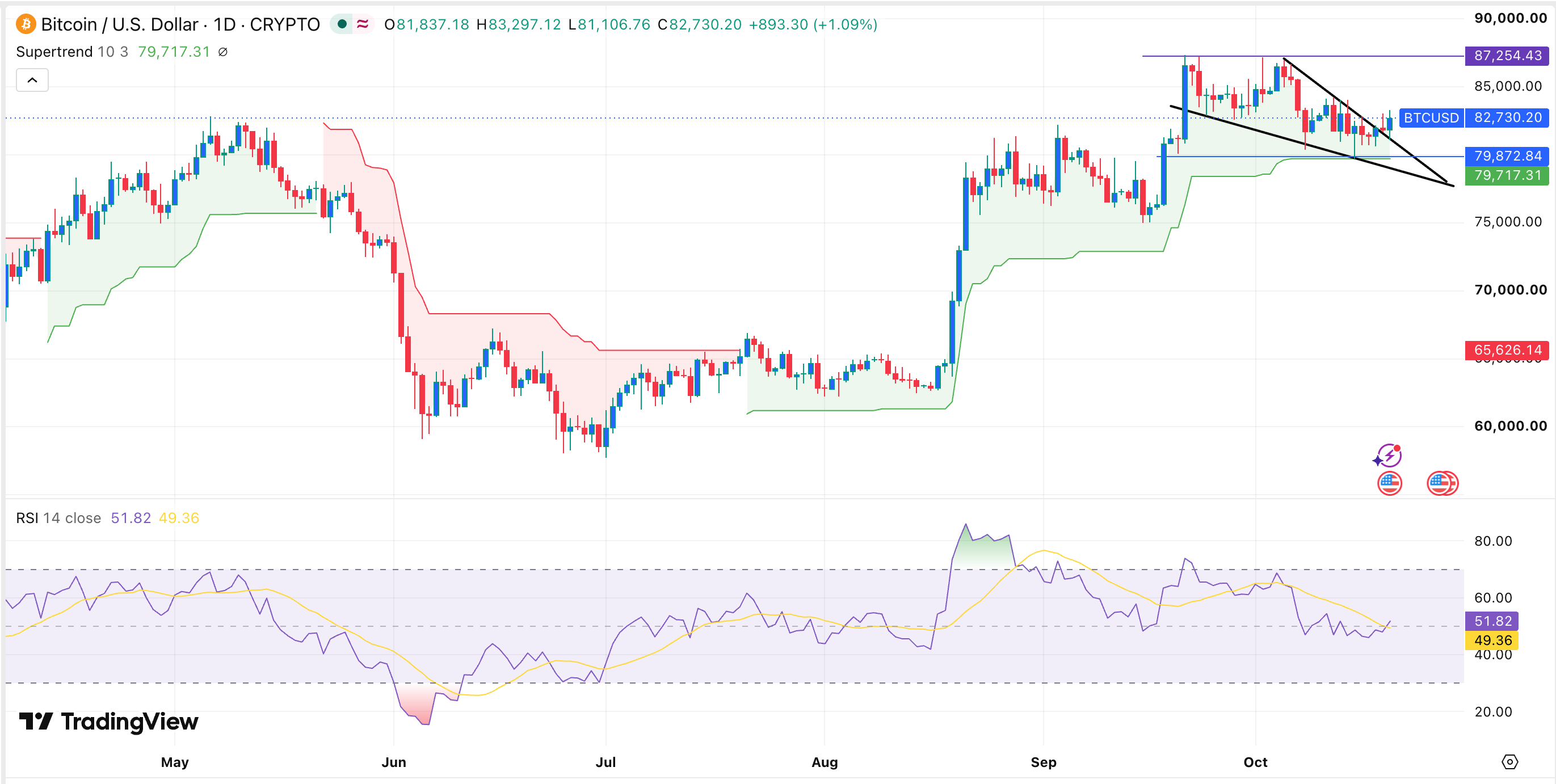
BTC price chart | Source: TradingView

The daily chart suggests that Bitcoin has more upside to go in the near term. It has formed a falling wedge pattern, which is characterized by two descending and converging trendlines. The two lines often leads to a bullish breakout, especially when they are nearing the convergence. 

Bitcoin has also remained above the Supertrend indicator and the 100-day moving average. Therefore, a rebound may push it to the important resistance level of $87,254. A surge above that level will point to more gains, possibly to $90,000, followed by $100,000. A jump to $100,000 would push the valuation of its Bitcoin holdings to nearly $85 billion.

MSTR stock forecast

mstr stock

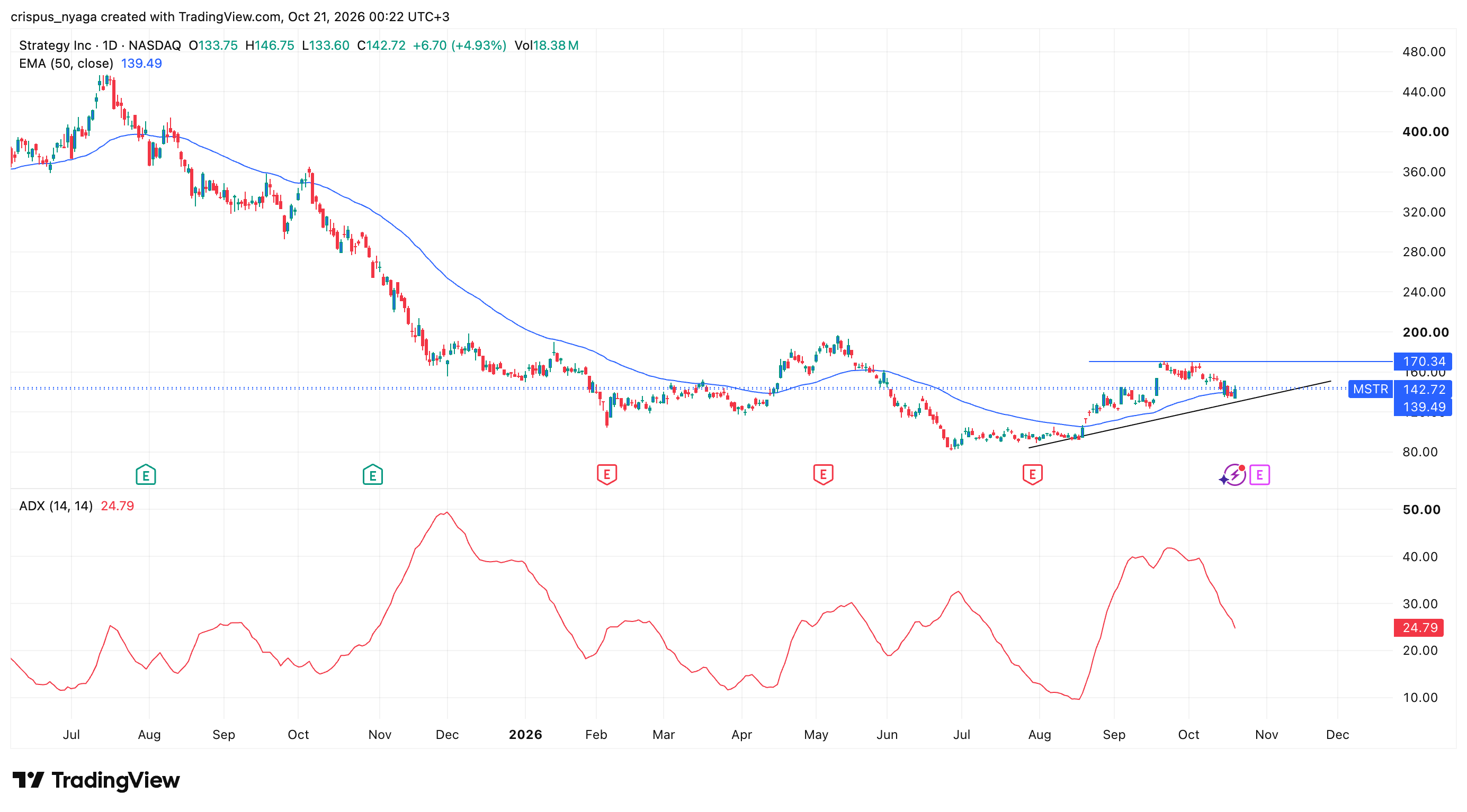
MSTR stock chart | Source: TradingView

The daily chart shows that MSTR stock has pulled back in the past few days, moving from a high of $170 to $142. This retreat, however, is losing momentum, as evidenced by the Average Directional Index (ADX), which has dropped from 40 to 24. 

Strategy has remained above the ascending trendline that links the lowest levels since August. Therefore, the stock will likely rebound, initially to $170, followed by $200.

The post MSTR stock eyes a rebound as JPMorgan delivers bold Bitcoin prediction appeared first on Invezz

The dream of a truly borderless financial system is moving closer to reality as industry leaders look toward tokenization to link international markets. Gabe Otte of Dinari believes that the ability to trade assets like Korean listed stocks through partnerships with entities such as Kakao Pay Securities represents a significant shift in how investors interact with global equities. According to Otte, the primary obstacle standing in the way of this evolution is not a lack of technical capability but rather a complex web of regulatory requirements.

He compares the current transition to the historical move from physical paper certificates to electronic shares, noting that while the medium changes, the underlying legal obligations remain constant. To solve this, Dinari is working to turn home market tokenized shares into fully compliant digital assets. By treating this challenge as a software problem rather than a complete structural overhaul, they hope to strip away the friction that typically plagues cross border trading and create a landscape defined by unified liquidity and transparent pricing.

Looking beyond simple stock trades, Otte envisions an infrastructure capable of supporting various real world assets including commodities and other securities. He suggests that just as stablecoins found widespread adoption by solving specific pain points, tokenized securities will likely follow suit because they offer lower costs and faster settlement times by removing unnecessary intermediaries. The goal is to move past the era of novelty tokens and achieve genuine market level utility on a global scale.

However, reaching this milestone requires deep coordination between local institutions and government regulators worldwide. For tokenization to be effective, it cannot exist as an isolated experiment on the fringes of finance; instead, it must be woven seamlessly into existing compliant market structures. Only then will the technology fulfill its promise of opening up global markets to everyone regardless of where they are located geographically.

Investors are entering the final stretch of 2026 gripped by a sense of profound uncertainty, mirroring the instability seen earlier this spring. According to CNN’s Fear and Greed Index, market sentiment plummeted to 18 on October 16, signaling a state of extreme fear. This sharp decline follows a volatile week where several macroeconomic pressures collided, dragging the index down from a relatively stable 46 just seven days prior.

Much of the current panic stems from a cooling enthusiasm for artificial intelligence. After years of unchecked growth, shareholders are beginning to voice concerns over whether actual AI revenues can justify the massive debts incurred to fund sprawling data center expansions. These doubts have hit chipmakers and software firms particularly hard, coinciding with a resurgence in energy costs as disruptions near the Strait of Hormuz pushed oil prices back above 100 dollars a barrel. Adding fuel to the fire, fresh inflation data suggests that the Federal Reserve may be forced to implement further interest rate hikes following their initial tightening in September.

This atmosphere marks a stark departure from the euphoria of 2025, creating a year defined almost entirely by apprehension. Throughout most of 2026, the index has hovered at an average of roughly 43, failing to reach any levels of extreme greed throughout its entire run. The psychological weight has been heavy since March, when geopolitical conflicts involving Iran sparked a similar plunge into extreme fear and sent major indices like the Nasdaq into correction territory.

While tools like the Fear and Greed Index serve as thermometers rather than crystal balls, veteran traders often view such extremes as contrarian signals. By aggregating metrics ranging from junk bond demand to safe haven shifts toward government bonds, the index provides a real time snapshot of investor psychology. For now, however, that snapshot reveals a market deeply worried about borrowing costs and global stability as it navigates an increasingly fragile economic landscape.

President Emmanuel Macron has departed for the Arabian Gulf to conduct critical energy negotiations just as France grapples with some of its most severe civil unrest in recent memory. The decision to leave the country comes amid a wave of violent riots that evolved from student protests into a broad coalition of ideological clashes. With thousands of arrests already made and roughly 3,000 businesses damaged, critics argue that the president’s departure signals a detachment from the crisis currently unfolding in his own streets.

The volatility has seen various factions, ranging from labor unions and environmentalists to far-left and religious advocacy groups, engage in destructive behavior across major cities. While the government has attempted to regain control through strict overnight curfews in Paris and elsewhere, the financial toll is staggering, with estimates suggesting over one billion dollars in damages. Despite these stakes, Macron defended his trip by arguing that securing energy deals is essential to lowering fuel prices, which he identified as a primary driver of the current instability.

This perceived absence has provided significant ammunition for Macron’s political rivals as the next presidential election approaches. On the right, Marine Le Pen described the state of the nation as being caught between violence and impotence, while on the left, Jean-Luc Mélenchon accused the administration of oscillating between police brutality and total inaction. This pincer movement leaves Macron’s centrist alliance vulnerable at a time when public trust is plummeting and national security appears compromised.

Beyond French borders, the imagery of burning buses and looted storefronts has sparked intense debate among American policymakers. Some conservative voices view the collapse of order in France as a warning about immigration and integration policies in Western democracies, while others point toward systemic economic grievances as the root cause. As Macron seeks diplomacy abroad, he returns to a home where his leadership is being questioned more aggressively than ever before.

What began as a localized outcry from frustrated youth has rapidly evolved into a nationwide crisis that is shaking the foundations of French urban centers. High school students initially flooded the streets earlier this month, driven by demands for improved educational facilities and better school conditions. However, these focused grievances quickly acted as a catalyst for a much broader wave of anger, drawing in citizens struggling with an escalating cost-of-living crisis that has left many feeling abandoned by their government.

The atmosphere shifted from peaceful demonstration to volatile instability as protests transitioned into widespread riots and looting across several major cities. This descent into chaos reflects a deep seated systemic frustration where economic hardship and social dissatisfaction have converged, creating a powder keg that ignited once the students provided the initial spark. Authorities continue to struggle with containing the violence while the underlying drivers of the unrest remain unaddressed.

While the turmoil plays out on the streets of France, it has unexpectedly found its way into the heated political arena of the United States. With midterm elections just two weeks away, American Republicans have begun leveraging the images of foreign disorder as a strategic talking point. By highlighting the volatility abroad, GOP strategists are attempting to draw parallels between European instability and domestic policies, seeking to link Democratic leadership to themes of immigration and socialism in a final push to sway voters before they head to the polls.

Democrats are entering the upcoming November elections with an appetite for a sweeping victory that could reshape the balance of power in Washington. Recent polling suggests the party might find success even in deep red territories that once felt completely out of reach, fueling hopes for a true blue wave. However, this optimism creates a precarious psychological landscape where anything less than total dominance across both chambers of Congress could be perceived as a failure by the Democratic base.

CNN senior political commentator David Axelrod notes that while Democrats are within striking distance in several key states, seizing control of the Senate remains a difficult climb. The path forward involves navigating a mix of purple battlegrounds like Georgia and Michigan alongside longshot opportunities in states such as Texas and Alaska. Because expectations have been set so high, the margin between celebration and disappointment may come down to just a handful of seats, leaving Republicans poised to claim victory simply by stemming the tide.

Historical precedent often works against the president’s party during midterms, making any ability to hold ground look like a win. For instance, President Joe Biden previously framed narrow losses in 2022 as a win for democracy because they avoided the predicted landslide. Conversely, Donald Trump has historically claimed triumph even when his party suffered significant setbacks, provided certain strategic goals were met. This dynamic ensures that regardless of the actual numbers, both sides will likely spin the results to fit their own narratives of success or betrayal.

The mathematical reality reveals a tightening race centered on a small number of tossup seats due to years of aggressive gerrymandering. While Democrats may only need to flip a few specific districts to reclaim House leadership, history shows that flipping both houses simultaneously is rare, occurring only twice in half a century. As candidates like Roy Cooper in North Carolina and Jon Ossoff in Georgia fight to maintain or gain momentum, the final result will determine whether this cycle becomes another historic shift or merely another example of polarized stalemate.