Archive

October 20, 2026

Browsing

Micron Technology shares MU rose on Monday as semiconductor stocks rebounded from a broad selloff driven by concerns over the sustainability of artificial intelligence spending and the valuations of companies linked to the AI boom.

Micron shares gained 2.85% during the session, recovering some of the losses from the previous week, when the memory-chip maker’s stock fell 11%.

Other semiconductor stocks also advanced as investors reassessed the outlook for AI-related demand.

The Nasdaq Composite rose 1.17%, while Nvidia, Advanced Micro Devices, Intel and SanDisk also moved higher.

Micron received additional attention after China’s ChangXin Memory Technologies (CXMT) forecast a sharp increase in revenue for the first nine months of 2026, highlighting the strength of demand in the memory-chip market while renewing questions about competition.

Semiconductor stocks recover as AI concerns ease

The rebound followed an eight-session decline across the semiconductor sector as investors questioned whether spending on AI infrastructure could continue growing at its recent pace.

Concerns surrounding the financial progress of privately held AI companies OpenAI and Anthropic contributed to the selloff.

Rising inflation also raised concerns that the Federal Reserve could need to increase interest rates more aggressively, potentially increasing financing costs for companies borrowing to build data centres.

However, the recovery on Monday suggested that investors were becoming more willing to buy semiconductor stocks after their recent declines.

Brian Mulberry, chief market strategist at Zacks Investment Management, said in a MarketWatch report that the sector’s rebound reflected confidence in AI spending and companies’ ability to monetise their AI offerings.

As third-quarter earnings season begins, Mulberry said investors would look for evidence across other industries that demand remained strong and adoption of AI technology was continuing.

Luke Rahbari, chief executive of Equity Armor Investments, said in the MarketWatch report that the selloff showed that the initial enthusiasm surrounding AI stocks might be fading as investors scrutinise valuations more closely.

He said investors were increasingly focusing on companies with stronger market positions and technological innovation.

CXMT revenue forecast highlights memory-chip demand

China’s CXMT expects revenue of between 265 billion yuan and 270 billion yuan ($39.6 billion to $40.4 billion) for the first nine months of 2026, according to a filing. That compares with 32 billion yuan a year earlier.

Despite the revenue forecast, CXMT shares fell 7.77% on Monday as concerns over AI-related valuations also affected Chinese technology stocks.

The development presents competing implications for Micron.

Strong revenue growth at CXMT could indicate that demand for memory chips remains robust as AI infrastructure expands.

However, CXMT’s progress also raises concerns about competition and the possibility that the Chinese manufacturer could take market share from established suppliers such as Micron.

Investors have recently focused on CXMT’s advances in developing memory chips capable of storing more data, adding to pressure on Micron shares.

For now, the broader recovery in semiconductor stocks has helped investors look beyond those competitive concerns, although the longer-term implications remain uncertain.

The post Micron stock is rebounding today: here’s why appeared first on Invezz

Investors looking beyond artificial intelligence (AI) should closely watch two healthcare names – Thermo Fisher Scientific (TMO) and Waters (WAT) – according to Josh Brown.

In his latest report, the Ritholtz’ chief executive highlighted laboratory equipment suppliers whose improving businesses are attracting buyers as tech stocks face pressure.

According to him, the opportunity is exposure to different earnings drivers, although both stocks have already rallied substantially.

Waters stock: a recovery with clear levels to watch

Waters offers exposure to spending on laboratory instruments, consumables and diagnostic tools –  with a recent combination with BD’s Biosciences and Diagnostic Solutions businesses expanding its operations.

Q2 sales reached $1.645 billion, including $817 million from the acquired businesses.

Importantly, the legacy operation also strengthened: its $828 million in revenue represented 7% reported growth and 9% growth at constant exchange rates.

That distinction matters because the investment case extends beyond acquisition-driven expansion. Waters raised its full-year organic growth forecast to 7%-9% and adjusted earnings guidance to $14.55 per share.

Brown’s chart analysis suggests investors are recognizing that improvement.

Using Friday’s $437 close, he identified the record near $455 as the next hurdle, with the rising 50-day moving average around $421 providing nearby support.

At about 30x the midpoint of annual adjusted earnings guidance, however, Waters already carries meaningful expectations.

Further gains will likely require evidence that solid demand and acquisition integration can keep supporting earnings, rather than relying entirely on money rotating into healthcare.

Wall Street analysts currently have a consensus Overweight rating on Waters Corp.

Thermo Fisher: earnings will test the breakout

Thermo Fisher stock offers a broader route into the same investment theme, supplying laboratory equipment and consumables while also serving drugmakers through clinical research and pharma services.

Its latest results show why buyers have returned. Q2 sales went up 10% to $11.99 billion, including 5% organic growth, while adjusted earnings climbed 13% to $6.03 per share.

Adjusted operating margin expanded to 22.8%, signaling improving sales are translating into stronger profitability.

Brown highlighted a different technical setup here: Thermo Fisher had already broken above its early October high, reaching a record near $703 before finishing Friday around $690.

He viewed the recovery in momentum following its pullback as supportive of another advance.

The immediate test is its October 21 earnings release.

A strong report could reinforce confidence that demand is catching up with the biotech stock’s advance; disappointing guidance could quickly challenge that optimism.

All in all, healthcare rotation may bring fresh buyers, but Thermo Fisher’s ability to sustain its breakout ultimately depends on delivering the growth those buyers now expect.

Note that Wall Street also currently rates TMO shares at Overweight on average, and they currently pay a small dividend yield of 0.28% as well.

The post Two stocks poised to benefit from rotation out of AI appeared first on Invezz

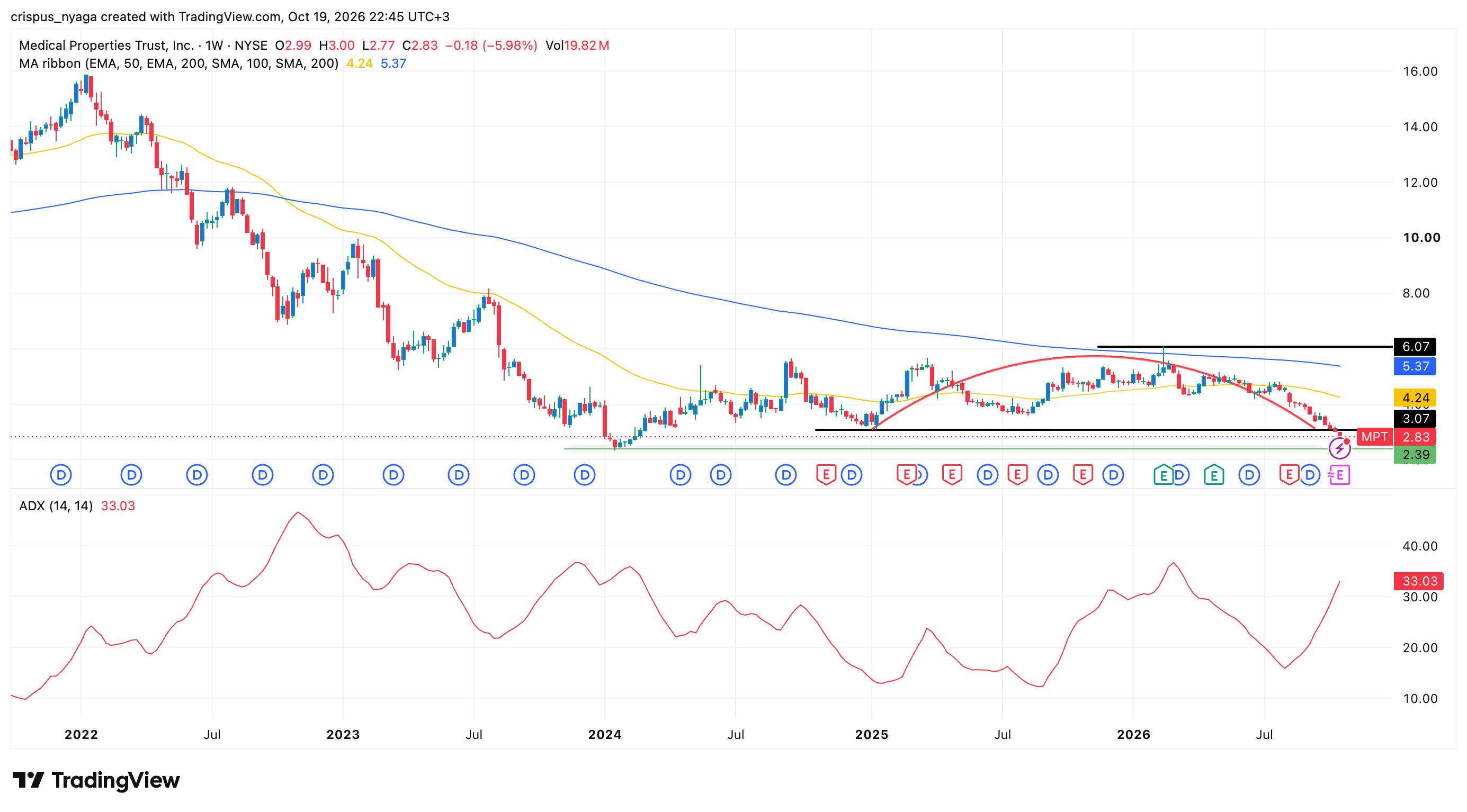
Medical Properties Trust stock continued its strong downward trend, reaching its lowest level since February 2024. MPT has slipped by 53% from the year-to-date high, even as the company has made efforts to extend its maturities. Over time, its market capitalization has slumped from over $15 billion to $1.68 billion, and technicals suggest that it has more downside.

Medical Properties Trust stock has formed risky technicals

Technical analysis suggests that the MPT stock has more downside to go in the near term. It dropped below the important support level of $3.0, its lowest level in January last year, and the lower side of the inverted cup-and-handle pattern. Inverted C&H is one of the most accurate continuation signs in technical analysis.

The stock has remained below the 50-week Exponential Moving Average (EMA). It is also along the lower side of the Bollinger Bands, while the Average Directional Index (ADX) has jumped to 33, its highest point since March, a sign that the downward trend is gaining momentum.

These technicals suggest that the stock has more downside to go, potentially to the psychological level of $2. A drop below that price will point to more downside, potentially to $2.50. 

medical properties trust

MPT stock chart | Source: TradingView

Medical Properties Trust is facing major challenges

MPT stock is facing some major challenges. One of them is the fact that interest rates and bond yields are rising. The Federal Reserve hiked interest rates by 0.25% in the last meeting, and analysts expect the bank to hike again later this year. US bond yields are hovering near their highest levels in years. 

REITs tend to underperform the market whenever the Fed is hiking interest rates. This partly explains why investors have continued shorting the company. Its short interest jumped to 24%, making it one of the most heavily shorted companies in the US.

Medical Properties has worked hard to improve its business and boost its balance sheet. In September, it completed the sale of two hospitals in a $371 million deal. Before that, in August, it announced a $2.4 billion private refinancing transaction to extend its debt maturities to 2032. 

The challenge, however, is that the refinancing was quite expensive, as the new Senior Secured Notes have a 9.25% rate. It used the new funds to pay its notes due 2026 and some of those due in 2027. The company also received $100 million in cash after the IPO of Infracore SA. 

Still, analysts have remained highly skeptical about Medical Properties Trust, with Wells Fargo slashing its target from $5 to $3.80. Royal Bank of Canada (RBC) also slashed its target from $5 to $4.50. 

These analysts believe that, while the refinancing is good, the company faces other challenges. Years after Steward and Prospect filed for bankruptcy, HSA and NOR, its other top tenants, are struggling to pay their rent. HSA is paying about 75% of its contractual rent. While NOR is paying, there is a risk that its crisis will resume. 

The post Medical Properties Trust has slumped: is it a good dividend stock to buy? appeared first on Invezz

SpaceX shares gained after Elon Musk proposed giving a share to every American child next year, while oil prices surged above $110 a barrel following reports of a US attack on an Iranian naval base.

CoreWeave rebounded after analyst upgrades, and Amazon received a higher price target from Morgan Stanley on its AI and cloud growth prospects.

SpaceX: Musk proposes giving shares to every American child

SpaceX shares rose on Monday after CEO Elon Musk said he planned to give one share of the company to every American child next year.

“There are roughly 70 million Americans below the age of 18,” Musk wrote on X. At current prices, distributing that many shares would represent approximately $10 billion in value and slightly more than 1% of the six billion-plus shares he controls.

The proposal follows Anthropic’s plan to allocate 5% of its stock to a public benefit fund, as companies explore ways to address public concerns about artificial intelligence safety.

However, details of Musk’s proposed distribution remain unclear, including the timing and type of shares involved. SpaceX did not respond to a request for comment.

The company’s shares had fallen more than 10% last week amid a broader technology sell-off.

Investors were also preparing for its third-quarter earnings report on Tuesday.

Analysts surveyed by FactSet expected earnings per share of $0.14 on revenue of $12.9 billion.

Brent crude rises above $110 after Iran attack report

Oil prices rose above $110 after Al Jazeera reported a US attack on Iran’s Konarak naval base, raising concerns about further disruption to Middle Eastern energy supplies.

Brent crude futures traded near $109 per barrel after rising above $110 in the session, while West Texas Intermediate traded above $103.

The reported attack renewed concerns about escalation in a conflict that has already disrupted shipping through the Strait of Hormuz.

Al Jazeera, citing Iran’s navy, reported that two light projectiles struck the naval complex, injuring two soldiers, and that a 35-millimetre cannon was targeted.

Supply concerns had already intensified, with Kpler data showing average crude flows through the Gulf falling to approximately 8.5 million barrels per day last week, based on a seven-day average, compared with more than 20 million barrels per day in the preceding week.

Oil had initially declined after the US moved to ease restrictions on Russian oil.

However, the latest reports shifted market attention back towards geopolitical risks and the possibility of further supply disruptions.

US Treasury yields also moved higher, with the 10-year yield rising five basis points to 5.148% and the 30-year yield reaching 5.48%.

Goldman Sachs upgrades CoreWeave

CoreWeave shares rebounded on Monday after a steep sell-off, supported by positive analyst commentary and a broader recovery in technology stocks.

Goldman Sachs upgraded the AI-focused cloud computing company to Buy from Neutral, although it lowered its price target to $106 from $139.

Analyst Gabriela Borges argued that investor concerns about the company’s risks may have become overstated.

Cantor Fitzgerald maintained its Overweight rating and $176 price target, while Evercore ISI and Deutsche Bank retained positive ratings with $150 targets.

The recovery followed a 24% decline over the five sessions through the previous week.

Investors have become increasingly concerned about CoreWeave’s debt-funded expansion and the cost of financing its data-centre infrastructure.

The company rents computing capacity powered by Nvidia graphics processing units to AI developers, including OpenAI, and major technology companies such as Meta Platforms.

Despite strong demand for AI computing capacity, investors are assessing whether future revenue and profits can justify the company’s substantial borrowing and infrastructure commitments.

Amazon stock surges 5% after Morgan Stanley upgrade

Amazon shares advanced 5% after Morgan Stanley raised its price target to $350 from $335 and reiterated an Overweight rating, identifying the company as one of its top picks.

The new target implies approximately 40% upside from Friday’s closing price of $250.

Analyst Brian Nowak expects Amazon Web Services (AWS) to remain a major growth driver, forecasting year-over-year growth of 47% in 2027.

Nowak also highlighted opportunities in agentic AI, which allows systems to perform tasks on users’ behalf, and in robotic fulfilment operations.

“We continue to think AWS’s growth and profit runway is under-appreciated,” Nowak wrote in a research note.

Amazon’s cloud business could benefit from expanding demand for AI computing, while its established e-commerce infrastructure may help it participate in AI-powered shopping.

Morgan Stanley also sees potential for Amazon to expand its use of robotics through new fulfilment centres and upgrades to existing facilities in 2027.

The post Evening digest: SpaceX plans share giveaway to US children, CoreWeave rebounds appeared first on Invezz

The Nasdaq Composite rose on Monday as investors returned to technology and artificial intelligence-related stocks following last week’s sharp selloff, while markets looked ahead to earnings from major US companies.

The tech-heavy index gained 1.1%, while the S&P 500 advanced 0.4%. The Dow Jones Industrial Average finished slightly below the flatline.

The rebound followed a difficult week for US equities, with the S&P 500 falling nearly 2% and the Nasdaq declining 4.5%.

Both indexes recorded their biggest weekly losses since late June.

The information technology sector also posted its worst weekly performance since April 2025.

Investors have become increasingly concerned about the cost of financing AI infrastructure and whether future earnings growth will justify the substantial investments being made across the sector.

Chip stocks recover as semiconductor index ends losing streak

Semiconductor stocks helped support the market recovery.

Intel shares climbed around 2% after JPMorgan upgraded the stock to neutral from underweight. Advanced Micro Devices gained 1%, while Micron Technology rose 2%.

The Philadelphia Semiconductor Index ended an eight-session losing streak during which it had fallen approximately 15.7%, marking its longest run of declines since October 2008.

The recovery followed heavy selling in technology stocks last week, when investors reassessed the financial risks associated with the AI investment boom.

The technology sector was the most net-sold global sector, according to Goldman Sachs, with hedge funds selling a record proportion of their technology holdings.

However, the rebound was uneven. CoreWeave shares fell around 0.44%, reversing earlier gains despite Goldman Sachs upgrading the cloud computing company to buy from neutral.

CoreWeave’s stock plunged more than 25% last week amid concerns about its debt burden, reported at around $50 billion.

The company’s credit default swaps also reached distressed levels, reflecting growing unease in the corporate bond market.

AI financing concerns remain a key market risk

Investor concerns intensified after reports that Anthropic generated $16.8 billion in third-quarter revenue, up from $11.6 billion in the second quarter.

Although revenue increased, the figures prompted questions about the pace of growth relative to the scale of investment in AI infrastructure.

Market participants are increasingly assessing whether AI-related companies can generate sufficient returns on capital to justify their borrowing and infrastructure spending.

The recent pressure on CoreWeave has also raised questions about the resilience of AI investments in an environment of higher interest rates.

If earnings growth moderates, concerns about debt financing could leave the broader market more vulnerable to further volatility.

Other cloud computing companies, including Nebius and Iren, outperformed CoreWeave on Monday.

Oil prices and corporate earnings remain in focus

Developments in energy markets added another source of uncertainty for investors. Attacks on shipping and energy infrastructure in the Persian Gulf, alongside continued strikes involving Russia and Ukraine, have raised concerns about prolonged supply disruptions.

US West Texas Intermediate crude futures settled 2.06% higher at $103.50 a barrel. Brent crude futures, meanwhile, fell 0.41% to $109.41 a barrel.

Higher oil prices can add to inflationary pressures and complicate the outlook for interest rates.

Investors are also preparing for a busy week of corporate earnings.

Meta Platforms and Tesla are scheduled to report results on Wednesday, while SpaceX is due to report on Tuesday.

The results could help investors assess the outlook for technology spending, AI-related investment, and corporate profitability as markets attempt to recover from last week’s losses.

The post Nasdaq rises 1.1% as chip stocks rebound after last week’s AI selloff appeared first on Invezz

Ivanhoe Electric is currently engaged in advanced negotiations to secure buyers for copper from its Santa Cruz project in Arizona. According to CEO Taylor Melvin, these potential offtake agreements are not just about selling the metal but could serve as a critical source of financing to get the mine built. While Melvin declined to name the specific companies involved, he noted that the firm is simultaneously coordinating project financing discussions with roughly a dozen commercial banks.

The urgency behind these deals stems from a tightening global copper market, fueled largely by the massive infrastructure requirements of the artificial intelligence revolution. As demand continues to outpace current supplies and push prices toward record levels, Melvin argues that the United States desperately needs more domestic production. He pointed out that while Santa Cruz is a significant step forward, much more development across the country is required to truly bridge the supply gap.

This trend of tech giants securing raw materials directly from miners is becoming more common. For instance, Amazon Web Services recently partnered with Rio Tinto to utilize copper from another Arizona operation for its own data centers. Ivanhoe hopes to replicate similar success at Santa Cruz, where they plan to produce copper cathode on site through underground mining and heap leaching. This high grade material serves as the essential feedstock for cables and wiring used throughout the modern digital economy.

Funding for the ambitious project is already gaining momentum on a government level. The company recently received a preliminary letter from the Export-Import Bank of the United States indicating potential debt financing of 1.1 billion dollars under the Make More in America Initiative. This follows public comments from President Donald Trump regarding federal support for the venture. Though some permitting hurdles remain at various government levels, Ivanhoe aims to begin producing its first cathodes by 2029 with an estimated initial capital cost of 1.43 billion dollars.

In a decisive move to prioritize ecological health over industrial gain, Greenland’s parliament has voted unanimously to block deep sea mining and seabed exploration around the island. The resolution instructs the government to draft a comprehensive law prohibiting these activities until at least the end of 2029. While the vote acts as a legislative mandate rather than an instant freeze, officials expect the formal legal framework to be finalized during the spring session of 2027. To ensure long term protection, the upcoming laws will include provisions allowing the moratorium to be extended in two year intervals beyond 2029.

Lawmakers were clear that their primary motivation is the preservation of the marine environment and the stability of fish populations. Because Greenland relies so heavily on its commercial fishing industry for economic survival, members of parliament concluded that the risks posed by seabed disruption far outweigh any hypothetical financial windfall from mining revenues. By choosing biological welfare over extractive profits, the territory is signaling a cautious approach to managing its vast underwater resources.

The timing of the vote adds a layer of geopolitical tension, coming just one day after U.S. President Donald Trump suggested via social media that massive mineral and energy exploration was poised to begin on the island. Trump linked these prospects to a recent trilateral security agreement between the United States, Denmark, and Greenland designed to limit non NATO influence in the region. However, those claims have been met with firm corrections from diplomacy channels, with the Danish Ministry of Foreign Affairs clarifying that security pacts do not grant Washington any special rights to extract minerals under Greenlandic law.

Despite this setback for ocean floor ventures, land based mining remains a high stakes game for Western powers seeking to break China’s grip on critical minerals. Deposits like those found at Tanbreez continue to make Greenland a strategic focal point for global supply chains. For now though, existing operators remain in limbo without new licenses being issued since 2021, leaving many international firms waiting on a green light that may not come anytime soon given current priorities in Nuuk.

From the heights of London’s Millbank Tower, the shifting tides of British politics are physically visible. This skyscraper once served as the bastion of the Conservative Party, but today it houses Reform UK, the populist movement led by Nigel Farage. This transition is more than just a change of address; it symbolizes a broader seismic shift occurring across Europe’s largest democracies. From France, where Marine Le Pen’s National Rally is gaining unprecedented ground, to Germany, where the AfD is challenging long-standing centrist norms, the traditional political establishment is facing an existential crisis.

This surge in populism is forcing legacy conservative parties into a difficult strategic corner. They must either pivot toward harder lines on immigration and national identity to stem the bleeding of their voter base or risk becoming irrelevant. Former British minister Steve Baker suggests that we are witnessing a fundamental realignment where identity and nationalism have replaced economics as the primary driver of political debate. With stagnant economic growth fueling deep frustrations with global institutions, many voters are seeking simple explanations for their hardships, often leading to increased hostility toward ethnic and cultural minorities.

In the United Kingdom, this struggle has evolved beyond mere policy disputes over border control and entered a volatile debate over nationality itself. While Reform UK capitalizes on anger over record migration levels, a deeper conflict has emerged regarding who qualifies as English. Current Conservative leader Kemi Badenoch has pushed back against ethno-nationalist definitions of citizenship, arguing against a vision of identity based solely on ancestry. However, voices like Baker warn that ignoring genuine anxieties about demographic changes in local communities allows these radical conversations to move further into the mainstream.

The instability extends even further rightward than previously imagined. Even as Reform UK navigates internal scandals and fluctuating polls, newer movements such as Restore Britain—backed by figures like Elon Musk—are emerging to claim that Farage is not aggressive enough on issues of Islam and national purity. Meanwhile, in Germany, the historical brandmauer or political firewall designed to keep extremists out of government is under immense pressure as nationalist sentiment grows. Across the continent, the old guard is discovering that once the door to identity politics opens wide, it becomes nearly impossible to close again.

Representative Marie Gluesenkamp Perez spent a recent afternoon at a county fairgrounds south of Seattle, leaning over a table to learn how to sharpen old kitchen knives and rusty scissors. For most politicians, such a scene might seem like mere optics, but for the owner of an auto repair shop, it is a reflection of the self sufficiency that defines her political identity. Representing Washington’s 3rd Congressional District, Gluesenkamp Perez has carved out a precarious existence as a Democrat in a region that consistently supports Donald Trump, positioning herself as the essential link between urban progressives and rural blue collar workers.

Maintaining this foothold requires a willingness to break ranks with her own party. From opposing student debt relief to voting for restrictive immigration bills and defending against climate change initiatives, she often finds herself in the lonely position of siding with Republicans. These choices have made her a target for progressive critics who view her deviations as performative or harmful to party unity. However, supporters argue that her independence is exactly what allows her to represent nearly one million people with wildly divergent worldviews in an era of extreme polarization.

Her legislative focus mirrors the grit of her district rather than the polish of Capitol Hill. While other lawmakers debate national theory, she focuses on right to repair laws for farmers and mechanics and leads a crusade against oversized sea lions threatening local salmon fisheries. By championing these hyper local issues, she argues that she isn’t being quirky but is simply reflecting the normal priorities of her constituents. This strategy appears to work mathematically; in 2024, she outperformed Kamala Harris in the district by seven percentage points, proving there is still appetite for center left leadership in red territory.

Despite her previous successes, the upcoming election presents a steeper climb. Unlike past cycles where she faced candidates linked to extremist movements, she now faces John Braun, a mainstream businessman and state legislator who may appeal more effectively to moderate swing voters. As Democratic leaders eye the broader goal of reclaiming the House, figures like Gluesenkamp Perez serve as a case study in survival. Her career suggests that for Democrats to maintain a durable majority, they must be willing to tolerate unorthodox members who treat their seats not as owned property, but as rentals that require constant maintenance and local loyalty.

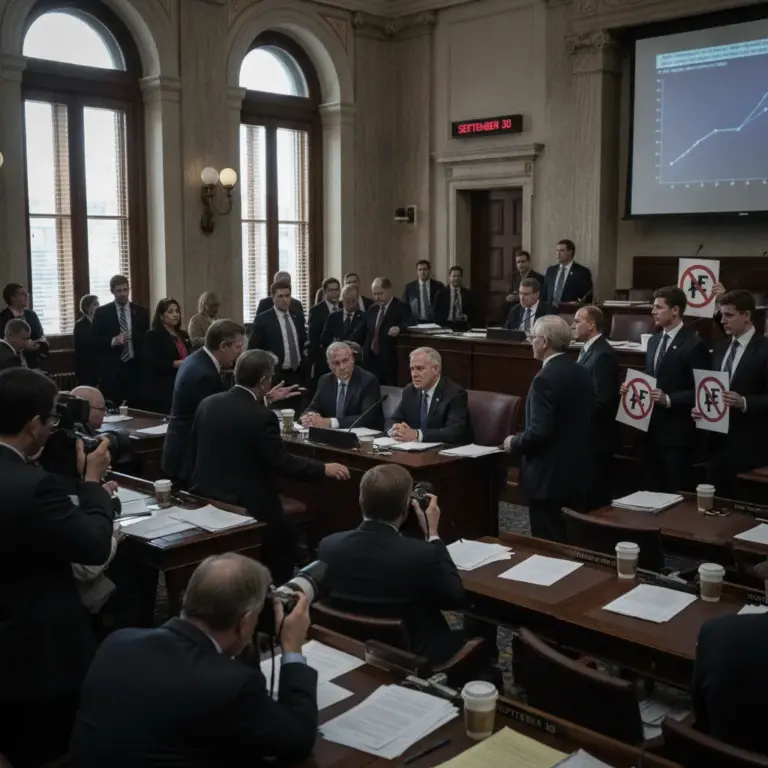
On the surface, the Senate’s final gathering in late September looked like a standard legislative wrap up. There were confirmations to handle, hearings involving former special counsel Jack Smith, and discussions over college sports. However, anyone watching closely could see that the actual goal had very little to do with governance and everything to do with the upcoming midterms. Both parties spent the week engaged in a high stakes game of political theater, trading blows over bills they knew would never actually pass.

The primary battlefield was the Ratepayer Protection Act, a proposal aimed at curbing rising utility costs linked to the explosion of AI data centers. Republicans framed it as a necessary shield for consumers against corporate greed, but Democrats dismissed it as a toothless charade designed solely for campaign commercials. Senator Richard Blumenthal and others argued the bill lacked any real enforcement mechanism, essentially serving as a messaging tool rather than meaningful law.

Much of this friction centered on Senator Jon Husted of Ohio, whose seat is currently one of the most contested in the country. Because Husted had previously fostered data center growth as a state official, critics argue the bill was a calculated attempt to give him cover before he returns home to face voters. Even some within his own party admitted that while the vote might not solve every energy problem, it would certainly provide helpful ammunition for Husted’s reelection campaign ads.

As the session closed, it became clear that neither side was particularly interested in compromise; instead, they preferred to weaponize failure. By blocking GOP measures on data centers and lawmaker stock trades, Democrats created their own talking points about Republican inefficiency. Meanwhile, Republicans intend to frame those same blocks as proof that Democrats are indifferent to the cost of living. In the end, the Senate didn’t produce many results for Americans, but it provided plenty of material for twenty four hour news cycles and campaign flyers.