Archive

November 2026

Browsing

The veil of secrecy surrounding the finances of elite AI labs is beginning to lift as Anthropic moves closer toward an initial public offering. Recent updates to the company’s S-1 filings provide a rare glimpse into the brutal mathematics of running a frontier model, revealing that while revenue is skyrocketing, the cost of the hardware required to power those models is climbing just as fast. Between June and September, Anthropic saw its quarterly revenue jump from 11.5 billion to 17 billion dollars, yet this impressive growth was shadowed by widening operating losses driven primarily by computing expenses.

The numbers suggest a worrying trend for potential investors who typically look for improving profit margins before a company goes public. In the most recent quarter disclosed, compute costs consumed 58 percent of total revenue, a significant increase from 48 percent in the previous period. Essentially, for every dollar spent on compute, the return has dipped from a peak of over two times back down to 1.72 times. This suggests that scaling an AI business isn’t simply a matter of adding more users; it requires an increasingly expensive foundation of silicon and electricity.

This margin squeeze appears to be a byproduct of Anthropic’s own success. Demand surged so rapidly that the company had to scramble for immediate capacity, leading them to enter expensive short-term agreements known as neoclouds rather than relying solely on cheaper, multi-year contracts with giant hyperscalers. These desperate measures included massive payouts to firms like SpaceX and Akamai, with billions allocated to ensure their systems didn’t crash under the weight of new users. While these are often described as champagne problems—since they stem from overwhelming popularity—they highlight a precarious dependency on third party infrastructure providers.

To combat these soaring bills, Anthropic is attempting to build its own internal infrastructure through an initiative called Anthropic Direct. However, given the current pace of global AI adoption, internal projects likely cannot scale quickly enough to replace external rentals entirely. For now, the company remains tethered to a volatile infrastructure market where any hiccup in data center construction or shifts in bond markets could turn today’s messy balance sheet into tomorrow’s crisis. Until they can decouple their growth from these predatory pricing cycles, Anthropic remains largely at the mercy of whoever owns the chips.


Binance co-CEO Richard Teng revealed that a sophisticated, multi-month operation led to a staggering loss of over 6 billion dollars in digital assets during a record-breaking cyberattack on October 29. In an interview with CNBC, Teng explained that the breach was not the result of a single mistake but rather a calculated campaign where hackers spent months infiltrating the company’s systems. The attackers utilized high-pressure social engineering tactics, including posing as recruiters to lure employees into fake job interviews that featured malware-laden coding exercises designed specifically to bypass corporate security measures.

The infiltration began as early as June when a DevOps engineer accidentally installed a tampered version of a developer tool while trying to download an AI coding assistant. Although Binance initially attempted to contain the threat by replacing hardware and rotating credentials, the hackers had already mapped out the roles of key personnel within the wallet infrastructure team. This foothold allowed them to pivot through internal AI tools and eventually gain authorization over the systems responsible for processing wallet transactions.

Despite the scale of the theft, Binance reports that it has already replenished roughly 98 percent of the 6.34 billion dollars in affected assets using its own reserves. While some funds remain difficult to recover due to their illiquidity or laundering efforts, several industry giants including Tether and Ripple have helped freeze approximately 3 billion dollars in stolen capital. Though federal investigators have linked the heist to North Korean actors known as TraderTraitor, Teng refrained from making definitive attributions himself.

To prevent future breaches, Binance has completely rebuilt its affected wallet systems and internal AI tools while implementing stricter security scans across all employee devices. An independent expert has been brought in to audit these changes as part of a broader effort to restore investor confidence in centralized exchanges. For now, the company remains focused on collaborating with global law enforcement agencies to track down any remaining missing funds moving through various blockchain channels.

Advanced Micro Devices shares climbed 7 percent in extended trading Tuesday after the company posted third-quarter results that comfortably beat Wall Street expectations. The chipmaker reported revenue of 13.38 billion dollars, a 45 percent increase from the previous year, driven largely by a massive surge in its data center business. This specific segment has become the engine of AMD’s growth, now accounting for 64 percent of total revenue compared to just 47 percent a year ago.

Chief Executive Officer Lisa Su expressed strong confidence in the company’s trajectory, noting that demand for data center processors is expected to accelerate further. While competitors like Intel have also seen growth in this sector, AMD appears to be navigating the supply chain more effectively, avoiding the guidance concerns that recently sent Intel’s stock tumbling. The resurgence is being fueled by the rise of agentic AI applications, which rely heavily on server CPUs to power virtual machines for extended periods.

The success in high-end AI infrastructure provides a critical cushion as other parts of the business struggle. AMD’s gaming and PC chip segments saw declines, with gaming revenue dropping 40 percent amid a broader industry slump and rising component costs that have dampened global PC shipments. Despite these headwinds, the company’s aggressive expansion into AI hardware, including its Helios rack-scale systems used by giants like Meta and Microsoft, has kept investors bullish.

Looking ahead, AMD expects fourth-quarter revenue to hit approximately 17 billion dollars, surpassing analyst estimates. To sustain this momentum, Su is focusing on scaling supply through 2027 and expanding the company’s intellectual footprint. Recent strategic moves include an 8.2 billion dollar acquisition of World Labs to develop 3D world models for robotics, alongside significant investments in AI pioneers like Anthropic.

As American voters head to the polls this Tuesday, investors are closely watching the ballot box to see who will seize control of Congress. At stake is not just political power, but the future trajectory of a stock market that has already surged twenty seven percent since the start of President Trump’s second term. While an explosion in artificial intelligence spending and robust earnings have driven recent gains, a shift in legislative power could introduce new variables into an already volatile economic landscape.

The prospect of a Democratic sweep has some analysts concerned about increased scrutiny of the tech sector. If Democrats secure both chambers, they may push for tighter oversight of AI development and attempt to roll back previous deregulation efforts, potentially rattling markets that have grown reliant on rapid innovation. However, historical data suggests that a split government does not necessarily signal a downturn. According to Ned Davis Research, stocks often perform reasonably well during periods of political gridlock, with median gains following midterms even when the president’s party loses its grip on the House.

Beyond technology, the looming shadow of the national debt remains a primary concern for Treasury yields. With budget deficits widening toward two trillion dollars and geopolitical tensions fueling energy price spikes, any outcome involving bipartisan compromise could lead to high stakes brinkmanship over the debt ceiling. Analysts suggest that while a divided government might force difficult negotiations to avoid shutdowns, it could also prevent extreme policy swings that typically spook institutional investors.

Conversely, if Republicans maintain their majorities in both houses, experts believe we would see maximum continuity for current policies. This scenario would likely favor further tax reforms and expanded defense spending while removing the threat of aggressive AI investigations. Strategists from JPMorgan indicate that such stability would provide the most supportive environment for infrastructure projects and federal permitting, keeping the momentum alive for those betting on long term industrial growth.

On Monday, Anthropic’s latest regulatory filing revealed a sharp increase in revenue in its third quarter alongside widening losses and nearly $895.4 billion in infrastructure commitments.

Meanwhile, Marvell Technology agreed to acquire Lumentum in an all-stock deal valued at approximately $115 billion, highlighting the growing demand for AI data-centre infrastructure.

In commodities, oil prices fell sharply on hopes of progress in US-Iran peace talks, while gold rebounded from a one-year low as easing crude prices reduced inflation concerns.

Anthropic’s Q3 revenue jumps twelve-fold as losses widen

Anthropic reported nearly $17 billion in third-quarter revenue, representing a twelve-fold increase from the same period last year, according to an amended Form S-1 filing with the US Securities and Exchange Commission.

However, the company behind the Claude AI platform reported a net loss of $23.3 billion, compared with $12.1 billion a year earlier.

Operating expenses increased 292% to $17.5 billion.

The filing also disclosed approximately $895.4 billion in purchase commitments and lease agreements, largely related to computing infrastructure.

Around $448 billion of these commitments are expected before the end of 2030.

Anthropic filed for an initial public offering on October 26 and plans to list on the Nasdaq Global Select Market under the ticker ANT.

Goldman Sachs and Morgan Stanley are leading the offering.

Marvell agrees to acquire Lumentum in $115 billion deal

Marvell Technology agreed to acquire data-centre optics maker Lumentum in an all-stock transaction valued at approximately $115 billion, including debt.

Under the agreement, Lumentum shareholders will receive 4.5 Marvell shares for each share they own.

The transaction values Lumentum at approximately $1,132 per share, representing a 24% premium to its October 28 closing price.

The acquisition will expand Marvell’s presence in AI infrastructure by combining its custom chips and networking processors with Lumentum’s optical connectivity technologies.

Marvell CEO Matt Murphy said AI infrastructure was undergoing a fundamental shift towards optical connectivity, creating a significant opportunity for the combined business.

However, the transaction has raised concerns about valuation, shareholder dilution and regulatory approval.

Both US and Chinese authorities will need to review the deal.

Oil prices fall as US-Iran peace talks raise supply hopes

Oil prices dropped more than 7% on Monday as diplomatic developments involving Iran and Qatar raised hopes of progress towards ending the US-Israeli war with Iran.

Brent crude futures fell 7.87% to $104.50 a barrel, while US West Texas Intermediate crude declined 7.7% to $96.08.

Iranian President Masoud Pezeshkian said Supreme Leader Ayatollah Mojtaba Khamenei had granted the government certain authorities regarding peace negotiations.

The discussions followed several weeks of concerns about shipping disruptions through the Strait of Hormuz and attacks on oil tankers.

However, analysts cautioned that a diplomatic breakthrough remained uncertain.

UBS analyst Giovanni Staunovo said the oil market continued to react sensitively to developments in the Middle East.

Goldman Sachs warned that Brent could reach $140 in 2027 if Gulf oil production remained 3.5 million barrels per day below its 2025 average.

Gold rebounds as falling oil prices ease inflation concerns

Gold prices recovered on Monday, rising nearly 2% after hitting a one-year low in the previous session.

Spot gold gained 1.93% to $3,949.90 per ounce, while US gold futures for December delivery rose 1.69% to $3,964.10.

The rebound followed a sharp decline in oil prices, which helped ease concerns about inflation and the potential impact on US interest rates.

Investors are also monitoring the November 3 US midterm elections for potential implications for fiscal policy and market sentiment.

Spot silver climbed 2.97% to $50.55 per ounce, while platinum gained 1.2% to $1,448.35. Palladium remained broadly steady at $976.13.

The post Evening digest: Anthropic losses widen, Marvell buys Lumentum appeared first on Invezz

SpaceX is exploring ways to enter the US wireless market, with a potential acquisition of EchoStar’s Boost Mobile emerging as one route to accelerate its ambitions.

The company, led by Elon Musk, has held discussions with EchoStar and Chairman Charlie Ergen about acquiring Boost Mobile or gaining access to its network, according to a report by The Washington Post on Monday.

The move could help SpaceX establish a fourth national wireless carrier and compete with AT&T, Verizon Communications and T-Mobile.

SpaceX shares SPCX rose more than 2% on Monday, trading slightly above their $135 initial public offering price.

Boost Mobile could accelerate SpaceX’s wireless ambitions

SpaceX has been expanding its Starlink satellite internet business and is looking to extend its reach into mobile communications.

However, its satellite network does not yet have the terrestrial infrastructure and low-band spectrum needed to provide comprehensive wireless coverage.

Starlink had 13.6 million users at the end of the third quarter, an increase of about 90% from a year earlier.

The service operates more than 11,000 satellites across over 170 countries, generating $5.2 billion in third-quarter revenue and profit margins above 65%.

Boost Mobile could provide a faster entry into the wireless market.

EchoStar’s service had more than 7.5 million subscribers at the end of 2025 and operates as a mobile virtual network operator (MVNO).

Rather than owning its own wireless infrastructure, Boost leases network capacity from AT&T and T-Mobile.

However, transferring those agreements to SpaceX could prove difficult.

Barclays analyst Kannan Venkateshwar said the network-leasing agreements might not transfer to a new owner without approval from AT&T and T-Mobile.

He added that the major carriers had repeatedly refused SpaceX network access, making it uncertain whether they would agree to transfer the Boost arrangements.

SpaceX’s options include partnerships and acquisitions

The Boost Mobile discussions follow reports that SpaceX has explored other ways to expand its wireless capabilities, including buying access to cellular towers.

The company has reportedly been in talks with Crown Castle, while American Tower has also indicated that it is discussing potential opportunities with SpaceX.

BNP Paribas analyst Sam McHugh said the latest report suggested a possible shift towards an MVNO arrangement, although SpaceX could pursue multiple options.

Citi analyst Michael Rollins has also identified an outright acquisition of a telecommunications company as a potential route.

Such a deal could bring forward the launch of Starlink Mobile by several years, although acquiring a larger business would be a substantial undertaking.

An acquisition of EchoStar could provide SpaceX with access to additional spectrum and Dish Wireless assets.

However, Dish Wireless remains in Chapter 11 proceedings, while EchoStar’s satellite television business emerged from bankruptcy protection last month.

EchoStar Chairman Charlie Ergen acknowledged in August that the company had struggled to make its wireless business successful.

He said EchoStar had flexibility to improve the business through partnerships or a merger.

Telecom stocks react as investors assess competitive threat

The prospect of SpaceX entering the wireless market has kept investors focused on the potential impact on established telecom operators and infrastructure providers.

AT&T and T-Mobile shares initially opened lower on Monday but recovered, trading up 0.12% and 1.77%, respectively, in midday trading. Verizon shares also rebounded after opening lower, gaining 0.64%.

Wireless tower operators had a weaker session.

Crown Castle shares declined 2.14%.

Crown Castle shares had gained around 30% over the previous month amid expectations that SpaceX could become a new tenant.

EchoStar was among the early beneficiaries of the report, rising 4.6% in early trading before its gains narrowed.

The post SpaceX stock rises as Musk explores Boost Mobile deal for wireless push appeared first on Invezz

Apple reported better-than-expected revenue and earnings for its September quarter.

The company’s shares were trading slightly higher in Monday’s after-hours trading as investors assessed the impact of higher device prices, supply constraints, and demand ahead of the holiday season.

The company generated revenue of $114.5 billion, up 12% from $102.5 billion a year earlier.

Earnings per share came in at $2.10, including a positive impact of five cents from tariff refunds.

Analysts tracked by FactSet had expected revenue of $113.4 billion and earnings per share of $1.99.

The results mark Apple’s first quarterly report since John Ternus became chief executive on September 1, succeeding Tim Cook.

Investors are now looking for details about the company’s outlook for the holiday quarter, particularly as higher component costs and product delays create uncertainty around demand.

iPhone revenue beats estimates despite supply constraints

iPhone revenue reached $57.58 billion, exceeding analysts’ expectations of $56.54 billion, according to LSEG data.

However, the figure included only eight days of sales of the new iPhone 18 Pro models. Apple’s foldable iPhone Duo was not available until after the quarter ended.

Apple’s performance came despite a challenging environment for smartphone manufacturers.

A global shortage of memory chips and other components has pushed up production costs, prompting the company to increase iPhone prices by $100.

The higher prices are part of a broader adjustment across Apple’s device range that began in late June.

The company’s chief financial officer, Kevan Parekh, said supply-chain constraints had limited its ability to meet demand in China.

Sales in the country reached $17.5 billion, an increase of around 20% from a year earlier, but below analysts’ expectations of $18.9 billion.

The supply shortage has affected the wider smartphone market.

Global smartphone shipments declined 20% in the third quarter, according to Counterpoint Research.

Apple, however, increased its market share from 18% to 22%, partly benefiting from stronger demand for its premium devices.

Apple’s capital expenditure totalled $2.24 billion during the quarter, below LSEG’s estimate of $3.33 billion.

This continues the company’s trend of investing lightly as other mega tech peers pour capex for AI buildout.

Mac and services revenue support quarterly performance

Apple also reported stronger-than-expected Mac sales, with revenue reaching $10.8 billion, approximately $1 billion above Wall Street forecasts.

Services revenue, which includes the App Store, Apple Pay and iCloud, totalled $31.6 billion.

Net income came in at $30.7 billion.

The company’s gross margin was 47.9%, within its previously provided forecast range of 47% to 48%.

Apple’s results come amid a broader retreat in technology stocks, following disappointing earnings from several major technology companies and concerns about the scale of spending on artificial intelligence infrastructure.

Unlike some of its technology peers, Apple has not committed to a comparable large-scale data-centre investment programme.

This has helped distinguish its business from companies facing questions about the returns on their AI spending.

However, Apple remains exposed to the semiconductor supply constraints affecting the wider technology industry, particularly the rising cost and limited availability of memory chips.

Holiday outlook and iPhone Duo delays remain in focus

Investors are closely watching Apple’s outlook for the holiday season, which is typically discussed during the earnings call following the results.

The company faces several uncertainties, including higher prices, component shortages, and delays affecting the iPhone Duo.

The foldable device has experienced extended delivery times, alongside reports of screen cracks.

Apple has said the issues have affected only a limited number of devices.

The company also delayed the launch of the cheaper base iPhone 18 model until next year, complicating comparisons with previous product cycles.

Parekh said it was difficult to determine how much of the stronger iPhone performance reflected customers purchasing devices ahead of anticipated price increases.

The post Apple posts earnings beat with better than expected iPhone and Mac sales appeared first on Invezz

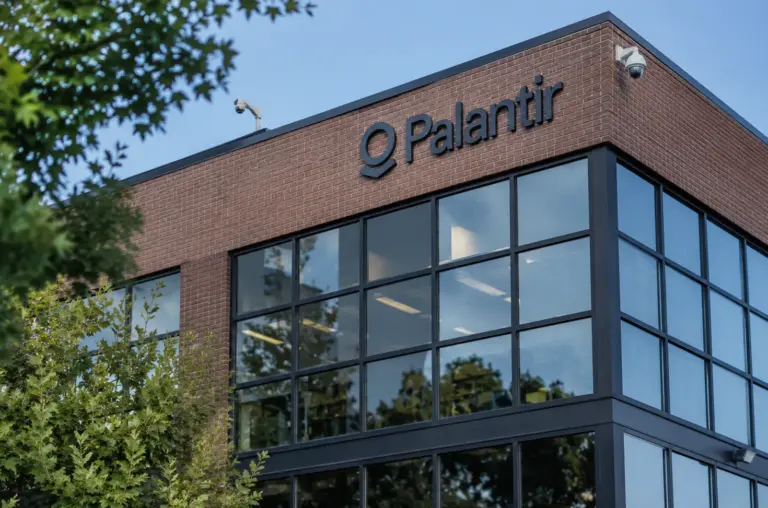
Palantir Technologies Inc (PLTR) nearly doubled its quarterly revenue – but investors have a more revealing question to consider: is the company “replenishing” its growth engine as quickly as it is collecting sales?

The software maker reported Q3 revenue of $2.313 billion after Monday’s closing bell, up roughly 96% from a year earlier and above the $2.18 billion analysts expected. Adjusted earnings reached $0.44 a share.

The Nov. 2 report strengthens the case that corporate AI spending is translating into “substantial” business – but also exposes a gap between revenue growth and new contract growth that deserves attention.

Commercial unit is changing Palantir stock’s investment case

US commercial revenue reached $984 million, surpassing the $953 million generated by American government customers for the first time.

For shareholders, the significance extends beyond which business occupies first place.

Corporate adoption gives Palantir another route to expansion – with purchasing decisions spread across businesses facing different operational problems and budget cycles.

That potentially broadens PLTR shares opportunity while trimming reliance on any single category of customer. However, a changing sales mix alone cannot really establish that customers will keep expanding their spending.

A stronger investment case requires repeat buys, deeper deployments and sustained profitability.

This quarter offers encouraging evidence of commercial demand; subsequent quarters must demonstrate that the demand can compound as the business becomes substantially larger.

Palantir’s contract figures deserve a clear look

Here’s the tension beneath the earnings celebration: US commercial revenue increased a whopping 148%, while the total value of newly signed US commercial contracts rose just 11%.

Those measures cover different things.

Revenue reflects work recognized during the quarter; contract value captures potential business over the life of agreements.

Comparing their growth rates, therefore, cannot establish that a slowdown is imminent.

Still, the divergence creates a useful question for investors: how much of today’s expansion reflects earlier deal wins, and how quickly is tomorrow’s revenue being replenished?

Large agreements can make quarterly bookings uneven.

The sensible test is whether contract momentum strengthens across several reporting periods.

Sustained weakness would make the current revenue trajectory harder to extrapolate, even if near-term results remain impressive.

Strong guidance raises the bar for PLTR shares

Management’s Q4 sales outlook of $2.649 billion to $2.653 billion implies about a 15% sequential growth at the midpoint.

That signals further expansion rather than an immediate pause.

For prospective buyers, however, operational momentum answers only part of the investment question.

The return on PLTR shares also depends on the growth already embedded in their purchase price.

A useful approach is to consider what happens if expansion moderates: would the expected earnings still justify the valuation?

Monday’s results strengthen Palantir’s business case.

Investors should now watch whether new contracts support the higher sales trajectory – and whether the price they pay leaves room for a less spectacular quarter.

The post Palantir delivers blowout quarter – but there’s a catch appeared first on Invezz

US stocks ended mixed on Monday as technology shares gave up earlier gains, extending pressure on the sector amid concerns about artificial intelligence spending and returns on investment.

The Nasdaq Composite fell 1.07%, while the S&P 500 declined 0.50%.

The Dow Jones Industrial Average outperformed, rising 0.43%.

The Nasdaq and S&P 500 had climbed as much as 1.4% and 1.1%, respectively, during the session before reversing course.

The session followed a difficult October for technology shares.

The Nasdaq fell 5.3% during the month, its worst monthly performance since March 2025, as investors questioned whether major technology companies’ investments in AI infrastructure were translating into sufficient cash generation.

Technology stocks retreat as AI spending concerns persist

Several major technology stocks ended lower. Nvidia and Meta Platforms declined 0.5% and 0.7%, respectively, while Apple fell around 2% ahead of its quarterly earnings report.

Chipmakers and companies linked to AI infrastructure also faced selling pressure.

Marvell Technology dropped approximately 12%, while Lumentum fell 18% after announcing a $115 billion all-stock acquisition agreement, including debt.

Oracle shares declined 8% after the company disclosed plans to raise $20 billion through a combination of common stock and bonds to finance its AI expansion.

The proposed fundraising added to investor concerns about the amount of debt and equity financing required to support infrastructure spending.

Intel also remained under pressure after falling 29% on Friday.

The company had forecast quarterly revenue below market expectations and said it did not expect positive cash flow this year.

Palantir and AMD shares declined ahead of their quarterly results, with AMD scheduled to report on Tuesday.

Despite the recent weakness, third-quarter S&P 500 earnings were on track to increase by more than 30% year over year, according to LSEG data.

AI-related companies accounted for a substantial portion of the expected growth.

Dow outperforms as investors rotate into other sectors

The Dow’s gains reflected stronger performance among companies outside the technology sector.

Sherwin-Williams rose 5.9%, while Home Depot advanced 3.63%.

Honeywell International, 3M and Boeing also gained more than 2% each.

The performance extended a broader rotation into more defensive and traditional industries.

During October, the Dow gained nearly 2%, supported by interest in sectors such as healthcare, while the Nasdaq and S&P 500 recorded monthly declines.

Amazon and Tesla also advanced on Monday, providing some support to the broader market.

Following the recent pullback, the S&P 500 was valued at approximately 19 times expected earnings, its lowest valuation since 2023.

Oil prices fall as investors await US midterm elections

Oil prices dropped sharply amid renewed hopes of progress towards a diplomatic agreement between the US and Iran.

Brent crude futures fell 7.63% to settle at $104.77 a barrel, while US West Texas Intermediate futures declined 7.36% to $96.46.

US Secretary of State Marco Rubio said President Donald Trump had not made a decision about attacking Iran and that Washington preferred a peaceful resolution.

Iranian state media also reported that the country’s foreign minister indicated an agreement was possible if the US demonstrated goodwill.

Lower oil prices helped ease some concerns about inflation and the potential impact on interest rates.

Longer-dated US Treasury yields also moved lower.

Investors are now turning their attention to Tuesday’s US midterm elections and upcoming employment data.

The elections will determine control of Congress, with polls indicating that Democrats could gain the House of Representatives, while the Senate outcome remains uncertain.

The post Nasdaq falls 1% as AI spending concerns weigh on tech stocks appeared first on Invezz

Graphite One has cleared a major regulatory hurdle in its quest to build a domestic supply chain for electric vehicle batteries. The Ohio Environmental Protection Agency recently granted the company its final air permit for a planned 80 million dollar battery anode plant in Conneaut. This facility, designed to handle blending and coating for synthetic anode materials, is intended to reduce the United States’ heavy reliance on China, which currently dominates the global processing of graphite and has tightened export controls on the critical mineral.

The approval sets a tight clock for the company, as construction must begin within eighteen months to keep the permit active. President and CEO Anthony Huston noted that this milestone brings the firm closer to generating its first revenue and achieving the goal of becoming the first American company to commercially produce synthetic graphite anode material. While standard local building permits are still required, Graphite One is moving into an expedited phase of engineering and procurement to get the project off the ground.

Financing for the ambitious project appears robust, with the Export-Import Bank of the US issuing non-binding letters of interest totaling over two billion dollars. These funds would support a phased expansion of the facility’s capacity from an initial ten thousand metric tons per year up to one hundred thousand metric tons. This Ohio plant serves as the final link in a larger strategic chain that begins at the Graphite Creek deposit near Nome, Alaska, which is considered by the US Geological Survey to be the largest graphite deposit in the country.

The push for domestic autonomy is not limited to Graphite One alone. In a similar move toward national security and energy independence, Titan Mining is working with the US Army to establish a graphite processing facility at the Anniston Army Depot in Alabama. By leveraging deposits in upstate New York and utilizing federal land through long-term leases, these companies are racing to ensure that the future of American energy storage is built on home soil rather than imported materials.