Archive

October 2026

Browsing

Corteva (CTVA) shares are undergoing a massive price adjustment on October 1st, plunging rather sharply after the market opened.

While a glance at CTVA stock might look alarming, the crash isn’t because of a sudden operational collapse or unexpected earnings miss.

Instead, it marks the planned execution of a major corporate restructuring.

Corteva officially completed the separation of its massive seed and advanced genetics division into a newly independent, publicly traded enterprise, shedding massive market value to form a standalone agriculture powerhouse.

What’s behind the massive decline in Corteva stock

The main force driving Corteva stock price down today is the official debut of Vylor Inc. (VYLR) on the New York Stock Exchange.

By spinning off its advanced seed and genetics division, Corteva transferred a substantial portion of its total enterprise capitalization into the new entity.

Under the terms of the split, Corteva shareholders of record as of September 24 received pro-rata VYLR common shares while keeping their existing CTVA stakes.

The resulting price drop in Corteva reflects this equity transfer rather than an actual loss of wealth, as investors’ combined holdings across CTVA and VYLR preserve their underlying portfolio value.

Legal clearance and court ruling

The transaction almost faced a last-minute disruption after the State of California filed a motion for a temporary restraining order – alleging the spin-off was designed to shield valuable seed assets from historical environmental liabilities related to PFAS chemicals.

However, on September 30, a US District Court denied California’s motion, arguing the state had waited until mere days before closing despite knowing about the plans for nearly a year.

This critical legal clearance removed the final obstacle blocking the corporate separation, allowing Corteva and Vylor Inc. to execute the stock distribution as scheduled on October 1 without lingering regulatory delays.

Should you invest in CTVA shares today?

With the Vylor separation complete, Corteva Inc emerges as a lean, pure-play global leader in crop protection.

For long-term investors, today’s crash offers a fresh baseline valuation to evaluate the streamlined business.

CTVA shares now focus entirely on high-margin crop protection solutions – backed by $11 billion innovation pipeline that has consistently delivered margin expansion.

Meanwhile, risk-tolerant growth investors can look toward Vylor stock for direct exposure to next-generation hybrid technologies and agricultural gene editing.

Rather than signaling fundamental distress, Corteva’s post-spin profile presents a compelling entry point for investors seeking stable, innovation-driven exposure to crop health and agricultural inputs

Note that Wall Street firms also currently have a consensus Overweight rating on CTVA, signaling continued confidence in what the future holds for the agri-science company.

A rather lucrative 5.92% dividend yield tied to the NYSE-listed firm makes it even more attractive as a long-term holding heading into next year (2027).

The post What’s happening with Corteva stock price today? appeared first on Invezz
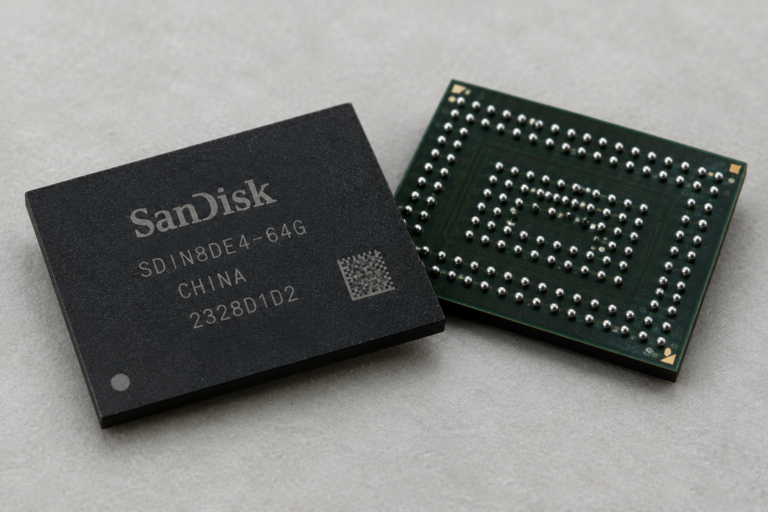
SanDisk shares SNDK rose in afternoon trading Thursday after Citi reiterated its Buy rating on the memory and storage company following Micron Technology’s latest earnings report.

The stock was up over 2% after staying under pressure in morning trading.

Citi maintained a $2,100 price target for SanDisk, implying more than 20% upside from current levels.

The brokerage said Micron’s results offered a favorable read-through for NAND fundamentals, particularly as demand from artificial intelligence data centers continues to expand.

Micron reported a 42% sequential increase in NAND revenue, while NAND prices rose about 30%, well ahead of the roughly 20% increase expected by consensus estimates.

Micron management also indicated that its NAND supply is expected to grow more slowly than overall industry supply growth in calendar 2026, reinforcing expectations that the market will remain tight.

“Sequentially, NAND revenue +42%, B/S +10% as prices increased ~30% (vs. consensus +20% qq/Citi +34% qq) on tight NAND conditions,” said Citi analyst Atif Malik in a Thursday investor note.

“Mgmt expects Micron NAND supply to grow less than industry supply growth in CY26. For CY27/CY28, expect industry NAND bit shipments to grow in the mid-20% range and the industry to remain supply constrained during both years.”

AI demand supports NAND outlook

Citi said the NAND market could remain supported by structural demand from AI infrastructure.

One key driver is the increasing use of solid-state drives to offload key-value cache, or KV cache, from more expensive and constrained high-bandwidth memory and other computing resources.

“We remain constructive on favorable NAND S/D fundamentals on durable AI-led datacenter demand (KV cache offloading to more cost-effective SSDs), and this read-through supports SanDisk’s thesis of strong business fundamentals and increased visibility,” Malik said.

Citi acknowledged that Micron’s expected NAND supply growth is higher than SanDisk’s expectation for industry compound annual growth of roughly the mid-teens.

However, the brokerage maintained its constructive view because of resilient demand and visibility provided by non-binding manufacturer agreements.

“We note while MU NAND B/S growth is higher than SanDisk’s expectations for industry CAGR of mid-teens, we remain constructive given durable demand and visibility via NBMs,” Citi said.

SanDisk stock has soared in 2026

The favorable NAND backdrop has already translated into a dramatic rally for SanDisk shares.

The stock has gained more than 530% this year and more than 1,300% over the past 12 months, as investors have increasingly focused on AI-driven demand for memory and storage products.

Micron shares, however, were down more than 0.15% Thursday despite reporting better-than-expected quarterly results and providing an upbeat outlook.

One concern for investors is that Micron’s earnings beat was smaller than those delivered in previous quarters.

Morgan Stanley analyst Joseph Moore noted that Micron posted an earnings beat of about 5% in the latest quarter, compared with beats of roughly 20% to 40% in several preceding quarters.

The company’s gross-margin guidance of about 86.25% also came in slightly below elevated expectations.

Micron attributed the sequential decline to temporary costs, including inventory absorption, higher fiscal 2027 bonus accruals and cleanroom startup expenses.

Management described the quarter as the cyclical floor for gross margins in fiscal 2027 and expects profitability to expand as revenue grows through the remainder of the year.

Analysts remain bullish on Micron

Analysts nevertheless continued to see support from tight supply conditions.

“The report ‘isn’t an earnings surprise story anymore,'” said Matt Britzman, senior equity analyst at Hargreaves Lansdown.

“We’re into the realm where earnings durability is driving shares higher, rather than any single set of blowout results.”

Raymond James analyst Melissa Fairbanks highlighted Micron’s comments that it has no clear visibility into when NAND supply will catch up with demand.

While the shortage could allow Micron to continue raising prices and expanding profitability, Fairbanks said the constrained supply environment could also limit near-term volume growth.

Goldman Sachs raised its price target for Micron to $1,250 from $1,100 while maintaining a Neutral rating.

Analyst James Schneider cited strong demand and a growing base of customer commitments.

Micron now has 26 long-term agreements covering about 35% of projected revenue through fiscal 2030, with roughly 75% of those agreements carrying structured pricing.

For SanDisk, the combination of AI-driven storage demand, limited NAND supply, and long-term customer commitments provides a supportive backdrop, even after the stock’s extraordinary gains this year.

The post SanDisk stock rises as Citi sees 20% upside after Micron earnings, tight NAND market appeared first on Invezz

Synopsys (SNPS) shares jumped 13% on Thursday after the chip-design software maker issued fiscal 2027 revenue and profit forecasts above analysts’ expectations and announced multi-year agreements with OpenAI and Amazon Web Services.

The company outlined its long-term growth targets at its 2026 Investor Day in New York, highlighting demand for chip-design and simulation tools as artificial intelligence investment drives increasingly complex semiconductor development.

Synopsys raises fiscal 2027 outlook

Synopsys expects fiscal 2027 revenue of between $11.1 billion and $11.2 billion, above the $10.81 billion average analyst estimate compiled by LSEG.

Its forecast for earnings per share of $19.04 to $19.12 also exceeds the $17.81 consensus estimate.

The company is targeting roughly 15% compound annual revenue growth between fiscal 2026 and 2030.

It expects its adjusted operating margin to reach about 44% in fiscal 2027 and approximately 50% by fiscal 2030.

Synopsys also expects non-GAAP earnings per share to grow at a mid-20% compound annual rate through fiscal 2030.

Within its business, the company forecasts electronic design automation revenue growth of at least 13% annually, simulation and analysis revenue growth of at least 10%, and Design IP growth of at least 17%.

Berenberg said the investor day “provided significantly more than the market expected,” according to a note to clients.

OpenAI and AWS deals support growth

The updated outlook came alongside new agreements with OpenAI and AWS.

Synopsys agreed to share revenue with OpenAI as part of a partnership to develop an AI model for chip-design work.

Amazon Web Services also signed a multi-year agreement worth more than $1 billion to license Synopsys’ chip-design intellectual property.

Deutsche Bank analyst Gianmarco P. Conti maintained a Buy rating on Synopsys and raised his price target to $640.

Conti said the Amazon and OpenAI agreements could support “higher segment growth floors, faster Ansys revenue synergy ramp, and a steeper operating-margin trajectory.”

Conti raised his fiscal 2030 revenue estimate for Synopsys to $15.87 billion from $15.15 billion.

Bank of America also raised its price target to $600 from $500 while maintaining a Buy rating.

Analyst Vivek Arya said Synopsys’ targets imply roughly 23% compound annual growth in pro forma EPS from fiscal 2026 through 2030.

KeyBanc raised its price target to $605 from $600 and maintained an Overweight rating, citing the fiscal 2027 guidance, higher long-term growth targets and planned margin expansion.

Synopsys plans $1 billion buyback

Synopsys expects free cash flow to grow at a mid-20% compound annual rate from fiscal 2026 through 2030.

After investing in the business, the company expects to return up to 50% of free cash flow to shareholders through share repurchases.

The company plans to buy back about $1 billion of its shares over the coming months, subject to market conditions.

Synopsys is also seeking to diversify its revenue beyond traditional software licensing through usage-based fees, customised products and royalties, according to Deutsche Bank.

The company’s updated framework comes as it positions its design and simulation portfolio around the expansion of digital and physical AI and the wider shift towards AI-powered engineering.

The post Synopsys stock jumps 13% as OpenAI and AWS deals boost outlook appeared first on Invezz

Anthropic is considering launching its initial public offering as soon as mid-November, potentially putting the artificial intelligence model maker on track to begin trading before the Thanksgiving holiday, Bloomberg News reported, citing people familiar with the matter. 

The company behind Claude could begin formal marketing for the IPO as early as the week of Nov. 9, the people said.

Anthropic is still expected to go public no later than the end of the year, although deliberations are ongoing and the timeline could change.

Anthropic considers November IPO

Anthropic had previously been expected to file publicly for an IPO after the summer.

The potential November timeline would place its offering among a broader market for new listings that has faced several delays and postponements.

The company is also entering the public markets amid intensifying competition from OpenAI, which has gained sales momentum in recent months.

Anthropic CEO Dario Amodei has argued that the pace of advances in AI models should slow, publishing an essay on his personal website focused on the need to “pace the frontier.”

OpenAI has also postponed its IPO plans. CEO Sam Altman recently argued that taking the company public now would be ill-advised.

Despite concerns surrounding competition and AI safety, prospective investors are said to view Anthropic at a valuation of between $1.8 trillion and $2 trillion.

The company is also expected to match or exceed the size of SpaceX’s IPO, according to previous Bloomberg News reporting.

Anthropic’s financial losses rise

Anthropic reported a net loss of almost $42 billion in 2025, up roughly fivefold from about $8.3 billion a year earlier, according to documents previously reported by Bloomberg News.

Revenue increased sharply during the same period, reaching about $4.6 billion in 2025 from $386 million in 2024. However, the company’s operating loss expanded to more than $8 billion.

More than $34 billion of Anthropic’s 2025 net loss came from a change in the fair value of its liabilities, according to the documents.

The potential IPO comes as investors assess a wider market for new listings.

Oura recently became the third company in several weeks to postpone its debut shortly before a planned share sale.

Other companies have also seen their IPO timelines slip as the performance of newly listed stocks weakened.

Excluding SpaceX and SK Hynix, the weighted-average return for more than 100 newly listed stocks is a loss of 4% this year, according to Bloomberg data.

That compares with a 12% gain for the S&P 500 and a 20% rise for the Nasdaq 100.

Broadcom plays key role in AI buildout

Anthropic’s IPO filing also highlights the company’s extensive infrastructure relationships with major technology firms, including Broadcom, Amazon and other partners.

Broadcom has a particularly broad relationship with Anthropic, spanning compute supply, equipment leasing and financing.

Reuters reported that Broadcom has agreed to lend Anthropic up to $42 billion to finance infrastructure spending.

The arrangement could make Anthropic Broadcom’s largest customer in its chip design business next year.

It also highlights the reciprocal spending relationships between AI companies and infrastructure providers that have drawn scrutiny from some investors.

Under the financing arrangement, Broadcom could designate a financing partner, while the debt instruments could potentially be converted into Anthropic shares.

Anthropic said in its filing that it does not expect any notes to be sold before completing its IPO.

The convertible note could finance about a third of Anthropic’s $125.2 billion commitment for a five-year lease of TPU computing capacity, according to Reuters.

The post Anthropic targets mid November IPO: report appeared first on Invezz

The future of the Bell Bay aluminium smelter has been secured until at least 2031 following a complex multi tiered agreement between Rio Tinto, the Tasmanian government, and the Australian Commonwealth. The deal resolves a looming energy crisis for the facility, whose previous power supply contract with state owned Hydro Tasmania was slated to run out by the end of 2026. Under the new five year arrangement, Hydro Tasmania will continue to provide electricity at rates the state government describes as globally competitive and the lowest possible price available.

To ensure the plant remains viable against volatile international markets, federal and state authorities are providing a combined support package of 200 million Australian dollars. Federal Industry Minister Tim Ayres explained that this subsidy is designed with safeguards to protect taxpayers, meaning the level of government assistance will fluctuate based on global aluminium prices. By implementing caps on yearly expenditure and specific thresholds, officials believe they have created a smart investment platform that keeps the industry competitive without granting an unconditional blank check.

For the community in northern Tasmania, particularly within the George Town municipality, this announcement provides much needed stability after a period of significant economic anxiety. The region recently suffered a blow when its only commercial manganese alloy smelter closed down, resulting in over 200 job losses. Given that Bell Bay pumps roughly 260 million dollars annually into the local economy via nearly 200 suppliers, maintaining its operation is seen as critical for regional survival.

Established in 1955 as the first aluminium smelter in the Southern Hemisphere, Bell Bay currently produces about 190,000 tons of metal each year. This long term commitment comes as Rio Tinto continues to strengthen its broader presence across Australia, including recent moves to expand its bauxite sourcing in Northern Queensland. Together with other recent modernization funds provided to various smelting operations across Hobart and Port Pirie, these deals signal a concerted effort by several levels of government to shore up Australia’s industrial base during a time of global transition.

Australian mining giant Lynas Rare Earths is making a massive move to secure its global standing with an all-share deal to acquire Meteoric Resources for 678 million US dollars. This strategic takeover gives Lynas full control of the Caldeira project in Brazil, which holds the title of the largest known ionic clay rare earth deposit outside of China. By absorbing Meteoric, Lynas effectively diversifies its asset portfolio, blending the new Brazilian deposits with its established high-grade hard rock operations at Mount Weld in Western Australia.

The financial structure of the deal involves an exchange where Meteoric shareholders will receive 0.0207 Lynas shares for every share they currently hold. From a technical standpoint, the addition of Caldeira is a game changer for Lynas, boosting its measured and indicated total rare earth oxide mineral resources by about 79 percent and increasing ore reserves by roughly 26 percent. According to recent feasibility studies, the site is expected to produce thousands of tons of neodymium-praseodymium and dysprosium-terbium oxides annually throughout the life of the mine.

Company leadership expressed strong confidence in the merger, with Lynas Chairman John Humphrey highlighting the synergy between two world class deposits. Meanwhile, Meteoric Executive Chair Andrew Tunks noted that his team’s disciplined approach made Caldeira an attractive target due to its high recoverability and low operating costs. Beyond just extraction, Lynas is now weighing whether to ship materials back to its existing processing plants in Malaysia or build entirely new downstream facilities right there in Brazil.

This acquisition comes during a period of significant growth and stability for Lynas, following a long term supply extension with Japan Australia Rare Earths and a renewed decade long license for its Malaysian plant. The move also aligns with the interests of major stakeholders like billionaire Gina Rinehart, who has consistently supported efforts to develop critical mineral supplies independent of Chinese influence. As geopolitical tensions continue to shape the energy transition market, this consolidation positions Lynas as a dominant player in the non Chinese rare earths landscape.

The United States Supreme Court has announced it will review a controversial Trump administration policy that allows for the mandatory detention of immigrants while they challenge their deportation orders. This high stakes legal battle centers on whether the government can deny bond hearings to individuals awaiting adjudication, a practice that critics argue violates federal law and denies basic due process. The case comes amid a sharp rise in immigration detentions, which climbed to over sixty five thousand by July 2026 compared to roughly forty thousand at the close of the previous administration.

At the heart of the judicial review is the experience of Ricardo Aparecido Barbosa da Cunha, a Brazilian citizen who lived in the U.S. for two decades and held a valid work permit before being arrested in late 2025. While lower courts have been split on the legality of mandatory detention, with some ruling it unconstitutional and others upholding it, the Supreme Court’s eventual decision will set a national precedent for how thousands of detainees are treated throughout their legal proceedings.

Beyond the courtroom, tensions surrounding immigration enforcement continue to escalate as President Trump suggests he may deploy Immigration and Customs Enforcement agents to polling sites during the upcoming midterms. This possibility has raised alarms regarding voter intimidation and remains an unresolved point of contention as the administration doubles down on its hardline approach to border control and internal enforcement.

Adding to the volatility is a series of federal lawsuits stemming from violent encounters between agents and civilians. The family of Renee Good, a U.S. citizen killed by an ICE agent during protests in Minneapolis, is suing top administration officials and alleging wrongful death. Despite claims from the Department of Homeland Security that Good participated in acts of domestic terrorism, witness videos appear to contradict those accounts, fueling accusations that the current deportation campaign is utilizing unconstitutional levels of force against both immigrants and citizens alike.

Bono has opened up about the contrasting approaches to activism between himself and Ed Sheeran, revealing that the pop star was keen to avoid political entanglements while collaborating on U2’s latest project. Speaking with Rolling Stone UK, the legendary frontman recalled their time working on Yours Eternally for the surprise Days of Ash EP. During those sessions, Sheeran reportedly asked Bono point blank if he was going to pull him into the world of politics. Despite the song featuring a Ukrainian soldier and focusing on the harrowing reality of front line warfare, Sheeran insisted that he wanted to keep his public image free from political leanings.

The conversation comes amidst a storm of controversy surrounding Sheeran’s Loop tour and the removal of opening act Macklemore following pro Palestinian statements made during several shows. While Sheeran previously claimed that the decision to drop the rapper was made by promoters rather than himself, emphasizing his desire for his concerts to remain spaces of unity and escapism, critics have questioned his silence. Bono suggested that these dynamics should not be personalized, quoting producer Brian Eno’s view that pop stars are often small fish swimming in a vast sea of overwhelming religious and political forces beyond their control.

Despite defending Sheeran’s right to choose his level of involvement, U2 remains steadfast in its own tradition of outspoken advocacy. Drummer Larry Mullen Jr. noted that artists are entitled to decide whether they wish to engage with social issues, but expressed deep concern over the influence of wealthy power brokers in the industry. Both Bono and Mullen pointed toward reports that billionaire Robert Kraft played a role in pushing for Macklemore’s removal as a dangerous precedent for creative freedom.

Mullen reflected on U2’s long history of provocation, noting that if similar pressures had been applied to them decades ago, hits like Sunday Bloody Sunday might never have seen the light of day. While acknowledging that Sheeran prefers to let his music speak without accompanying manifestos, U2 continues to warn against any system where corporate interests or billionaires can dictate what happens on a musical stage. For now, it seems the collaboration between these two titans represents a truce between two very different philosophies on how fame should be used for social change.

In a wide ranging and often tense sit down interview with TIME Magazine, President Donald Trump doubled down on his aggressive stance toward Iran, suggesting that lasting peace with the nation may be impossible. Despite previous hints at renewed negotiations, the president stated that annihilating Iran could actually create global peace, refusing to rule out such an extreme option. These comments arrive as the U.S. finds itself seven months into a conflict where public confidence is wavering, with recent polling indicating that a vast majority of Americans believe the administration lacks a coherent strategy to end the fighting.

Beyond foreign policy, the president spent considerable time defending his extensive and lavish renovations of the White House. Describing the historic residence as having been a disgraceful dump upon his arrival, Trump detailed various upgrades including gilded accents in the Oval Office and a redesigned Rose Garden modeled after his Mar-a-Lago estate. While questioned on why these aesthetic changes matter to citizens facing economic hardship, Trump insisted the building is a vital symbol of American greatness that required his unique expertise to fix. This includes plans for a massive ninety thousand square foot ballroom that he claims will also function as a military complex.

The conversation took another sharp turn as Trump voiced lingering frustration with several of his own Supreme Court appointees. Specifically citing Justices Neil Gorsuch, Brett Kavanaugh, and Amy Coney Barrett, the president lamented that they have voted against him too frequently on issues like tariffs and birthright citizenship. In a revealing exchange about judicial independence versus allegiance, Trump contrasted the perceived lack of unity among his picks with the steadfastness of Democratic justices. Though he denied wanting blind loyalty, he made it clear that he viewed their rulings against his policies as poor decisions for the country.

Closing out the discussion, the president remained coy about the fate of the Kennedy Center, which is currently embroiled in legal battles over its structural safety. Rather than promising to preserve the landmark arts institution, Trump suggested it was in terrible shape and refused to commit to any specific outcome beyond saying only he could save it. The seventy five minute encounter ended on an abrasive note, with Trump snapping at reporters for focusing on negative topics rather than asking positive questions about his tenure.

Former government officials and security experts are sounding the alarm after the Trump administration systematically dismantled several key bodies tasked with investigating threats to U.S. elections. According to recent reports, the Justice Department’s election threats task force, which previously prosecuted dozens of individuals for harassing and intimidating poll workers regardless of their political affiliation, has effectively gone dormant. Critics argue that while the federal government once provided a critical deterrent against domestic terrorism and violence targeting election staff, that safety net has vanished in practice.

The erosion of these safeguards accelerated shortly after the start of the second term. Attorney General Pam Bondi moved quickly to eliminate the FBI’s foreign influence task force, which monitored interference from adversaries like Russia and China. Simultaneously, leadership at the Cybersecurity and Infrastructure Security Agency saw personnel fired or reassigned, and vital funding for local official training programs was cut. Experts like Geoff Hale warn that these moves have destroyed a decade of trust and communication between federal and local agencies, leaving regional authorities blind to broader patterns of malicious activity.

Despite abandoning these broad security frameworks, the administration has redirected its resources toward specific priorities that align with the president’s long held grievances. Federal agents recently conducted high profile raids in Fulton County and Puerto Rico to seize old election materials under the guise of foreign interference probes, though these actions have yet to produce concrete results. These maneuvers coincided with a primetime address where President Trump alleged significant vulnerabilities in U.S. hardware and databases without providing substantiating evidence.

More recently, the focus has shifted heavily toward pursuing noncitizen voters. Attorney General Todd Blanche highlighted a surge in prosecutions for voter fraud involving noncitizens, framing this as a return to law enforcement basics compared to previous administrations. However, former advisors like Caitlin Durkovich suggest this pivot ignores genuine risks, arguing that the administration has gutted the very apparatus needed to detect sophisticated bad actors just as they claim foreign operations remain a threat to American democracy.