
Archive

November 4, 2026

Browsing

Behind closed doors, President Donald Trump is grappling with a stark duality regarding the current midterm trajectory. While he continues to express public optimism that polling might be inaccurate and that a surprise victory remains possible, sources close to the president reveal a deeper sense of apprehension. In private conversations, Trump has acknowledged that the Republican Party could be staring down a worst case scenario as the night unfolds.

This internal uncertainty stands in sharp contrast to the mood among top House Democrats, who appear increasingly confident. With only a small net gain required to seize control of the House and Senate, Democratic leaders are bullish about securing a comfortable majority. This confidence comes as early reports emerge from across the country, including logistical hurdles in New York where printer errors initially hampered ballot scanning in Westchester County.

Beyond the immediate numbers, the atmosphere remains tense over allegations of voter intimidation and fraud. Homeland Security Secretary Markwayne Mullin insisted that federal agents would not be used to intimidate voters at polling sites, though he signaled an aggressive post election push to gather data and ensure no noncitizens participated in the vote. These tensions mirror disputes seen in California and Nevada, where administration officials have pushed back against local election processes.

Meanwhile, specific regional battles are adding to the volatility of the evening. In Alaska, Senator Dan Sullivan has raised alarms over voter confusion caused by another individual with his name appearing on the ballot, calling it a calculated scandal. From record shattering turnout in South Carolina to economic anxiety playing out in Iowa, the night is shaping up to be a critical referendum on the current administration’s impact on everyday Americans.
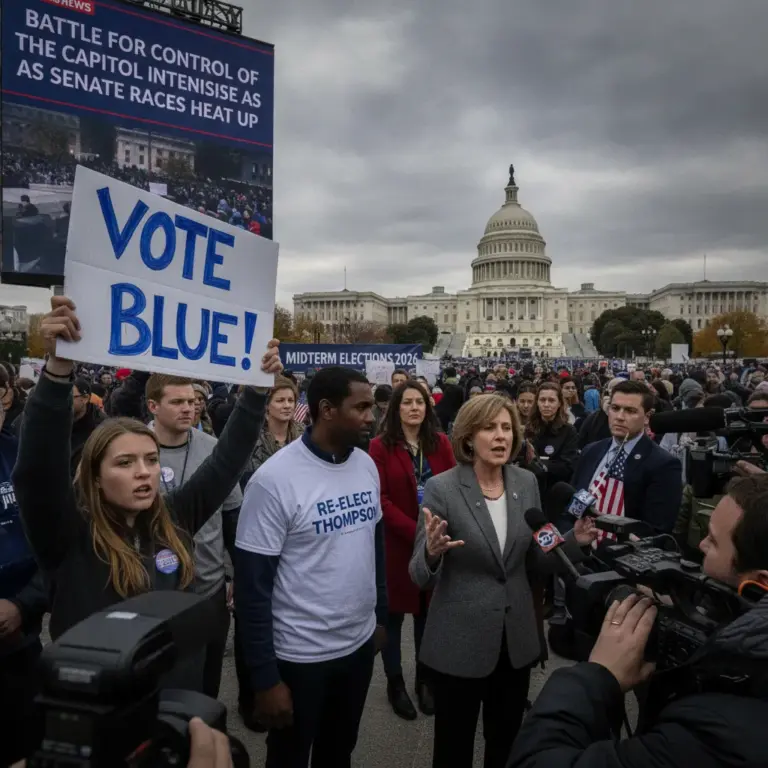

The balance of power in the United States Senate hangs in a delicate tension as voters head to the polls for the 2026 midterms. Republicans currently hold a comfortable fifty three to forty seven lead, but that cushion is facing significant pressure from an aggressive Democratic push. To reclaim control, however, Democrats face a steep uphill climb that requires flipping seats in several states where President Donald Trump secured double digit victories during his last campaign.

Much of the national attention is centered on traditional swing states such as Georgia, Michigan, and North Carolina, where narrow margins often decide the outcome. These high stakes contests serve as the primary frontline for both parties, with each side pouring resources into these volatile regions to either protect their slim advantages or carve out a path toward a new majority.

Beyond the usual battlegrounds, the political map has expanded into surprisingly unexpected territory. Campaigns are now fighting tooth and nail in states like Alaska, Kansas, Ohio, and Texas. While these areas have leaned safely red in recent presidential cycles, current polling suggests they could become competitive flashpoints, turning long shot challenges into genuine threats to Republican stability across the heartland_of America.

The American labor market showed surprising resilience in September, with job openings jumping significantly higher than economists had anticipated. According to the latest data from the Bureau of Labor Statistics, there were 7.52 million open positions across the country, marking an increase of 333,000 from August. This figure comfortably beat expectations and pushed the job opening rate to 4.5 percent of the total workforce. Currently, there are roughly 1.05 openings for every single unemployed person, suggesting a healthy demand for talent that spans several key sectors including manufacturing, professional services, and local government.

This growth in opportunity has translated into renewed confidence among employees, evidenced by a sharp spike in those choosing to leave their current roles. Quits climbed to 3.36 million in September, reaching their highest level since early last year. Economists often view these voluntary departures as a primary indicator of worker optimism, implying that people feel secure enough in their prospects to seek better pay or working conditions elsewhere. At the same time, actual hires rose while layoffs dipped to their lowest levels since March 2025, creating a positive trend of movement within the economy.

Heather Long, chief economist at Navy Federal Credit Union, noted that having more vacancies than unemployed individuals represents a significant shift from where the market stood a year ago. She suggested that this upward trajectory is particularly encouraging given the persistent pressure of inflation and high fuel costs currently facing businesses and consumers alike. It indicates that companies are gradually ramping up their recruitment efforts despite various macroeconomic headwinds slowing down other parts of the industry.

These findings provide a hopeful backdrop as investors and analysts look toward Friday’s official nonfarm payrolls report. While Wall Street expects a modest gain in employment and believes the unemployment rate will hover around 4.2 percent, the surge in openings suggests underlying strength. Adding to this optimistic mood was separate news released Tuesday showing that September factory orders for manufactured goods grew by 1.8 percent, further signaling industrial activity remains robust heading into the final quarter of the year.

The veil of secrecy surrounding the finances of elite AI labs is beginning to lift as Anthropic moves closer toward an initial public offering. Recent updates to the company’s S-1 filings provide a rare glimpse into the brutal mathematics of running a frontier model, revealing that while revenue is skyrocketing, the cost of the hardware required to power those models is climbing just as fast. Between June and September, Anthropic saw its quarterly revenue jump from 11.5 billion to 17 billion dollars, yet this impressive growth was shadowed by widening operating losses driven primarily by computing expenses.

The numbers suggest a worrying trend for potential investors who typically look for improving profit margins before a company goes public. In the most recent quarter disclosed, compute costs consumed 58 percent of total revenue, a significant increase from 48 percent in the previous period. Essentially, for every dollar spent on compute, the return has dipped from a peak of over two times back down to 1.72 times. This suggests that scaling an AI business isn’t simply a matter of adding more users; it requires an increasingly expensive foundation of silicon and electricity.

This margin squeeze appears to be a byproduct of Anthropic’s own success. Demand surged so rapidly that the company had to scramble for immediate capacity, leading them to enter expensive short-term agreements known as neoclouds rather than relying solely on cheaper, multi-year contracts with giant hyperscalers. These desperate measures included massive payouts to firms like SpaceX and Akamai, with billions allocated to ensure their systems didn’t crash under the weight of new users. While these are often described as champagne problems—since they stem from overwhelming popularity—they highlight a precarious dependency on third party infrastructure providers.

To combat these soaring bills, Anthropic is attempting to build its own internal infrastructure through an initiative called Anthropic Direct. However, given the current pace of global AI adoption, internal projects likely cannot scale quickly enough to replace external rentals entirely. For now, the company remains tethered to a volatile infrastructure market where any hiccup in data center construction or shifts in bond markets could turn today’s messy balance sheet into tomorrow’s crisis. Until they can decouple their growth from these predatory pricing cycles, Anthropic remains largely at the mercy of whoever owns the chips.

Binance co-CEO Richard Teng revealed that a sophisticated, multi-month operation led to a staggering loss of over 6 billion dollars in digital assets during a record-breaking cyberattack on October 29. In an interview with CNBC, Teng explained that the breach was not the result of a single mistake but rather a calculated campaign where hackers spent months infiltrating the company’s systems. The attackers utilized high-pressure social engineering tactics, including posing as recruiters to lure employees into fake job interviews that featured malware-laden coding exercises designed specifically to bypass corporate security measures.

The infiltration began as early as June when a DevOps engineer accidentally installed a tampered version of a developer tool while trying to download an AI coding assistant. Although Binance initially attempted to contain the threat by replacing hardware and rotating credentials, the hackers had already mapped out the roles of key personnel within the wallet infrastructure team. This foothold allowed them to pivot through internal AI tools and eventually gain authorization over the systems responsible for processing wallet transactions.

Despite the scale of the theft, Binance reports that it has already replenished roughly 98 percent of the 6.34 billion dollars in affected assets using its own reserves. While some funds remain difficult to recover due to their illiquidity or laundering efforts, several industry giants including Tether and Ripple have helped freeze approximately 3 billion dollars in stolen capital. Though federal investigators have linked the heist to North Korean actors known as TraderTraitor, Teng refrained from making definitive attributions himself.

To prevent future breaches, Binance has completely rebuilt its affected wallet systems and internal AI tools while implementing stricter security scans across all employee devices. An independent expert has been brought in to audit these changes as part of a broader effort to restore investor confidence in centralized exchanges. For now, the company remains focused on collaborating with global law enforcement agencies to track down any remaining missing funds moving through various blockchain channels.

Advanced Micro Devices shares climbed 7 percent in extended trading Tuesday after the company posted third-quarter results that comfortably beat Wall Street expectations. The chipmaker reported revenue of 13.38 billion dollars, a 45 percent increase from the previous year, driven largely by a massive surge in its data center business. This specific segment has become the engine of AMD’s growth, now accounting for 64 percent of total revenue compared to just 47 percent a year ago.

Chief Executive Officer Lisa Su expressed strong confidence in the company’s trajectory, noting that demand for data center processors is expected to accelerate further. While competitors like Intel have also seen growth in this sector, AMD appears to be navigating the supply chain more effectively, avoiding the guidance concerns that recently sent Intel’s stock tumbling. The resurgence is being fueled by the rise of agentic AI applications, which rely heavily on server CPUs to power virtual machines for extended periods.

The success in high-end AI infrastructure provides a critical cushion as other parts of the business struggle. AMD’s gaming and PC chip segments saw declines, with gaming revenue dropping 40 percent amid a broader industry slump and rising component costs that have dampened global PC shipments. Despite these headwinds, the company’s aggressive expansion into AI hardware, including its Helios rack-scale systems used by giants like Meta and Microsoft, has kept investors bullish.

Looking ahead, AMD expects fourth-quarter revenue to hit approximately 17 billion dollars, surpassing analyst estimates. To sustain this momentum, Su is focusing on scaling supply through 2027 and expanding the company’s intellectual footprint. Recent strategic moves include an 8.2 billion dollar acquisition of World Labs to develop 3D world models for robotics, alongside significant investments in AI pioneers like Anthropic.

As American voters head to the polls this Tuesday, investors are closely watching the ballot box to see who will seize control of Congress. At stake is not just political power, but the future trajectory of a stock market that has already surged twenty seven percent since the start of President Trump’s second term. While an explosion in artificial intelligence spending and robust earnings have driven recent gains, a shift in legislative power could introduce new variables into an already volatile economic landscape.

The prospect of a Democratic sweep has some analysts concerned about increased scrutiny of the tech sector. If Democrats secure both chambers, they may push for tighter oversight of AI development and attempt to roll back previous deregulation efforts, potentially rattling markets that have grown reliant on rapid innovation. However, historical data suggests that a split government does not necessarily signal a downturn. According to Ned Davis Research, stocks often perform reasonably well during periods of political gridlock, with median gains following midterms even when the president’s party loses its grip on the House.

Beyond technology, the looming shadow of the national debt remains a primary concern for Treasury yields. With budget deficits widening toward two trillion dollars and geopolitical tensions fueling energy price spikes, any outcome involving bipartisan compromise could lead to high stakes brinkmanship over the debt ceiling. Analysts suggest that while a divided government might force difficult negotiations to avoid shutdowns, it could also prevent extreme policy swings that typically spook institutional investors.

Conversely, if Republicans maintain their majorities in both houses, experts believe we would see maximum continuity for current policies. This scenario would likely favor further tax reforms and expanded defense spending while removing the threat of aggressive AI investigations. Strategists from JPMorgan indicate that such stability would provide the most supportive environment for infrastructure projects and federal permitting, keeping the momentum alive for those betting on long term industrial growth.